

Digital Transformation
Peppol E-Invoicing Explained: The UAE's Chosen Model
Last updated: July 2026 · By the QZ Infomatics Tax Technology Team
If you have started reading about UAE e-invoicing, you have almost certainly hit the word "Peppol" and wondered what it actually means. It sounds technical, but the idea behind it is simple, and it sits at the heart of how the UAE's new e-invoicing system works. This guide explains what Peppol is, how the network operates, and why the UAE chose it as the foundation for its national e-invoicing model.
What is Peppol?
Peppol is an international network and set of standards that lets businesses and governments exchange electronic documents, such as invoices, in a single, standardised way. Instead of every company building custom connections to every trading partner, Peppol provides one common framework that everyone can plug into.
The key phrase to remember is "connect once, reach all." Once your business is connected to the Peppol network through a service provider, you can exchange documents with any other organisation on the network, anywhere it operates.
Peppol is both an organisation and a network. It is governed by OpenPeppol, a non-profit association that maintains the technical specifications, standards, and rules that keep the whole system interoperable and secure.
What does Peppol stand for?
Peppol stands for Pan-European Public Procurement On-Line. It began in 2008 as a European Union initiative to standardise and simplify public procurement, making it easier for businesses to trade with government bodies across member states.
Since then, Peppol has grown far beyond both procurement and Europe. It is now used for business-to-business and business-to-government invoicing in many countries, including across Asia-Pacific and, increasingly, the Middle East.
That global spread is exactly why it appeals to governments building modern e-invoicing systems. Rather than inventing a national standard from scratch, they adopt a proven, internationally interoperable one.
How does Peppol work? The corner models
Peppol works through what are called "corner models," which simply describe how many parties are involved in moving a document from sender to receiver. Understanding these makes the whole system easy to grasp.
The models evolved over time:
Two-corner model: a direct connection between a supplier and a buyer. Simple, but it requires a custom link for every partner.
Three-corner model: a single central platform sits between trading partners, but everyone must join that same platform.
Four-corner model: the core of modern Peppol, explained below.
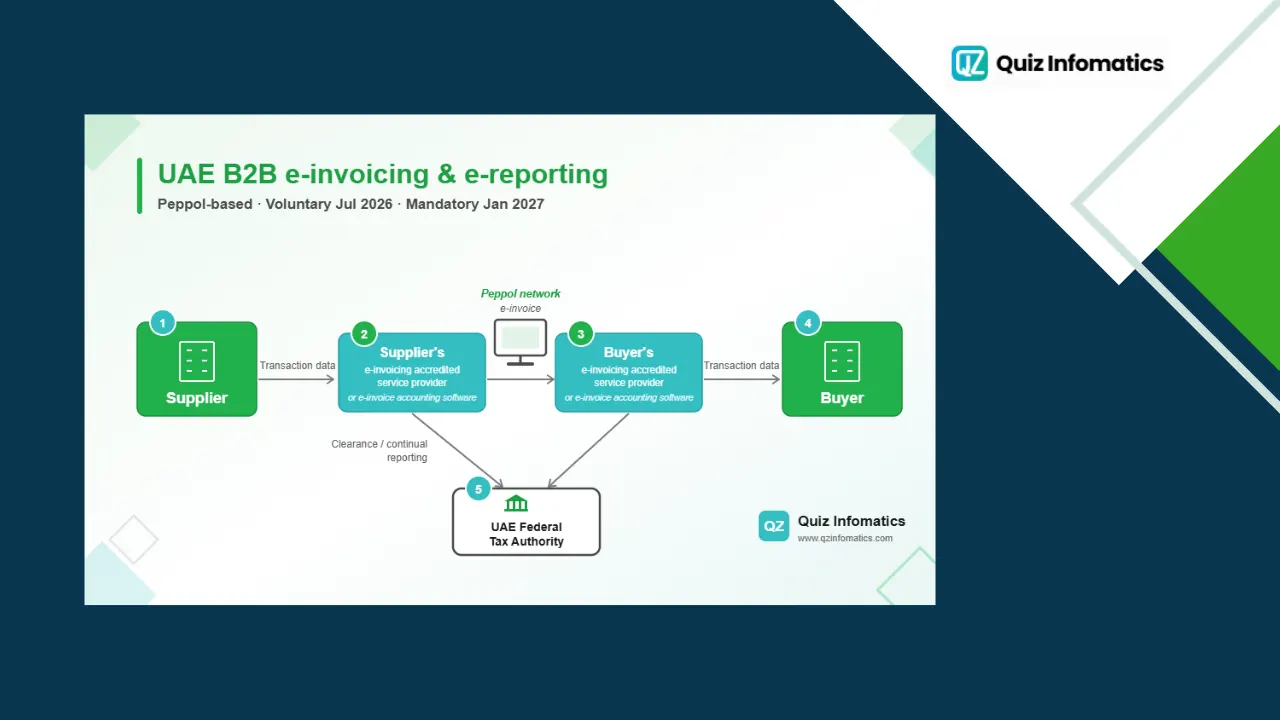
Five-corner model: the four-corner model plus the tax authority, which is the model the UAE uses.
The four-corner model
The four-corner model is the standard Peppol flow, and it is what makes "connect once, reach all" possible. It involves four parties: the sender, the sender's access point, the receiver's access point, and the receiver.
Here is the flow. The supplier sends an invoice through their access point. That access point locates the buyer's access point using Peppol's directory services, then transmits the document securely across the network. The buyer's access point delivers it into the buyer's system.
The important benefit is that both the sender and receiver can use their own preferred provider, while still exchanging documents in a fully standardised way. There is no single platform everyone must join, and no vendor lock-in.
The five-corner model
The five-corner model adds a fifth participant to the flow: the tax authority. It is often called the Peppol CTC (Continuous Transaction Controls) model, or DCTCE, which stands for Decentralised Continuous Transaction Control and Exchange.
In this model, alongside exchanging the invoice between buyer and seller, the access points also report the relevant tax data to the government platform in near real time. This gives the tax authority visibility of transactions as they happen, rather than long after the fact.
This is the model gaining momentum worldwide as more countries introduce e-reporting mandates, because it embeds compliance directly into the invoicing process while keeping the decentralised, no-lock-in benefits of Peppol.
What is a Peppol Access Point?
A Peppol Access Point is a certified service provider that acts as your gateway onto the Peppol network. You do not connect to Peppol directly; instead, your business connects to an access point, and that provider handles the technical exchange.
The access point receives your invoice data, validates it, converts it into the correct Peppol format if needed, and transmits it securely to the recipient's access point. To operate, a provider must pass OpenPeppol's certification and follow its protocols and security rules.
In practice, you connect your ERP or accounting system to an access point, and it manages all communication with the network. This is what removes manual work and reduces errors in document exchange.
What formats does Peppol use?
Peppol uses standardised document formats built on common international standards, which is what guarantees interoperability across countries and systems. You do not need to master the technical detail, but a few terms are worth knowing.
Peppol documents are based on the Peppol BIS (Business Interoperability Specifications), which use the UBL (Universal Business Language) structure. For invoicing, these align with the European standard EN 16931, ensuring a consistent core of invoice content everywhere Peppol operates.
To handle country-specific needs without breaking interoperability, OpenPeppol developed PINT (Peppol International). PINT allows local variations to be layered onto the global standard, and the UAE uses its own localised version called PINT AE.
Peppol vs traditional EDI: why the shift?
Peppol is often compared to traditional EDI (Electronic Data Interchange), and the key difference is that Peppol is open and standardised, while classic EDI is usually closed and custom-built. That distinction explains why governments increasingly favour Peppol.
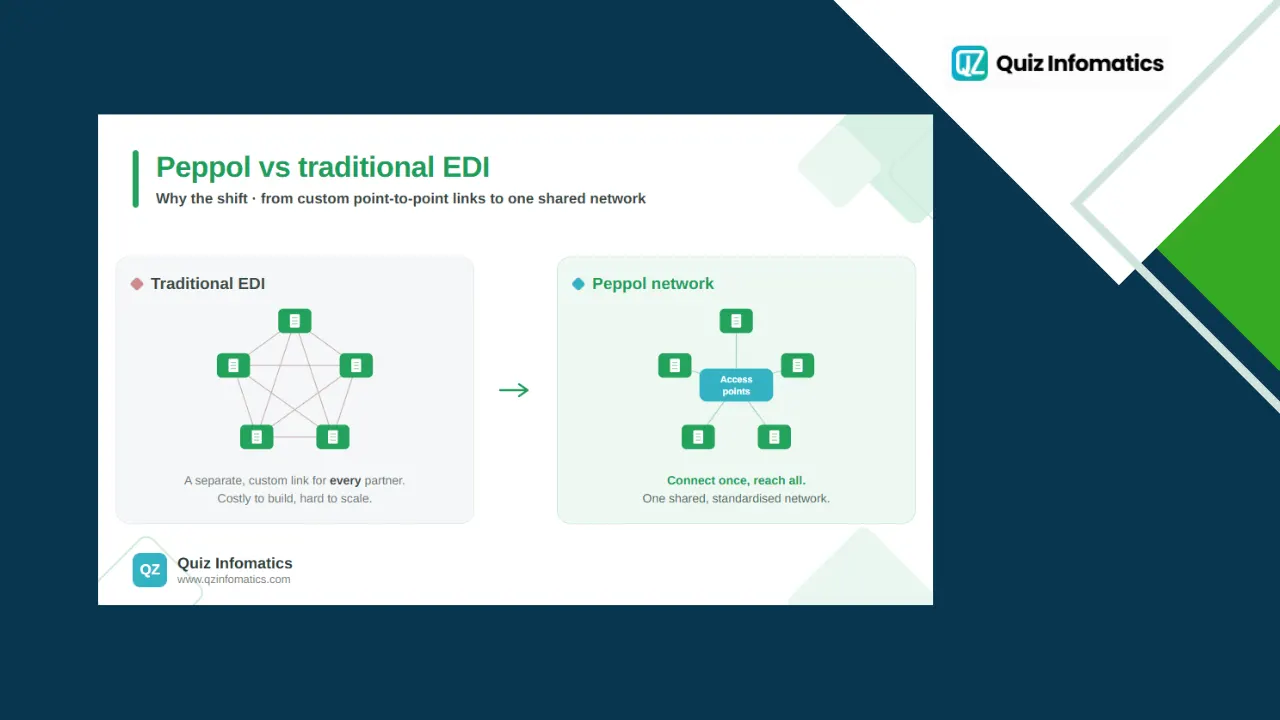
With traditional EDI, businesses typically build point-to-point connections with each trading partner, often using different formats and agreements for each one. It works, but it is costly to set up and maintain, and it does not scale easily as the number of partners grows.
Peppol replaces that fragmented approach with a single, shared network and format. Connect once through an access point, and you can transact with everyone else on the network. For a national mandate covering thousands of businesses, that scalability and consistency is exactly what makes Peppol practical.
Why did the UAE choose Peppol?
The UAE chose a Peppol-based model because it is proven, internationally interoperable, decentralised, and avoids vendor lock-in, aligning the country with global best practice. Rather than building an isolated national system, the UAE adopted a framework already trusted worldwide.
Specifically, the UAE adopted the Peppol-based five-corner model, the Decentralised Continuous Transaction Control and Exchange (DCTCE) approach, using the PINT AE format. Businesses connect through Ministry of Finance-accredited service providers, which serve as the Peppol access points for the UAE system.
There are clear advantages to this choice. It gives businesses freedom to choose from multiple accredited providers rather than being forced onto a single government platform. It supports interoperability with trading partners in other Peppol countries. And it lets the tax authority receive data in near real time for stronger compliance. For the full picture of the national mandate, see our complete guide to e-invoicing in the UAE.
How does Peppol work in the UAE e-invoicing system?
In the UAE, a compliant e-invoice flows from your system through an accredited access point, across the Peppol network to your buyer, with tax data reported to the Federal Tax Authority. It follows the five-corner pattern end to end.
The steps look like this:
Your ERP or accounting system generates the invoice data.
Your Accredited Service Provider (ASP), acting as your Peppol access point, validates the data and converts it into the required PINT AE format.
The invoice is transmitted over the Peppol network to the buyer's ASP, who delivers it to the buyer.
Both providers report the tax data to the Federal Tax Authority's platform in near real time.
Status messages confirm the invoice and tax data were successfully exchanged and reported.
The takeaway is that a compliant UAE e-invoice must travel through this accredited, Peppol-based route. A PDF emailed directly to a customer sits entirely outside the system and has no compliance value.
What are the benefits of Peppol?
The biggest benefit of Peppol is that a single connection lets you exchange documents with every partner on the network, removing the cost and complexity of building custom links. The advantages extend to both businesses and governments.
Key benefits include:
Connect once, reach all. One connection reaches every organisation on the network, at home and across borders.
Interoperability. Standardised formats mean documents are understood consistently across countries and systems.
No vendor lock-in. You can choose from many certified access points and switch if needed, which encourages competition and innovation.
Automation and accuracy. Machine-readable exchange reduces manual entry, errors, and delays, speeding up payment.
Compliance-ready. The five-corner model builds tax reporting directly into the invoicing flow.
Cross-border trade. Because many countries share the standard, international invoicing becomes far simpler.
For a growing UAE business, these benefits turn a compliance requirement into an opportunity to modernise and streamline how invoices move.
Where is Peppol used around the world?
Peppol is used across Europe and, increasingly, in Asia-Pacific and the Middle East, which is part of why it has become a global reference point for e-invoicing. It started in the European Union but has expanded well beyond it.
Beyond Europe, Singapore was the first Asian country to establish a Peppol authority, and the network is now used in countries such as Australia, Japan, Malaysia, and New Zealand, among others. National Peppol authorities work alongside OpenPeppol to set local requirements while preserving global interoperability.
For the UAE, adopting Peppol places its e-invoicing system within this growing international community rather than in isolation. That matters for any business trading across borders, because a single approach can serve multiple markets as more countries bring their mandates online.
What does Peppol mean for UAE businesses?
For UAE businesses, Peppol means you will exchange invoices through an accredited access point rather than by email, so your systems need to produce clean, structured data and connect properly. The good news is that you do not manage the Peppol technicalities yourself; your provider does.
Your main responsibilities are to ensure your ERP or accounting system can generate compliant invoice data, that your master data is accurate, and that you appoint an accredited provider before your deadline. Modern ERP platforms such as Odoo, Microsoft Dynamics 365, and others can be configured to connect smoothly to the framework.
This is where the right compliance solution and support matter. Our ClearTax e-invoicing solution helps UAE businesses validate data and generate compliant e-invoices, while our ERP implementation services ensure your finance systems produce the structured data the Peppol-based model requires.
Let’s talk about your business
Start with a free 30-minute call. We’ll ask the right questions, listen carefully, and give you an honest view of what’s possible.
How should you get ready for Peppol e-invoicing?
The smartest way to get ready is to prepare early, while adoption is still voluntary, focusing on clean data, a capable system, and an accredited provider. Preparation is mostly practical rather than technical.
A simple readiness path looks like this: confirm which phase and deadline apply to you, assess whether your current system can produce structured data or connect to an access point, clean your customer and supplier records, and shortlist an accredited provider well before your deadline. Using the voluntary pilot window to test the connection before it counts is a low-risk way to build confidence.
Because a smooth transition depends on planning and expertise, working with an experienced partner early pays off. Our ERP consultants help UAE and GCC businesses prepare their systems and processes for Peppol-based e-invoicing.
Common misconceptions about Peppol
A few myths cause confusion about Peppol, and clearing them up makes the system much easier to understand. The three below come up most often.
"Peppol is software I need to install." Not quite. Peppol is a network and a set of standards, not an application you buy off the shelf. You access it through a certified service provider, who handles the connection for you.
"Peppol is just a PDF sent electronically." No. A PDF is an unstructured document. Peppol carries structured, machine-readable data in a standardised format, which is what allows automatic processing and reporting.
"I connect to Peppol directly." Usually not. Businesses connect to an access point, which connects to the network. You choose your provider, and they manage the technical exchange on your behalf.
Peppol in a nutshell
To recap the essentials:
Peppol is an international network and standard that lets businesses exchange documents like invoices in one standardised, interoperable way, on a "connect once, reach all" basis.
It works through corner models, with the four-corner model handling exchange between access points, and the five-corner model adding the tax authority for real-time reporting.
The UAE chose the Peppol-based five-corner DCTCE model with the PINT AE format, connecting businesses through accredited service providers.
For businesses, it means exchanging invoices through an accredited access point, so your systems must produce clean, structured data.
Preparation is mostly about clean data, a ready ERP, and choosing an accredited provider early.
Peppol may sound like jargon, but it is really just a smart, standardised way to move business documents. Understanding it makes the UAE's e-invoicing system far less intimidating, and preparing early turns compliance into an opportunity.
Frequently asked questions
What is Peppol in simple terms? Peppol is an international network and set of standards that lets businesses exchange documents like invoices in one standardised way. Connect once through a provider, and you can reach any organisation on the network.
What does Peppol stand for? Peppol stands for Pan-European Public Procurement On-Line. It began as a European Union project in 2008 and has since become a global e-invoicing standard.
What is a Peppol Access Point? An access point is a certified service provider that connects your business to the Peppol network. It validates, formats, and securely transmits your documents on your behalf.
What is the Peppol five-corner model? It is the four-corner exchange model plus the tax authority as a fifth participant. Also called Peppol CTC or DCTCE, it reports tax data to the government in near real time, and it is the model the UAE uses.
Does the UAE use Peppol? Yes. The UAE adopted a Peppol-based Decentralised Continuous Transaction Control and Exchange (DCTCE) model, using the PINT AE format and accredited service providers as access points.
What is PINT AE? PINT AE is the UAE's localised version of the Peppol International (PINT) invoice format. It applies the global Peppol standard with the specific requirements needed for the UAE.
Do I need to understand Peppol technically to comply? No. Your accredited service provider handles the Peppol technicalities. Your job is to ensure your system produces clean, structured invoice data and to appoint a provider before your deadline.
Is Peppol only for large businesses? No. Peppol is designed to work for organisations of all sizes, and part of its original purpose was to help smaller businesses trade and compete more easily. In the UAE, businesses of different sizes fall under the mandate on staggered timelines, but all connect through the same Peppol-based framework.
How does Peppol connect to my ERP? Your ERP or accounting system links to an access point, usually through a built-in connector or integration provided by your service provider. The access point then handles all communication with the Peppol network, so invoices flow automatically from your system.
About the author
QZ Infomatics Tax Technology Team - QZ Infomatics is a Dubai-based ERP and IT consultancy (Business Bay) that helps businesses across the UAE and GCC prepare for tax-technology change, including e-invoicing readiness, ERP configuration, and compliance solutions such as ClearTax and Odoo. The team works with construction, manufacturing, trading and distribution, food and beverage, and facility management businesses to align their finance systems with UAE regulatory requirements. This guide reflects hands-on experience helping UAE companies get ready for Peppol-based e-invoicing.
This article is general information, not tax or legal advice. E-invoicing rules and timelines can change, so confirm your specific obligations with the Ministry of Finance, the Federal Tax Authority, or a qualified tax adviser. You can also read OpenPeppol's own overview in its Discovering Peppol briefing. Preparing for e-invoicing? Talk to our team.