
Digital Transformation
AI in Security: How Smart Systems Are Changing Surveillance
Last updated: July 2026 · By the QZ Infomatics AI & Cognivision Team
For decades, security cameras had one job: record everything, and hope someone reviews the footage after something goes wrong. That model is being replaced. Artificial intelligence has turned cameras from passive recorders into systems that watch, understand, and raise the alarm while an incident is still unfolding. This guide explains what AI in security actually means, how AI surveillance works, where it is being used, and what it means for businesses in the UAE.
What is AI in security?
AI in security is the use of artificial intelligence, particularly computer vision and machine learning, to automatically monitor, detect, and respond to security events without relying on a person watching every screen. Instead of simply recording video, the system interprets what it sees and acts on it.
The difference is between recording and understanding. A traditional camera captures pixels. An AI security system recognises that those pixels show a person climbing a fence at 2am, and sends an alert within seconds.
This shift changes the entire purpose of surveillance. Security moves from reactive, where footage is reviewed after an incident, to proactive, where threats are flagged as they happen.
What is AI surveillance?
AI surveillance is video monitoring enhanced with artificial intelligence, so cameras can detect people, vehicles, objects, and behaviours automatically and in real time. It is often called intelligent video analytics or smart surveillance.
An AI surveillance system typically combines three things: cameras that capture footage, AI models trained to recognise specific things in that footage, and software that turns detections into alerts, dashboards, and automated actions.
Crucially, AI surveillance does not just answer "what happened?" after the fact. It answers "what is happening right now, and does someone need to act?"
Why traditional CCTV falls short
The core weakness of traditional CCTV is that it depends on human attention, and human attention does not scale. This is the problem AI is solving.
Consider the practical reality. A single operator may face dozens of live feeds at once. Research on control-room monitoring has repeatedly found that operator attention declines sharply after roughly 20 minutes of watching multiple screens, which means genuine incidents get missed simply because no one can concentrate on everything at once.
Then there is the noise problem. Basic motion detection triggers on wind, shadows, rain, insects, and passing cars. Industry analyses of traditional alarm systems suggest the overwhelming majority of alarm-triggered police dispatches turn out to be false, with reported figures often in the range of 90 to 99 percent. The result is alert fatigue, where operators start ignoring alarms because most of them are nothing.
The third gap is time. Traditional CCTV is used mainly as evidence after an incident. It rarely prevents anything, because by the time footage is reviewed, the event is long over.
How does AI surveillance work?
AI surveillance works by capturing video, analysing each frame with trained AI models, and triggering an action when the system recognises something that matters. The process runs continuously and in real time.

The flow is straightforward:
Capture. A camera records video and converts it into digital data.
Analyse. A deep-learning model examines each frame to detect objects, people, vehicles, or behaviours it has been trained to recognise.
Interpret. The system applies rules and context: Is this person inside a restricted zone? Is this happening outside working hours? Has this vehicle been loitering for 20 minutes?
Act. If the criteria are met, the system sends an alert, triggers an alarm, locks a door, or logs the event with a timestamped clip.
The intelligence comes from training. Models learn by processing large volumes of labelled examples until they can distinguish a person from a shadow, or a delivery from an intrusion. The underlying technology is computer vision, and our simple introduction to computer vision explains the fundamentals in plain English.
Edge AI: why processing location matters
An increasingly important detail is where the analysis happens. Edge AI means the model runs on the camera or a local device rather than in the cloud, and this has real advantages for security.
Processing locally cuts latency, so alerts arrive in near real time. It reduces bandwidth costs, because you are not streaming every frame to a data centre. And it can improve privacy, since footage does not need to leave the site.
This is why on-premises deployment remains dominant in sensitive settings. Industry analysis indicates that more than 60 percent of public-sector AI surveillance systems remained on-premises in 2025, driven by data-security requirements, low-latency needs, and regulatory compliance.
What can AI security systems detect?
AI security systems can detect a wide range of objects, people, and behaviours, and most real deployments combine several capabilities. Understanding these makes the applications much easier to grasp.
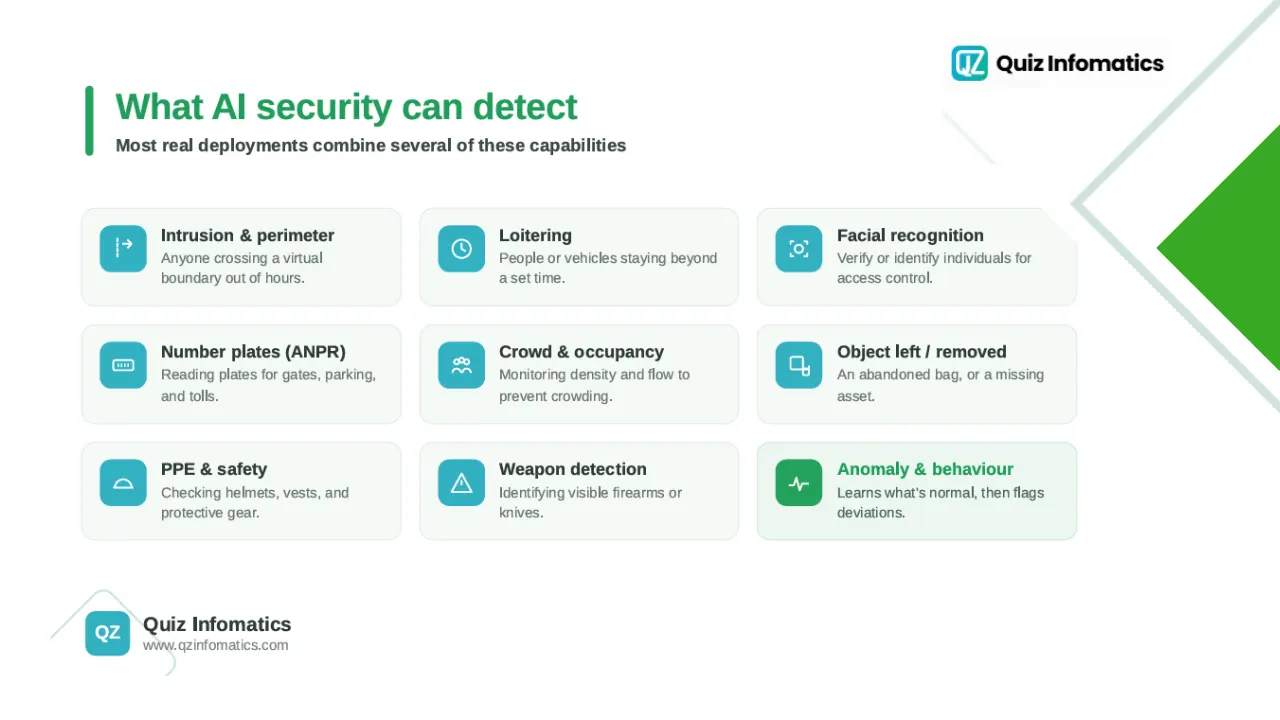
Common detection capabilities include:
Intrusion and perimeter breach - flagging anyone crossing a virtual boundary outside authorised hours.
Loitering - identifying people or vehicles that remain in an area beyond a set time.
Facial recognition - verifying or identifying individuals for access control and investigations.
Automatic number plate recognition (ANPR) - reading vehicle plates for parking, tolls, and gate access.
Crowd and occupancy analysis - monitoring density and flow to prevent overcrowding.
Object left behind or removed - spotting an abandoned bag or a missing asset.
PPE and safety compliance - checking whether workers are wearing helmets, vests, or protective gear.
Weapon detection - identifying visible firearms or knives, an area where reported system accuracy commonly exceeds 95 percent.
Anomaly and behaviour detection - learning what normal looks like in a scene and flagging deviations.
The last one is the most powerful. Rather than being told exactly what to look for, the system learns a location's normal rhythm and raises a flag when something breaks the pattern.
What are the applications of artificial intelligence in security?
Applications of artificial intelligence in security now span nearly every sector that needs to protect people, property, or operations. The technology has moved well beyond high-security government sites.
Commercial buildings and offices. Access control, visitor management, and after-hours intrusion detection, with alerts routed straight to a facilities or security team.
Retail. Theft detection, queue monitoring, and shelf analytics, where the same cameras deliver both loss prevention and customer-experience insight.
Manufacturing and industrial sites. Safety compliance, restricted-zone monitoring, and equipment protection. Our manufacturing industry solutions show how visual monitoring supports safer, more efficient plants.
Facility management. Perimeter security, unauthorised-access alerts, and incident logging across large or multi-site properties. This fits naturally alongside our facility management solutions.
Logistics and warehousing. Loading-bay monitoring, cargo protection, and vehicle access control across busy sites.
Smart cities and public safety. Traffic monitoring, crowd management, and public-space surveillance, usually the largest and most visible deployments.
Critical infrastructure. Perimeter protection for energy, utilities, and transport assets, where a breach carries serious consequences.
Real-world examples of AI in security
The clearest examples of AI security are the ones already operating around you, often without much fanfare. Concrete cases make the technology far easier to understand.
Automatic gate access that reads a number plate and opens the barrier for registered vehicles.
Airport and border control using facial recognition to verify identity at e-gates.
Construction site safety systems that flag workers entering an area without a helmet.
Retail loss prevention that detects concealment behaviour and alerts staff discreetly.
Warehouse perimeter alerts that distinguish a person climbing a fence from a cat crossing it.
Crowd density monitoring at stadiums and malls that warns operators before an area becomes unsafe.
Each of these turns raw video into a decision and an action, which is the practical payoff of AI in security.
How big is AI surveillance now?
AI surveillance has moved from niche to mainstream, and the market growth reflects that. The global AI in video surveillance market was estimated at around USD 6.51 billion in 2024 and is projected to reach USD 28.76 billion by 2030, growing at a compound annual rate above 30 percent.
The deployment numbers are just as telling. Industry estimates suggest AI-based video surveillance capability now spans hundreds of millions of active cameras worldwide, with well over 280 million AI-capable cameras deployed globally in 2025 supporting real-time analytics. Facial recognition alone has been actively deployed in more than 75 countries in public and commercial spaces.
Three forces are driving this: cheaper high-quality cameras, dramatic accuracy gains in deep learning, and edge computing that makes real-time analysis practical on site.
"The shift we see with clients is subtle but decisive. They stop asking 'can we review the footage?' and start asking 'why didn't the system tell us at the time?' Once a camera can raise a reliable alert on its own, expectations change permanently, and security stops being a filing cabinet of recordings." - QZ Infomatics AI & Cognivision Team
What are the benefits of AI in security?
The core benefit of AI in security is turning passive recording into active protection, with a level of consistency and scale that human monitoring cannot match. The practical gains follow from there.
Real-time response. Threats are flagged as they happen, not discovered afterwards.
Fewer false alarms. By distinguishing people and vehicles from wind, shadows, and animals, AI filters out much of the noise that causes alert fatigue. Reported reduction rates vary widely by vendor and setting, so treat specific vendor figures with healthy scepticism and test in your own environment.
Consistent attention. Software does not get tired, distracted, or bored at minute 21.
Scale without headcount. One operator can oversee far more cameras when the system surfaces only what matters.
Faster investigations. Instead of scrubbing through hours of footage, teams search by person, vehicle, or event.
Operational insight. The same cameras generate data on footfall, queues, and safety compliance, so security spend delivers business value too.
That last benefit is often the one that justifies the investment. A system installed for security frequently ends up improving operations as a by-product.
Let’s talk about your business
Start with a free 30-minute call. We’ll ask the right questions, listen carefully, and give you an honest view of what’s possible.
AI in security in the UAE
In the UAE, AI-powered security is expanding quickly across smart cities, large facilities, retail, and industrial sites, supported by the country's wider digital-transformation agenda. Conditions here favour adoption.
Common local use cases include traffic and public-safety monitoring, access control and surveillance for large facilities and free-zone sites, retail analytics in malls, safety compliance on construction sites, and perimeter protection for logistics hubs. Oil, gas, and construction operators also use vision systems for remote inspection and safety enforcement.
Two factors make the UAE a natural fit. First, significant investment in smart-city infrastructure means the cameras, connectivity, and cloud capacity are already being built out. Second, the region's mix of large facilities, ports, and 24-hour operations creates exactly the round-the-clock monitoring problem AI is good at solving. Connecting video with sensor data through platforms such as CitrIoT extends that visibility further, turning cameras and IoT devices into a single operational picture.
What are the challenges of AI surveillance?
AI surveillance is powerful, but it is not magic, and the challenges are real. Being honest about them is the best way to deploy it responsibly and successfully.
Privacy and ethics. This is the biggest one. Continuous monitoring and facial recognition raise legitimate questions about consent, proportionality, and data misuse. Systems handling personal or biometric data must respect privacy law and be deployed with clear governance.
Bias and accuracy. Models trained on unrepresentative data can perform unevenly across different groups. This matters enormously when the output influences who gets stopped or investigated.
Edge cases. Unusual lighting, weather, angles, or rare scenarios can defeat a model that looked flawless in testing.
Data quality and volume. Good detection depends on good camera placement, resolution, and relevant training data.
Integration. A detection is worthless if it does not reach the right person or trigger the right workflow.
Ongoing maintenance. Models need monitoring and periodic retraining as sites, seasons, and behaviours change.
None of these are reasons to avoid AI security. They are reasons to plan properly, define clear policies on what is monitored and why, and keep humans in the loop for consequential decisions.
Keeping humans in the loop
The most effective deployments pair AI with human judgement rather than replacing it. AI is excellent at watching everything tirelessly and surfacing what deserves attention. People are better at context, nuance, and deciding what to do about it.
That combination is the practical model: the system filters thousands of events down to a handful worth reviewing, and a trained person makes the call. It also provides an accountability layer, which matters for both ethics and trust.
Where AI security is heading
The next phase of AI security is shaped by three trends: edge AI, multimodal models, and generative AI. Together they are making systems faster, more capable, and easier to use.
Edge processing continues to push intelligence onto the cameras themselves, cutting latency and improving privacy. Multimodal and generative AI go further, allowing systems not just to detect objects but to describe scenes, summarise incidents, and answer natural-language questions such as "show me anyone who entered the loading bay after 8pm."
Integration is the other major direction. Video is becoming one input among many, combined with access control, IoT sensors, and operational data into a single view. For a broader perspective on this shift, see our take on how businesses are evolving with technology and AI.
How do businesses get started with AI security?
The best way to start is with one focused, high-value use case rather than trying to automate every camera at once. A narrow scope proves value quickly and keeps risk low.
A practical path looks like this: identify the specific problem, whether that is after-hours intrusion, PPE compliance, or vehicle access; assess your existing cameras and network; run a proof of concept on a small number of feeds; define your privacy and data-retention policy up front; then scale what works.
Existing infrastructure often goes further than people expect. Many organisations can add AI analytics to cameras they already own, rather than replacing the entire estate. If you would like help scoping this, our AI solutions team works with UAE and GCC businesses to identify the right use case, test it, and integrate the results into real workflows, while our IoT services connect video with the wider sensor environment.
AI in security, in a nutshell
To recap the essentials:
AI in security uses computer vision and machine learning to monitor, detect, and respond automatically, turning cameras from recorders into active systems.
AI surveillance works by capturing video, analysing it with trained models, interpreting context, and triggering alerts or actions in real time.
It solves the core weaknesses of traditional CCTV: limited human attention, overwhelming false alarms, and after-the-fact review.
Applications span retail, manufacturing, facilities, logistics, critical infrastructure, and smart cities.
The challenges are real, especially privacy, bias, and integration, which is why clear governance and humans in the loop matter.
AI has not replaced security teams. It has given them a system that never blinks, so their attention goes where it counts.
Frequently asked questions
What is AI in security? AI in security is the use of artificial intelligence, mainly computer vision, to automatically monitor, detect, and respond to security events in real time, rather than relying on people watching every camera feed.
How is AI used in surveillance? AI analyses live video to detect people, vehicles, objects, and behaviours. It can flag intrusions, loitering, unsafe conditions, or unusual activity and send instant alerts, instead of just recording footage for later review.
Is AI surveillance better than traditional CCTV? It is better at detecting incidents as they happen and at filtering out false alarms, because it interprets what it sees rather than just recording. Traditional CCTV remains useful as evidence, but it is reactive by nature.
Can AI security reduce false alarms? Yes. By telling people and vehicles apart from wind, shadows, and animals, AI filters out much of the noise that plagues motion detection. Reported reduction rates vary a lot by vendor and environment, so it is worth testing on your own site.
Is AI surveillance legal in the UAE? Video surveillance is widely used across the UAE, but deployments involving personal or biometric data must comply with applicable privacy and data-protection requirements. Confirm your specific obligations with a qualified adviser before deploying facial recognition.
Does AI surveillance replace security staff? No. The most effective setups pair AI with people: the system watches everything and surfaces what matters, while trained staff apply context and decide how to respond.
Do I need to replace my existing cameras? Often not. Many organisations add AI analytics to their existing camera estate, provided image quality and placement are adequate. A readiness assessment will confirm what can be reused.
What is edge AI in security? Edge AI means the analysis runs on the camera or a local device instead of the cloud. It reduces latency and bandwidth costs and can improve privacy, since footage does not need to leave the site.
About the author
QZ Infomatics AI & Cognivision Team - QZ Infomatics is a Dubai-based technology and IT consultancy (Business Bay) delivering AI, computer vision, and IoT solutions for businesses across the UAE and GCC. Through its Cognivision AI-vision offering and CitrIoT platform, the team helps organisations in manufacturing, facility management, retail, and logistics apply visual and sensor intelligence to security, safety, and operations. This guide reflects hands-on experience scoping and deploying AI vision projects in the region.
Exploring AI-powered security for your business? Talk to our AI solutions team.