Digital Transformation
Progress Billing and Interim Payment Certificates in Construction ERP
Last updated: July 2026 · By the QZ Infomatics Construction Technology Team
Construction is one of the slowest-paying industries in the world, and a contractor who cannot invoice steadily for the work they have done can run out of cash long before a project is finished. Progress billing is the answer to that problem, and getting it right is one of the most important things a contractor can do, which is why so many now run it inside dedicated construction ERP software for UAE contractors. This guide explains what progress billing is, how interim payment certificates work, and how construction billing software keeps the cash flowing.
What is progress billing?
Progress billing is a method of invoicing where a contractor bills for the work completed so far at regular intervals throughout a project, rather than issuing a single invoice at the end. It matches payment to progress, so money comes in as the work is done.
On a project that lasts many months, a lump-sum-at-the-end approach would be impossible; the contractor would have to fund the entire build from their own pocket. Progress billing solves this by turning one enormous invoice into a series of smaller, regular ones tied to how much has been completed.
It is also called progressive billing or progress invoicing, and it is the standard way construction projects are paid. Each bill covers the value of work done in that period, and the client pays it, usually after a formal valuation and certification step.
Why does progress billing matter in construction?
Progress billing matters because construction runs on cash flow, and steady, accurate billing is what keeps a contractor solvent through a long project. The stakes here are genuinely high.
The industry's payment record is poor. Research shows the average construction payment cycle runs around 90 days, roughly double the level analysts consider healthy, with 82 percent of contractors waiting 30 or more days past the expected payment date, and late payments draining an estimated 280 billion US dollars a year from the sector. Every weakness in the billing process makes that worse.
Strong progress billing pushes back against this. Accurate, timely bills that are hard to dispute get certified and paid faster, while sloppy ones get queried, delayed, and reduced. For a contractor, the quality of their progress billing directly determines how healthy their cash flow is.
How does progress billing work?
Progress billing works through a repeating cycle: the contractor applies for payment based on work done, that application is valued and certified, retention is deducted, and the client pays. This cycle repeats every billing period until the project is complete.
The typical steps in each period are:
Application for payment. The contractor submits a claim for the value of work completed to date.
Valuation. The engineer or quantity surveyor assesses the actual value of work done.
Certification. An interim payment certificate is issued, confirming the amount due.
Deductions. Retention and previously paid amounts are subtracted.
Payment. The client pays the net certified amount.
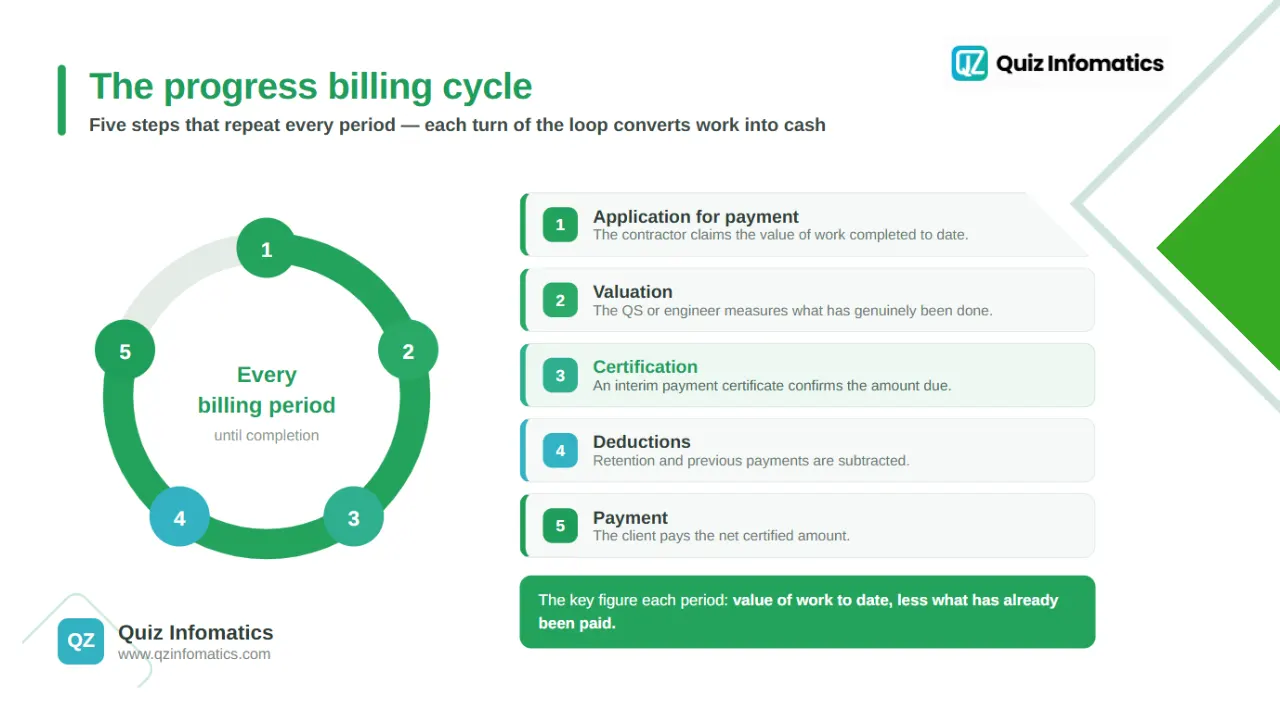
The key figure in each cycle is the value of work completed to date, minus what has already been paid. This is why measurement and valuation are so central: the whole payment rests on an accurate assessment of how much of the project is actually finished.
What is an interim payment certificate?
An interim payment certificate (IPC) is the formal document, usually issued by the engineer or quantity surveyor, that certifies how much the contractor is owed for a given billing period. It is the certified basis on which the client pays.
The IPC is not just an invoice; it is an independent confirmation of value. The contractor applies for a sum, but it is the certifier who assesses the work and issues the certificate for the amount genuinely due, which protects both parties.
Once certified, the IPC triggers payment within the timescale set by the contract. In this way, the interim payment certificate is the pivot point of the entire progress billing cycle, converting completed work into a payment obligation.
What is included in a progress bill?
A progress bill sets out the value of work done to date and then adjusts it for retention and previous payments to arrive at the net amount due. Each element has to be accurate for the bill to be certified smoothly.
A typical progress bill or IPC includes:
Value of work completed to date. The measured value of everything done so far.
Materials on site. Often, materials delivered but not yet installed can be claimed.
Variations. Any approved changes to scope, valued and included.
Less retention. The agreed retention percentage withheld as security.
Less previous payments. Everything already certified and paid in earlier periods.
Net amount due. The final figure the client pays this period.
Getting each line right is what makes a bill defensible. A well-supported progress bill, backed by measurement and records, is far harder to dispute or cut than a vague one.
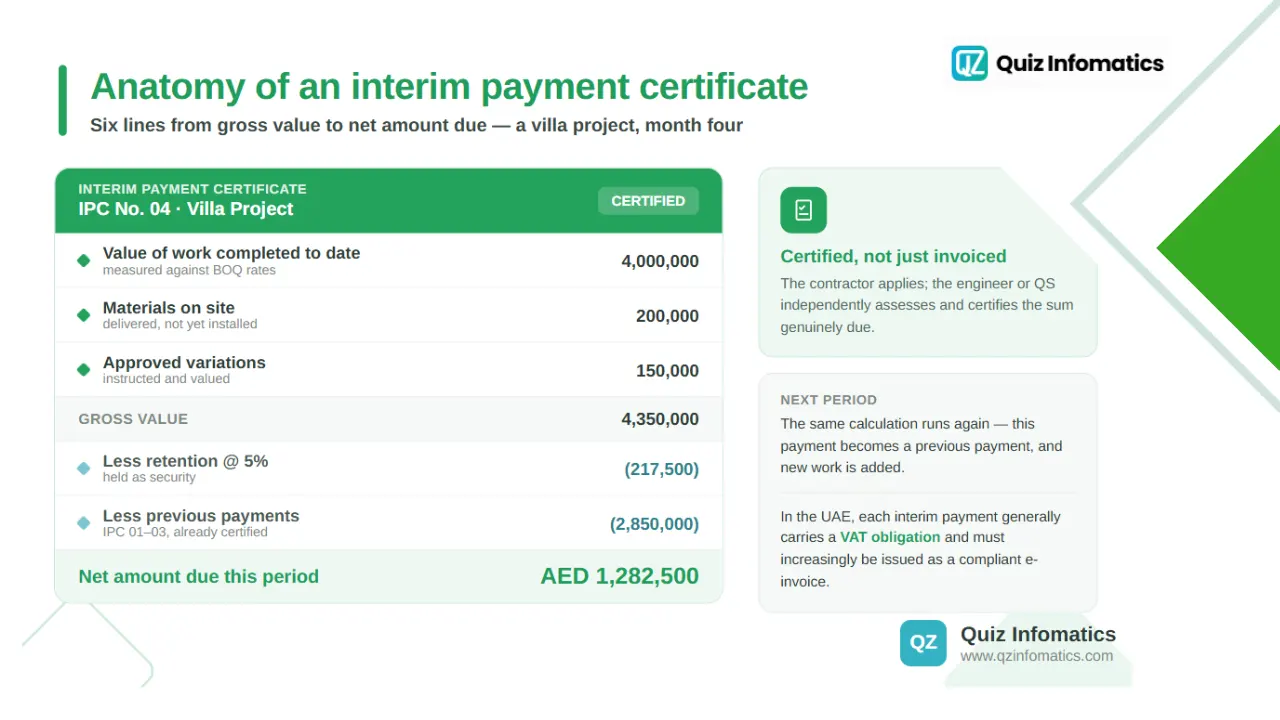
A progress bill example
To make it concrete, imagine a contractor on a villa project at the end of month four. The measured value of all work completed to date comes to 4 million dirhams, plus 200,000 dirhams of materials delivered to site and an approved variation worth 150,000 dirhams.
From that gross figure, retention of 5 percent is deducted, along with everything already certified and paid in months one to three. The net amount on the interim payment certificate is what the client pays for this period. Next month, the same exercise runs again, this time crediting the payment just made and adding the new work done. Repeated across the whole project, this rolling calculation is exactly what progress billing automates, and exactly where manual spreadsheets tend to slip.
What are the methods of progress billing?
There are several methods of progress billing, and the right one depends on the contract and how the work is best measured. Most construction projects use one of a few standard approaches.
Percentage of completion. Billing based on the proportion of the total work completed.
Milestone billing. Payment triggered when defined milestones are reached, such as completing the foundations.
Unit-price or measured billing. Billing based on measured quantities of work done, valued against agreed rates.
Cost-to-cost. Estimating completion by comparing costs incurred to total expected costs.
In traditional construction, measured billing against the bill of quantities is common, because it ties each payment directly to specific, priced items of work. Whichever method is used, the goal is the same: an accurate, fair reflection of progress.
Progress billing and the bill of quantities
Progress billing is closely tied to the bill of quantities, because the BOQ provides the priced items against which completed work is measured and valued. The two work hand in hand.
Each period, the quantities completed are measured and valued using the rates in the bill of quantities, giving an objective basis for the amount claimed. This is why a well-structured BOQ makes progress billing so much cleaner: the valuation is a matter of measurement against agreed rates, not negotiation.
This valuation work is central to the quantity surveyor's role. Accurate interim valuations protect the contractor's cash flow while giving the client confidence that they are paying only for work genuinely done.
Progress billing, retention, and defects
Progress billing and retention are intertwined, because a slice of every progress payment is typically withheld as retention until the work is complete and defects are cleared. This connects billing directly to quality.
Retention, usually around 5 to 10 percent, is deducted from each progress bill and released later, often half at practical completion and half after the defects liability period. Outstanding defects can therefore delay the release of money the contractor has already earned.
This links progress billing to the snag list: clearing defects promptly is not just a quality matter, it directly affects when the final retention is released and the project is financially closed out.
Progress billing, VAT, and e-invoicing in the UAE
In the UAE, progress billing has important tax implications, because each interim payment can create a VAT obligation and, increasingly, must comply with e-invoicing rules. Contractors need to handle this correctly.
For construction services billed progressively, the tax point is generally tied to the payment or the issue of the tax invoice, so each progress bill typically carries VAT that must be accounted for. Getting this wrong across many interim payments on a large project can create significant compliance headaches.
The move to mandatory structured e-invoicing adds another layer. As the UAE rolls out its framework, progress bills and interim payment certificates will need to be issued as compliant e-invoices, which our complete guide to e-invoicing in the UAE explains in detail. This makes connecting billing to a compliant system more important than ever.
The challenges of manual progress billing
Manual progress billing is slow, error-prone, and a common source of payment delays and disputes. For a busy contractor, spreadsheets simply cannot keep up.
Common problems include:
Measurement errors. Manual take-off and valuation mistakes distort the bill.
Slow preparation. Compiling bills by hand delays submission and therefore payment.
Disputes. Poorly supported bills get queried, reduced, or rejected.
Retention tracking. Retention amounts across many periods are easy to lose track of.
Version confusion. Variations and previous payments get misrecorded across spreadsheets.
Each of these directly delays cash. In an industry where payment is already slow, adding avoidable friction to the billing process is a serious commercial risk.
Let’s talk about your business
Start with a free 30-minute call. We’ll ask the right questions, listen carefully, and give you an honest view of what’s possible.
Construction billing software and ERP
The most reliable way to manage progress billing is with construction billing software or a construction ERP that generates interim bills directly from measured, priced data. Automation removes much of the manual risk.
Good construction billing software links the BOQ, the budget, variations, and retention together, so a progress bill is generated from live project data rather than rebuilt by hand each month. It tracks previous payments and retention automatically, applies the correct valuations, and produces clean, defensible bills that get certified faster.
This capability is usually part of a wider construction ERP. Platforms such as Odoo, configured for construction, can bring billing together with the BOQ, procurement, and cost control, and a well-run ERP implementation is what makes that integration reliable. The result is faster billing, faster payment, and far fewer disputes.
Progress billing for subcontractors
Progress billing does not stop with the main contractor; subcontractors are billed and paid the same way, which the main contractor must manage carefully. This adds a whole layer of complexity.
A main contractor receiving progress payments must in turn value and pay its subcontractors' progress claims, apply retention to them, and reconcile everything against the main contract. When this is handled in scattered spreadsheets, errors and delays multiply, and subcontractors, who sit at the bottom of the payment chain, suffer most.
Managing this in dedicated subcontractor management software lets the main contractor tie each subcontractor's progress billing and retention back to the project budget, keeping the whole payment chain under control.
Progress billing in the UAE
In the UAE, progress billing is standard practice, governed largely by the interim payment provisions of FIDIC-based contracts. It is central to how projects are paid across the region.
FIDIC contracts set out a clear interim payment mechanism: the contractor applies, the engineer certifies, retention is deducted, and payment follows within a defined period. On the large, long-running projects typical of the UAE, this steady flow of certified payments is what keeps contractors and their supply chains solvent.
For UAE contractors, running progress billing efficiently, accurately, and in compliance with VAT and e-invoicing rules is essential. If you want the wider context on the systems behind this, our plain-English guide to what an ERP system is sets the foundation.
How QZ Infomatics helps contractors
Getting paid on time comes down to accurate, fast, compliant progress billing connected to the rest of your project data. That connection is what protects cash flow.
A practical step is to generate progress bills and interim payment certificates directly from your BOQ, budget, and measured progress in one system, with retention, variations, and previous payments handled automatically and VAT applied correctly. This turns billing from a monthly scramble into a fast, reliable process.
If you would like help with that, our contractor accounting software and construction ERP bring BOQ, cost control, budgeting, subcontractor management, variations, retention, and progress billing into one platform, built for how contracting businesses actually work.
Progress billing and interim payments, in a nutshell
To recap the essentials:
Progress billing invoices for work completed at regular intervals through a project, rather than in one lump sum at the end.
An interim payment certificate is the certified document confirming how much the contractor is owed for a billing period.
A progress bill shows the value of work to date, adjusted for materials, variations, retention, and previous payments.
It is tied to the BOQ for valuation, retention for security, and VAT and e-invoicing for compliance in the UAE.
Construction billing software and ERP automate the process, producing faster, cleaner bills that get paid sooner.
In an industry defined by slow payment, progress billing is a contractor's lifeline. Doing it accurately, quickly, and in one connected system is one of the most direct ways to protect cash flow and keep a project moving.
Frequently asked questions
What is progress billing? Progress billing is a method of invoicing where a contractor bills for the work completed so far at regular intervals throughout a project, rather than issuing a single invoice at the end. It matches payment to progress.
What is an interim payment certificate? An interim payment certificate (IPC) is a formal document, usually issued by the engineer or quantity surveyor, that certifies how much the contractor is owed for a given billing period and triggers payment.
How does progress billing work? The contractor applies for payment based on work done, the claim is valued and certified via an interim payment certificate, retention and previous payments are deducted, and the client pays the net amount. This repeats each period.
What is included in a progress bill? A progress bill includes the value of work completed to date, materials on site, approved variations, less retention and less previous payments, giving the net amount due for the period.
What are the methods of progress billing? Common methods include percentage of completion, milestone billing, unit-price or measured billing against the BOQ, and cost-to-cost. The right method depends on the contract and how the work is best measured.
How is progress billing related to retention? A percentage of each progress payment, typically 5 to 10 percent, is withheld as retention until the work is complete and defects are rectified, usually released in two halves at practical completion and after the defects liability period.
Does progress billing affect VAT in the UAE? Yes. Each interim payment generally creates a VAT obligation, and progress bills increasingly need to be issued as compliant e-invoices under the UAE's e-invoicing framework, so correct tax handling is essential.
Can construction billing software automate progress billing? Yes. Construction billing software and ERP systems generate interim bills directly from measured, priced data, track retention and previous payments automatically, and produce compliant, defensible bills that get certified and paid faster.
About the author
QZ Infomatics Construction Technology Team - QZ Infomatics is a Dubai-based ERP and IT consultancy (Business Bay) that implements construction and contracting software across the UAE and GCC. The team helps contractors automate progress billing, interim payment certificates, retention, and VAT by bringing BOQ, budgets, subcontractor accounts, and billing into one connected system, drawing on hands-on experience with construction ERP for UAE projects. This guide reflects that practical experience helping contracting businesses protect their cash flow.
Still preparing progress bills by hand? See our construction ERP for UAE contractors.