

Digital Transformation
Subcontractor Retention and Retainage Tracking in Construction ERP
Last updated: July 2026 · By the QZ Infomatics Construction Technology Team
On almost every construction project, a slice of every payment is held back and locked away, sometimes for years. It is called retainage, or retention, and while it protects the party paying, it can strangle the cash flow of the contractors and subcontractors doing the work. Tracking it accurately, especially across many subcontractors, is one of the hardest jobs in construction finance, which is why contractors increasingly rely on subcontractor management software to do it. This guide explains what retainage is, how it works, how it is calculated, and how to track it.
What is retainage in construction?
Retainage in construction is a percentage of each payment, typically 5 to 10 percent, that is withheld from a contractor or subcontractor until the project is complete and any defects have been fixed. It is a financial safeguard built into the contract.
The party paying, whether an owner or a main contractor, holds this money back as security. It gives them assurance that the work will be finished properly and any defects rectified, because the contractor only receives the withheld sum once those obligations are met.
Retainage has been used in construction since the 1840s, and it remains standard practice today, especially on commercial and public projects. For the party doing the work, though, it means a portion of money they have genuinely earned is not paid until much later.
What is the difference between retainage and retention?
There is no real difference: retainage and retention are two words for the same thing, an amount withheld until a project is complete. The term used simply depends on where you are.
"Retainage" is the common term in the United States, while "retention" is used in the United Kingdom, the Commonwealth, and the UAE. Both describe the same practice: a percentage of payment held back as security for completion and quality.
So a contractor in Dubai talking about "retention" and a contractor in Texas talking about "retainage" are describing exactly the same mechanism. Throughout this guide, the two terms are used interchangeably.
How does retainage work in construction?
Retainage works by withholding a set percentage from each progress payment throughout the project, accumulating the held funds, and releasing them once the work is complete and defects are cleared. It is applied gradually, not all at once.
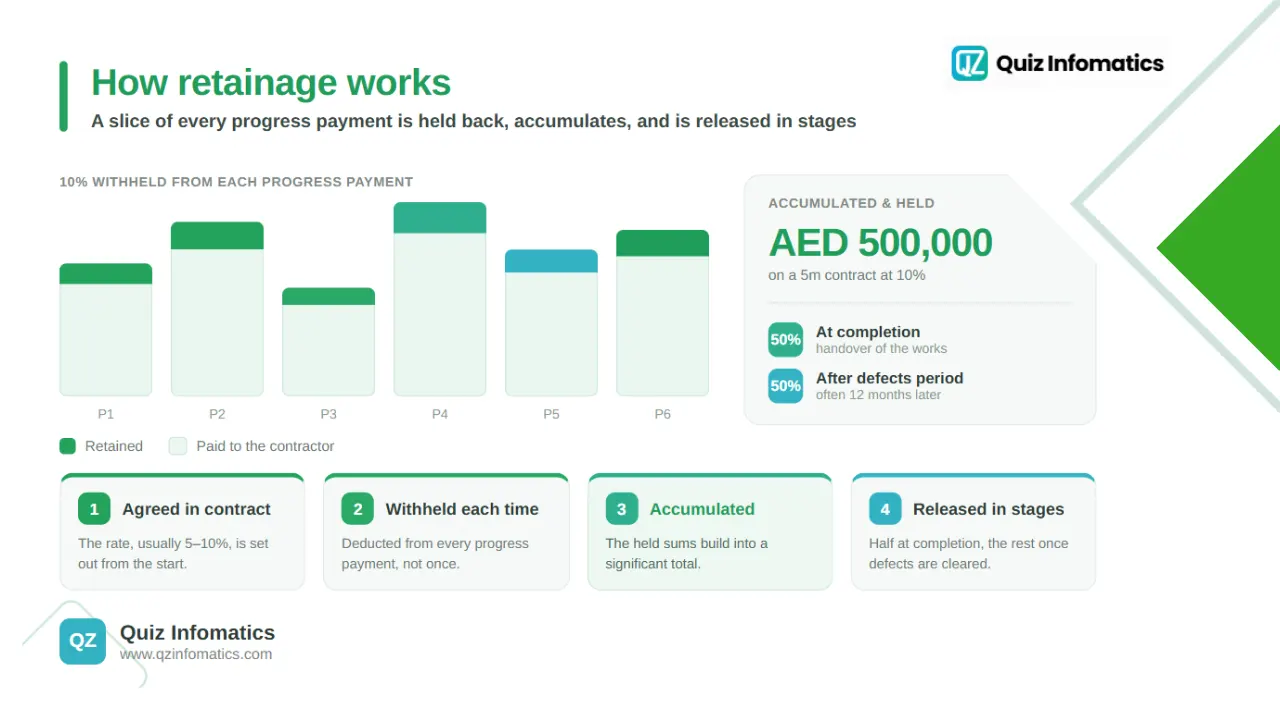
Here is the typical flow:
Agreed in the contract. The retainage percentage, usually 5 to 10 percent, is set out in the construction contract from the start.
Withheld from each payment. Each time the contractor is paid for progress, the retainage percentage is deducted and held back.
Accumulated. The withheld amounts build up over the life of the project into a significant sum.
Released in stages. The retainage is released once obligations are met, often half at substantial completion and the remainder after the defects period.
The key point is that retainage is deducted from every progress payment, not taken as a lump sum at the beginning or end. This spreads the withholding across the project, but it also means the contractor is continually financing that held-back money.
How is retainage calculated?
Retainage is calculated by applying the agreed percentage to the value of work completed in each payment period, then adding it to the running total held. The maths is simple, but it accumulates quickly.
Take a project with 10 percent retainage. If the contractor completes 500,000 dirhams of work in a month, the payer withholds 50,000 and pays 450,000. The next month, the same 10 percent is applied to that period's work, and the held amount grows.
By the end of a large project, the accumulated retainage is substantial. On a 5 million dirham contract at 10 percent, a full 500,000 dirhams is withheld across all the payment cycles, and none of it is released until the work is finished and the defects, or punch list, are cleared. For a contractor working on thin margins, that held sum can represent their entire profit on the job.
Why does retainage exist?
Retainage exists to protect the party paying and to give the contractor a strong incentive to finish the work properly. It is fundamentally a risk-management and quality tool.
For the owner or main contractor, the held funds provide security. If the contractor fails to complete the work or fix defects, there is money available to cover the cost of putting things right, or of bringing in someone else to finish. This reduces the payer's risk considerably.
For the contractor, the retained sum is a powerful motivator to close out the project, resolve any snags, and meet every contractual obligation. In that sense retainage aligns interests, even if it strains the cash flow of the party whose money is held.
When is retainage released?
Retainage is usually released in two stages: a first portion at substantial completion, and the remainder after the defects liability period ends and outstanding defects are cleared. Release depends on obligations being met, not just time passing.
The first release typically comes when the project reaches substantial or practical completion and is handed over. The final portion is held through the defects liability period, often 12 months, and released once any defects identified during that time have been rectified.
This ties retainage directly to defects and the snag list. Clearing the punch list promptly is not just about quality; it directly determines when the final retention is released. Verified completion, final inspections, and sometimes lien waivers or their equivalent are usually required before the money is paid.
Retainage flows down the chain: subcontractor retention
Retainage flows down the payment chain: the owner withholds from the main contractor, and the main contractor in turn withholds from its subcontractors. This creates a tracking challenge that sits at the heart of construction finance.
A main contractor is therefore managing retainage in two directions at once. It has retainage receivable, the money the owner is holding from it, and retainage payable, the money it is holding from its subcontractors. These must be tracked separately, per project and per subcontractor, across many payment periods.
Good practice is to match the rate withheld from subcontractors to the rate withheld from the main contractor, rather than inflating it, and to release a subcontractor's retention when their scope is complete where the contract allows. Managing this fairly and accurately across a whole supply chain is exactly where subcontractor management tools earn their place.
The cash-flow impact on subcontractors
Retainage hits subcontractors hardest, because they sit at the bottom of the payment chain and their margins are thinnest. For many, the held money is the difference between profit and loss on a job.
The impact is severe. Because retainage can equal or exceed a subcontractor's entire profit margin, subcontractors often make no profit until a project ends, and some wait years to collect the money they are owed. Meanwhile they must still pay their own workers, suppliers, and overheads on time.
This is why proactive retainage management matters so much for smaller firms. A subcontractor who tracks exactly what is being held, when it is due for release, and who chases it diligently protects their cash flow. One who loses track effectively hands the payer an interest-free loan of their own profit.
Retainage accounting: receivable vs payable
In accounting terms, retainage is tracked as a receivable when it is money owed to you, and a payable when it is money you are holding from others. Keeping the two separate is essential for accurate books.
Retainage receivable, the amount a customer is withholding from you, is recorded as an asset, often a contract asset, because it is revenue earned but not yet received. Retainage payable, the amount you are withholding from subcontractors, is recorded as a liability, because you will owe it once their obligations are met.
Getting this classification right matters for financial reporting. Misrecording retainage can distort profit and loss statements and mislead anyone reading the accounts, which is why retainage is usually tracked separately from ordinary receivables and payables for clear visibility.
Retention bonds: an alternative to withholding cash
A retention bond is an alternative to holding cash retainage, where a surety bond replaces the withheld money and frees up the contractor's working capital. It is a useful option where cash flow is tight.
Instead of the payer holding back cash from each payment, the contractor provides a bond from a surety that guarantees the same protection. The contractor gets paid in full, improving their cash flow, while the payer retains security through the bond.
Retention bonds are not always available or appropriate, and they carry their own cost, but they can be a valuable tool for contractors who want to avoid tying up large sums in retained cash across long projects.
Common retainage tracking problems
The most common retainage problems are losing track of what is held, forgetting to claim release, and errors in managing retention in both directions. Each quietly costs contractors money.
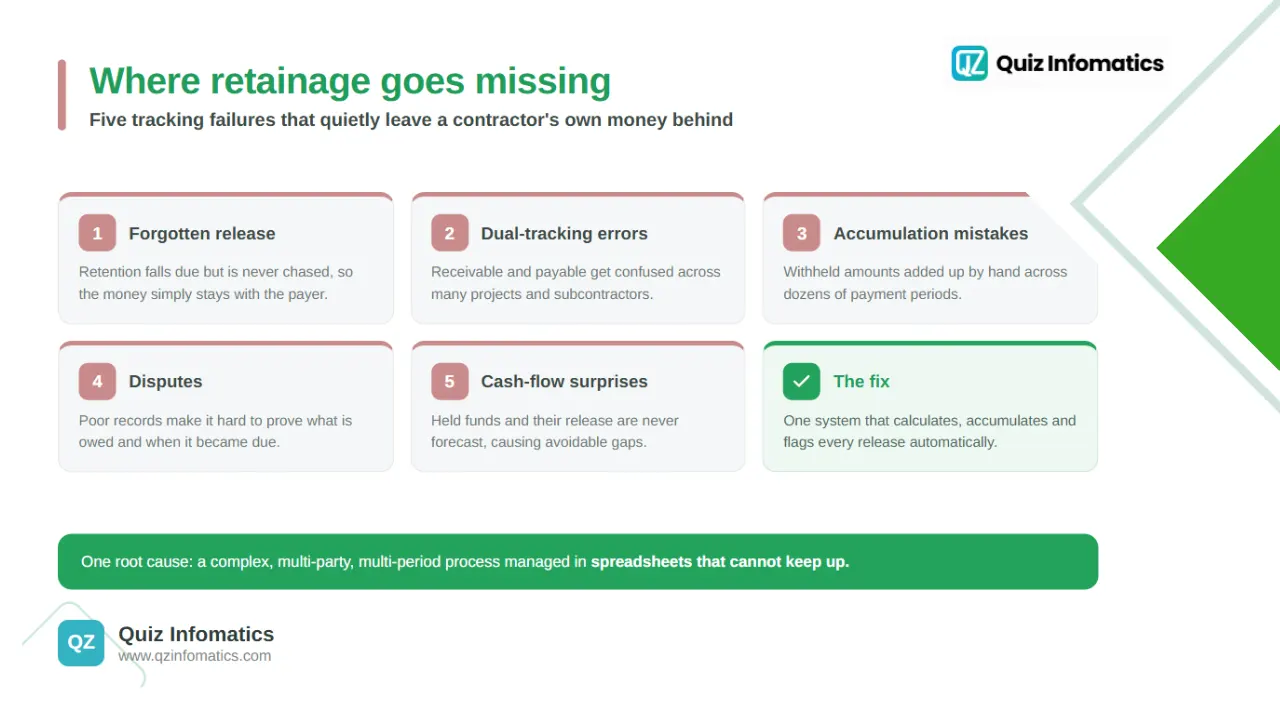
Frequent issues include:
Forgotten release. Retainage that falls due but is never chased, leaving the contractor's money with the payer.
Dual-tracking errors. Confusing retainage receivable and payable across many projects and subcontractors.
Manual accumulation mistakes. Errors in adding up withheld amounts across dozens of payment periods.
Disputes. Poor records making it hard to prove what is owed and when it is due.
Cash-flow surprises. Failing to forecast held funds and their release, causing avoidable cash gaps.
Each of these stems from the same root cause: trying to manage a complex, multi-party, multi-period process in spreadsheets that cannot keep up.
Tracking retainage in a construction ERP
The most reliable way to manage retainage is with a construction ERP that tracks held and owed amounts automatically, per project and per subcontractor, with clear release schedules. Automation removes the manual risk that costs contractors their own money.
A good construction ERP calculates retainage on every progress payment, accumulates the held amounts, tracks retainage receivable and payable separately, and flags when each release falls due. Nothing is forgotten, the two directions never get confused, and the contractor always knows exactly how much of their money is held and when it is coming.
This capability is central to modern contractor accounting software. Platforms such as Odoo, configured for construction, can bring retainage together with billing, cost control, and subcontractor accounts, and a well-run ERP implementation is what makes that tracking accurate and reliable.
Retention in the UAE
In the UAE, retention is standard practice, governed largely by the provisions of FIDIC-based contracts. It works the same way as retainage elsewhere, under the local term "retention."
UAE construction contracts typically withhold retention of around 5 to 10 percent from each interim payment, releasing it in stages at practical completion and after the defects liability period. On the large, long-running projects common in the region, this held money can amount to very significant sums across a contractor's portfolio.
For UAE contractors, tracking retention accurately, in both directions and across many subcontractors, is essential to protecting cash flow. If you want the wider context on the systems behind this, our plain-English guide to what an ERP system is sets the foundation.
How QZ Infomatics helps contractors
Controlling retention comes down to accurate, automatic tracking connected to your billing, subcontractor accounts, and cash-flow forecasting. That control is what stops earned money from slipping through the cracks.
A practical step is to manage retention receivable and payable in the same system as your progress billing, subcontractor accounts, and budget, so every held amount is tracked, every release is flagged, and nothing is forgotten. This turns retention from a spreadsheet risk into a controlled, forecastable part of your cash flow.
If you would like help with that, our construction ERP software for UAE contractors brings BOQ, cost control, budgeting, subcontractor management, billing, and retention into one platform, built for how contracting businesses actually work.
Let’s talk about your business
Start with a free 30-minute call. We’ll ask the right questions, listen carefully, and give you an honest view of what’s possible.
Retainage and retention, in a nutshell
To recap the essentials:
Retainage (or retention) is a percentage of each payment, typically 5 to 10 percent, withheld until a project is complete and defects are cleared.
Retainage and retention mean the same thing; the term depends on the region, with "retention" used in the UAE.
It is calculated by applying the percentage to each progress payment, accumulating into a substantial held sum.
It flows down the chain, so main contractors track retainage both received from owners and withheld from subcontractors.
It hits subcontractors hardest, which is why accurate tracking, ideally in a construction ERP, is so important to cash flow.
Retainage is one of the largest, most easily mismanaged sums on any construction project. Tracking it accurately, in both directions and in one connected system, is one of the most direct ways a contractor can protect their hard-earned cash.
Frequently asked questions
What is retainage in construction? Retainage is a percentage of each payment, typically 5 to 10 percent, withheld from a contractor or subcontractor until the project is complete and any defects are fixed. It provides the payer with security for completion and quality.
What is the difference between retainage and retention? There is no real difference. They are two terms for the same practice. "Retainage" is used in the United States, while "retention" is used in the UK, the Commonwealth, and the UAE.
How does retainage work in construction? A set percentage is withheld from each progress payment throughout the project, accumulating into a held sum that is released once the work is complete and defects are cleared, often in two stages.
How is retainage calculated? Retainage is calculated by applying the agreed percentage to the value of work completed in each payment period. On a 5 million dirham contract at 10 percent, 500,000 is withheld across all payments.
When is retainage released? It is usually released in two stages: a portion at substantial completion, and the remainder after the defects liability period ends and outstanding defects are rectified.
Why do contractors withhold retainage from subcontractors? Retainage flows down the payment chain. Main contractors withhold it from subcontractors as security for their work, mirroring the retainage the owner withholds from them, though good practice is to match the rate rather than inflate it.
How does retainage affect subcontractor cash flow? Severely. Because retainage can equal or exceed a subcontractor's entire profit margin, subs often make no profit until a project ends and may wait a long time to collect, while still paying their own costs.
Can construction ERP track retainage? Yes. A construction ERP calculates and accumulates retainage automatically, tracks amounts receivable and payable separately per project and subcontractor, and flags releases, removing the errors common in manual tracking.
About the author
QZ Infomatics Construction Technology Team - QZ Infomatics is a Dubai-based ERP and IT consultancy (Business Bay) that implements construction and contracting software across the UAE and GCC. The team helps contractors track retention and retainage in both directions, alongside billing, subcontractor accounts, and cost control, in one connected system, drawing on hands-on experience with construction ERP for UAE projects. This guide reflects that practical experience helping contracting businesses protect their cash flow.
Losing track of retention across projects and subcontractors? See our construction ERP for UAE contractors.