

Digital Transformation
WIP and Percentage-of-Completion Revenue Recognition in Construction ERP
Last updated: July 2026 · By the QZ Infomatics Construction Technology Team
A construction company can show a healthy profit on paper and still collapse. The reason is that construction accounting is uniquely tricky: projects span months or years, costs and billings rarely line up, and a project that looks profitable today can quietly turn into a loss. The tools that reveal the truth are the WIP report and the percentage-of-completion method. This guide explains what they are, how revenue recognition works in construction, and how a construction ERP - the same platform behind subcontractor management software and cost control - keeps it accurate.
What is a construction WIP report?
A construction WIP (work in progress) report is a financial schedule that shows the true financial position of every active project, comparing costs incurred, revenue earned, and amounts billed. It is the single most important report in construction accounting.
Unlike an ordinary profit and loss statement, a WIP report looks project by project. For each job, it reveals how much has been spent, how much revenue has genuinely been earned based on progress, and how that compares to what has actually been billed to the client.
That comparison is what makes the WIP report so powerful. It exposes whether a project is really making money, whether it has been over-billed or under-billed, and whether trouble is brewing, long before it shows up in the bank balance.
What is the percentage-of-completion method?
The percentage-of-completion method is an accounting approach that recognises revenue and profit gradually as a project progresses, in proportion to how much work has been completed, rather than all at once when the project finishes. It matches revenue to the effort actually expended.
This matters because construction projects are long. If a contractor waited until a two-year project was finished to recognise any revenue, their financial statements would be meaningless in the meantime, showing costs with no matching income.
The percentage-of-completion method solves this by recognising a fair share of the revenue and profit in each period, reflecting genuine progress. It is the standard approach for long-term construction contracts under modern accounting rules.
What is percentage-of-completion revenue recognition?
Percentage-of-completion revenue recognition means recording revenue over time as a project advances, based on a measure of how complete it is, in line with accounting standards such as IFRS 15. It is the formal accounting treatment behind the method.
Under IFRS 15, which applies in the UAE, revenue from many construction contracts is recognised "over time" rather than at a single point, provided certain criteria are met, such as the client controlling the asset as it is built. The most common way to measure progress is the input-based cost-to-cost method.
In simple terms, revenue is recognised in step with the work done, so the income statement reflects the real economic activity of each period. This gives a far truer picture of performance than waiting for handover.
How does the cost-to-cost method work?
The cost-to-cost method measures how complete a project is by dividing the costs incurred so far by the total estimated costs, then applies that percentage to the contract value to calculate earned revenue. It is the workhorse of construction revenue recognition.
The calculation runs like this:
Percentage complete = costs incurred to date divided by total estimated costs.
Earned revenue = percentage complete multiplied by the total contract value.
Recognised profit = earned revenue minus costs incurred to date.
For example, if a project has a contract value of 10 million dirhams, total estimated costs of 8 million, and costs to date of 4 million, then it is 50 percent complete, and 5 million dirhams of revenue has been earned so far. The accuracy of this figure depends entirely on the estimate of total costs, which is why cost forecasting is so critical.
What is included in a WIP report?
A WIP report includes each project's contract value, costs to date, estimated total costs, percentage complete, earned revenue, amount billed, and the resulting over- or under-billing. Each column builds the picture of a project's true position.
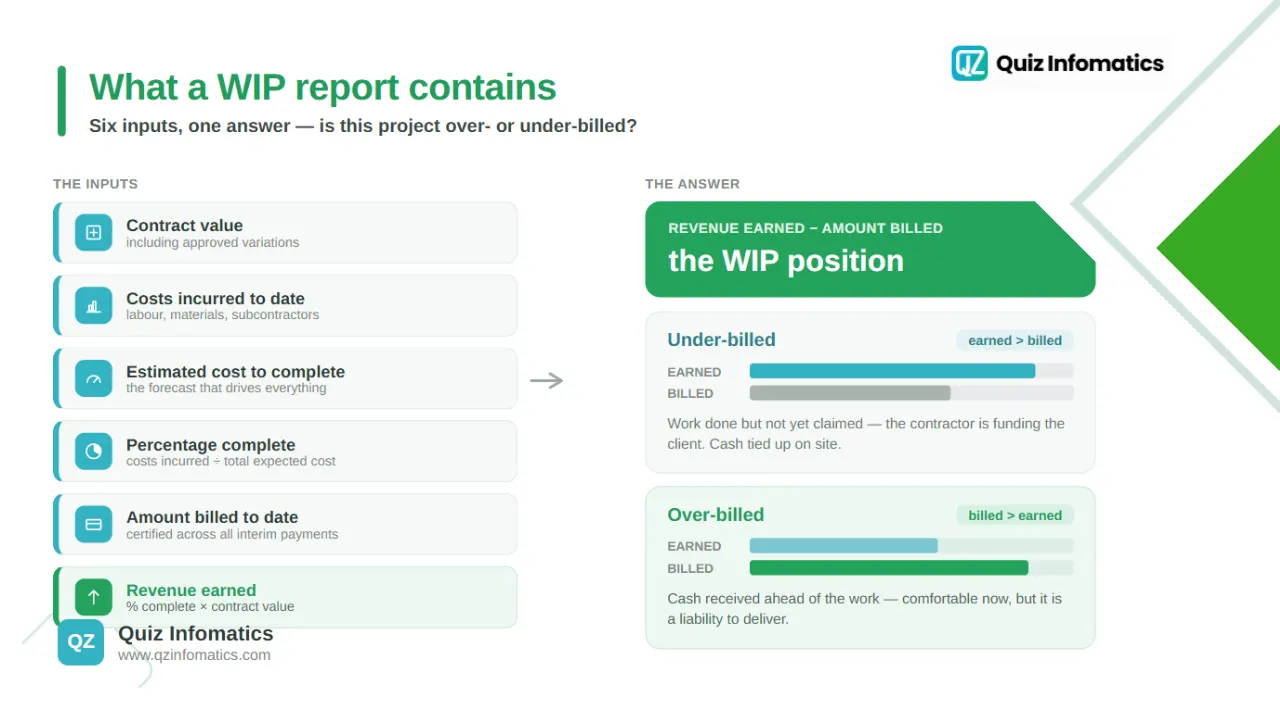
A typical WIP schedule shows, for every active job:
Contract value. The total revenue expected, including approved variations.
Costs to date. What has actually been spent so far.
Estimated total cost. The forecast final cost, including cost to complete.
Percentage complete. Costs to date as a proportion of estimated total cost.
Earned revenue. Percentage complete applied to the contract value.
Billed to date. What has actually been invoiced to the client.
Over- or under-billing. The difference between earned revenue and billed to date.
Reading across a single row tells you everything about a project's health. Reading down the columns tells you the financial position of the whole business at a glance.
Over-billing vs under-billing: what's the difference?
The difference is simple but critical: over-billing means you have billed more than you have earned, while under-billing means you have earned more than you have billed. Both carry important messages.
Over-billing, also called billings in excess of costs and earnings, appears as a liability. It often reflects healthy cash flow, because the contractor has collected money ahead of the work, but it must be treated carefully, since that money represents work still to be done.
Under-billing, or costs and earnings in excess of billings, appears as an asset. It means the contractor has done work they have not yet invoiced, which ties up cash and can signal slow billing or a problem in the payment process. Persistent under-billing is a warning sign worth investigating.
Reading a WIP report: a worked example
To bring it together, take a single project on a WIP report. Its contract value is 10 million dirhams, estimated total cost is 8 million, and costs to date are 4 million, making it 50 percent complete, with 5 million dirhams of earned revenue.
Now compare that to billing. If the contractor has billed the client 5.5 million dirhams, they are over-billed by 500,000, having collected ahead of the work. If instead they have only billed 4.2 million, they are under-billed by 800,000, meaning they have done work worth more than they have invoiced and are effectively financing the client. Either way, the WIP report surfaces it instantly, so the contractor can act, whether that means correcting the billing or investigating why costs are tracking as they are.
Why does the WIP report matter?
The WIP report matters because it reveals project profitability and warns of problems early, and the lack of exactly this kind of visibility is a leading cause of construction company failure. The stakes could hardly be higher.
The failure statistics are sobering. Research shows that around 44 percent of construction businesses fail within five years, and roughly 82 percent of all business failures are tied to poor cash flow management. Industry studies of construction failures repeatedly point to the same internal causes: failure to evaluate project profitability, poor billing procedures, and a lack of early-warning measures. A WIP report is the direct remedy for all three.
Its greatest value is catching "profit fade," where a project's expected profit quietly erodes as costs creep up. A good WIP report, updated regularly, shows this happening while there is still time to act, turning accounting from a backward-looking record into a forward-looking early-warning system.
WIP, cost estimates, and the quantity surveyor
The accuracy of a WIP report depends entirely on the accuracy of the estimated cost to complete, which makes reliable cost forecasting essential. Garbage in, garbage out applies powerfully here.
Because the percentage complete is driven by estimated total costs, a poor estimate distorts the whole report, overstating or understating profit. This is why disciplined cost forecasting, tied to the bill of quantities and updated as the project progresses, is fundamental to trustworthy WIP.
This work sits squarely with the quantity surveyor, whose cost value reconciliation and forecasting feed directly into the WIP schedule. Without rigorous cost control underneath it, a WIP report is only as good as its guesses.
Percentage of completion vs completed contract method
The two main approaches to construction revenue recognition are the percentage-of-completion method and the completed contract method, and they differ in when revenue is recognised. The choice has a big impact on the financial statements.
The completed contract method recognises all revenue and profit only when the project is finished. It is simpler, but for long projects it produces distorted, lumpy financials that do not reflect ongoing activity, and it is generally not acceptable for long-term contracts under IFRS.
The percentage-of-completion method recognises revenue and profit gradually as work proceeds. It is more complex but far more accurate, which is why it is the standard for long-term construction contracts and the basis of every meaningful WIP report.
WIP, IFRS 15, and UAE corporate tax
In the UAE, revenue recognition is not just an accounting exercise; it now directly affects corporate tax, because taxable profit is based on accounting profit. This makes getting WIP right more important than ever.
Under IFRS 15, construction revenue is generally recognised over time, and with the UAE's corporate tax regime, the profit recognised in each period feeds into the taxable profit for that period. Inaccurate or inconsistent revenue recognition can therefore create both financial-reporting and tax problems.
Add the VAT treatment of interim payments and the move to structured e-invoicing, covered in our complete guide to e-invoicing in the UAE, and it becomes clear that UAE contractors need their WIP, revenue recognition, and billing handled accurately and consistently in one place.
The challenges of manual WIP reporting
Manual WIP reporting in spreadsheets is slow, error-prone, and often out of date by the time it is finished. For a growing contractor, this is a serious risk.
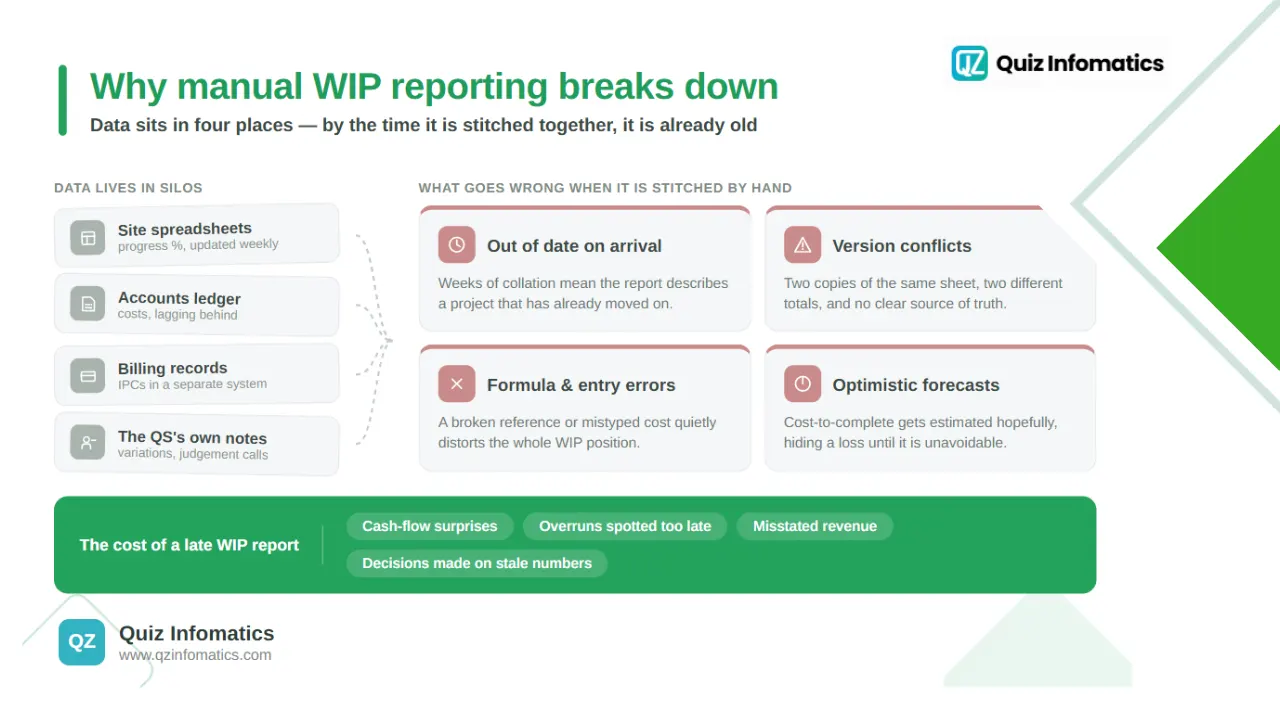
Common problems include:
Stale data. A WIP report built by hand reflects last month, not today.
Estimate errors. Manually updating cost-to-complete across many projects invites mistakes.
Disconnected sources. Costs, billings, and contract values living in separate systems rarely reconcile cleanly.
Subjectivity. Without disciplined data, percentage-complete becomes guesswork.
No early warning. By the time a spreadsheet reveals a problem, it may be too late to fix.
Each of these undermines the very purpose of WIP, which is to give an accurate, timely picture. A report that is wrong or late is worse than useless, because it breeds false confidence.
WIP and revenue recognition in construction ERP
The most reliable way to produce WIP reports and recognise revenue correctly is with a construction ERP that calculates them automatically from live cost, billing, and contract data. Automation removes the manual risk and delay.
A good construction ERP links contract values, actual costs, cost forecasts, and billing together, then generates the WIP schedule and percentage-of-completion revenue in real time. Percentage complete updates as costs are booked, earned revenue recalculates automatically, and over- and under-billing are visible instantly across every project.
This capability is central to modern contractor accounting software. Platforms such as Odoo, configured for construction, can bring cost control, billing, and revenue recognition together, and a well-run ERP implementation is what makes that automation accurate and reliable. The result is WIP you can trust, produced in minutes rather than days.
WIP reporting in the UAE
In the UAE, accurate WIP reporting and revenue recognition are increasingly essential, driven by IFRS 15, corporate tax, and the scale of local projects. Contractors here cannot afford to treat it as an afterthought.
The combination of long, high-value projects, IFRS-based reporting, corporate tax, and demanding lenders and sureties means UAE contractors need a clear, accurate view of project profitability at all times. A reliable WIP report is what provides it, supporting both compliance and good decision-making.
For UAE contractors, connecting WIP and revenue recognition to the rest of their project data is a genuine advantage. If you want the wider context on the systems behind this, our plain-English guide to what an ERP system is sets the foundation.
How QZ Infomatics helps contractors
Trustworthy WIP and revenue recognition come down to connecting contract values, actual costs, and billing in one accurate system. That connection is what protects both profit and compliance.
A practical step is to generate WIP reports and percentage-of-completion revenue automatically from your live project data, so profitability, over- and under-billing, and early warnings are always current rather than reconstructed each month in spreadsheets. This turns construction accounting into a real-time management tool.
If you would like help with that, our construction ERP software for UAE contractors brings BOQ, cost control, budgeting, subcontractor management, billing, and revenue recognition into one platform, built for how contracting businesses actually work.
Let’s talk about your business
Start with a free 30-minute call. We’ll ask the right questions, listen carefully, and give you an honest view of what’s possible.
WIP and percentage of completion, in a nutshell
To recap the essentials:
A construction WIP report shows the true financial position of every active project, comparing costs, earned revenue, and billings.
The percentage-of-completion method recognises revenue and profit gradually as a project progresses, rather than all at the end.
Cost-to-cost is the common measure: percentage complete equals costs to date divided by estimated total costs.
Over- and under-billing reveal whether you have billed ahead of or behind the work you have earned.
In the UAE, accurate revenue recognition matters for IFRS 15, corporate tax, and cash flow, and a construction ERP is the reliable way to get it right.
WIP reporting and revenue recognition are the difference between knowing your true profitability and merely hoping for it. In an industry where profitable-looking companies fail every day, getting them right, in one connected system, is one of the smartest things a contractor can do.
Frequently asked questions
What is a construction WIP report? A construction WIP (work in progress) report is a schedule showing the true financial position of each active project, comparing costs incurred, revenue earned based on progress, and amounts billed, to reveal profitability and over- or under-billing.
What is the percentage-of-completion method? It is an accounting method that recognises revenue and profit gradually as a project progresses, in proportion to the work completed, rather than recognising everything at project completion.
How is percentage of completion calculated? Most commonly using the cost-to-cost method: percentage complete equals costs incurred to date divided by total estimated costs. Earned revenue is that percentage applied to the total contract value.
What is the difference between over-billing and under-billing? Over-billing means you have billed more than you have earned, appearing as a liability. Under-billing means you have earned more than you have billed, appearing as an asset and often signalling slow billing.
Why is the WIP report important? It reveals each project's true profitability and warns of problems like profit fade early. A lack of this visibility is a leading cause of construction company failure, so the WIP report is a vital early-warning tool.
What is percentage-of-completion revenue recognition under IFRS 15? Under IFRS 15, construction revenue is often recognised "over time" as the project progresses, measured by a method such as cost-to-cost, rather than at a single point when the project completes.
Does revenue recognition affect UAE corporate tax? Yes. Because taxable profit is based on accounting profit, the revenue and profit recognised in each period under IFRS 15 feed into corporate tax, making accurate WIP and revenue recognition important for compliance.
Can construction ERP automate WIP and revenue recognition? Yes. A construction ERP calculates WIP schedules and percentage-of-completion revenue automatically from live cost, contract, and billing data, keeping profitability and billing positions accurate and always current.
About the author
QZ Infomatics Construction Technology Team - QZ Infomatics is a Dubai-based ERP and IT consultancy (Business Bay) that implements construction and contracting software across the UAE and GCC. The team helps contractors automate WIP reporting, percentage-of-completion revenue recognition, cost control, and billing by bringing BOQ, budgets, and project accounts into one connected system, drawing on hands-on experience with construction ERP for UAE projects. This guide reflects that practical experience helping contracting businesses understand their true profitability.
Not sure which of your projects are really making money? See our construction ERP for UAE contractors.