

Digital Transformation
Labour Camp and Manpower Cost Allocation for GCC Contractors
Last updated: August 2026 · By the QZ Infomatics Construction Technology Team
In the GCC, a construction worker's wage is only a fraction of what that worker actually costs. Add the labour camp, transport, visa, medical, gratuity, and food, and the true cost is far higher, and unless all of it is allocated to the right project, your job costs are simply wrong. This is one of the least understood but most important areas of construction finance in the region, and it is exactly what a purpose-built construction ERP for UAE contractors is designed to handle. This guide explains labour burden, WPS, and manpower cost allocation for GCC contractors.
What is labour burden in construction?
Labour burden is the total cost of employing a worker beyond their base wage, expressed as the difference between what you pay in wages and what that worker truly costs your business. It is the gap between the headline salary and the real, fully-loaded cost.
Every worker carries indirect costs on top of their pay. Charging only the base wage to a project understates its true labour cost, which distorts profitability and leads to underpriced bids. Industry benchmarks show that relying on unburdened labour costs underestimates labour expenses by roughly 30 percent, producing artificially competitive bids and cash-flow deficits, with labour itself typically making up 30 to 50 percent of total construction cost.
The solution is a fully-burdened labour rate: the base wage plus all the indirect costs of employment, divided by the worker's productive hours. That burdened rate is what should be charged to jobs, not the raw wage.
Why is labour burden different in the GCC?
Labour burden in the GCC is fundamentally different from Western markets, because the cost components are different. The familiar Western burden items, income-tax withholding, social security, and workers' compensation, largely do not apply here, but a distinct and often larger set of costs does.
In the Gulf, the burden is dominated by the costs of housing, feeding, transporting, and sponsoring a largely expatriate workforce. A worker must be accommodated in a labour camp, transported to site, fed, medically insured, sponsored through visas and permits, and provided for on departure. These are real, significant costs that Western burden calculators simply do not capture.
This is why generic labour-costing advice fails in the GCC. A contractor in Dubai or Riyadh who applies a Western burden rate will badly misjudge their true labour cost, because the structure of employment here is unique to the region.
What makes up GCC labour burden?
GCC labour burden is made up of accommodation, transport, food, visa and permit costs, medical, end-of-service gratuity, and camp overheads, on top of the base wage. Understanding each component is the first step to costing it properly.
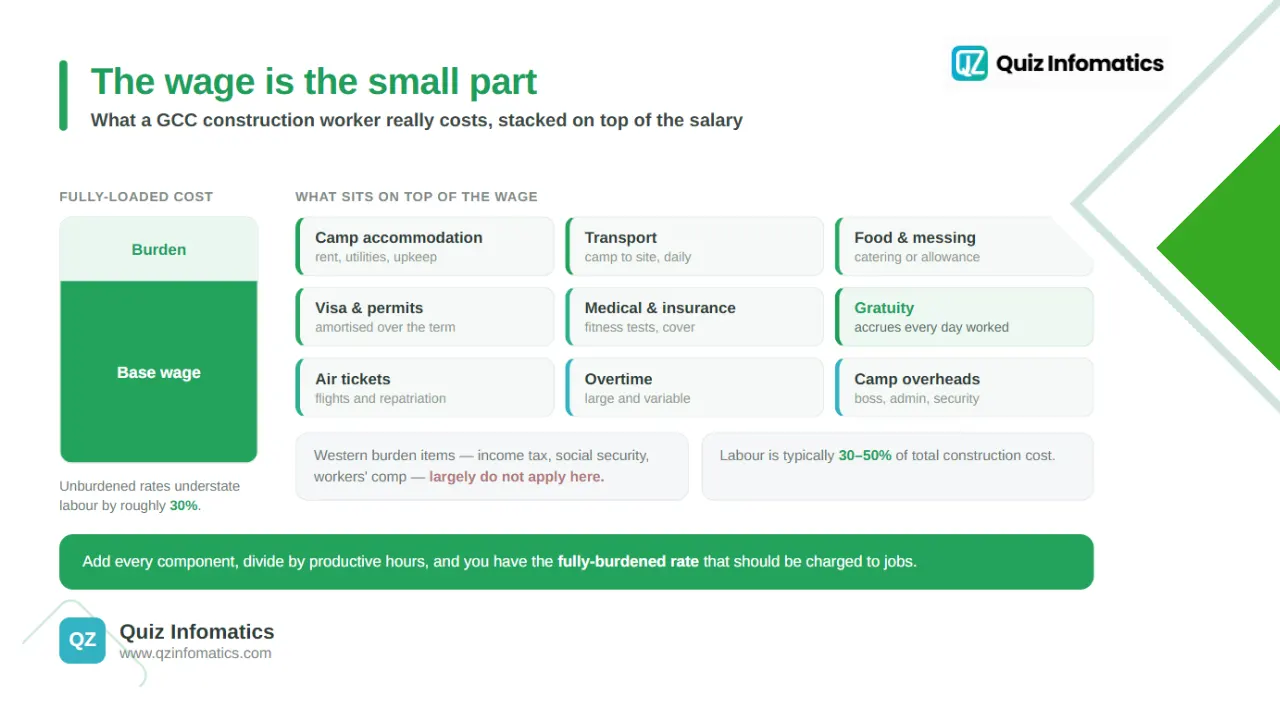
The main components are:
Base wage. The salary paid, processed through the Wage Protection System.
Labour camp accommodation. Housing workers in compliant accommodation, including rent, utilities, and maintenance.
Transport. Buses moving workers between camp and site, often daily.
Food and messing. Catering or messing allowances for the workforce.
Visa, work permit, and Emirates ID. Sponsorship, permit, and identity costs, usually amortised over the visa period.
Medical fitness and health insurance. Mandatory medical testing and insurance cover.
End-of-service gratuity. An accruing liability payable when a worker leaves.
Air tickets and repatriation. Flights home, often contractually provided.
Overtime. A significant, variable cost on many projects.
Camp overheads. Camp boss, administration, security, and cleaning, shared across all residents.
Add these together and the true cost of a GCC construction worker is well above their wage. A labourer earning a modest monthly salary can cost the company considerably more once accommodation, transport, food, and the rest are included.
What is the WPS in the UAE?
The Wage Protection System (WPS) is a mandatory electronic salary-transfer system in the UAE that requires employers to pay workers' wages through approved banks and agents, monitored by the Ministry of Human Resources and Emiratisation. It exists to guarantee that workers are paid in full and on time.
Under WPS, employers must transfer salaries electronically through the approved channels, creating a verifiable record that wages have been paid. Failure to comply, or to pay on time, can trigger fines and blocks on new work permits, so WPS compliance is not optional for contractors employing labour in the UAE.
For cost allocation, WPS matters because it is the authoritative record of the base wage element of labour cost. Similar wage-protection systems operate across the GCC, including Saudi Arabia's system linked to platforms such as Mudad, and equivalents in Qatar and Oman, so this is a region-wide feature of managing a workforce.
What is end-of-service gratuity, and why must it be allocated?
End-of-service gratuity is a lump-sum payment GCC employers owe workers when their employment ends, and it must be accrued and allocated to projects because it builds up steadily as a real cost. Ignoring it is one of the most common job-costing mistakes.
Under the UAE Labour Law, an employee who completes at least a year of service is generally entitled to gratuity of 21 days' basic wage for each of the first five years of service, and 30 days' basic wage for each year thereafter, based on their basic salary. Similar entitlements exist across the GCC.
The key point for costing is that gratuity accrues continuously, even though it is only paid out later. A contractor who does not accrue and allocate this cost as workers earn it will understate job costs today and face a large, unbudgeted bill when workers eventually leave. It should be built into the fully-burdened labour rate from the start.
How is labour camp cost allocated to projects?
Labour camp cost is allocated to projects by calculating the total cost of running the camp, dividing it by the number of workers to get a cost per worker, and charging that to projects based on how many of their workers it houses. It turns a shared overhead into a per-project cost.
A labour camp is a shared facility, so its total cost, rent, utilities, catering, transport, camp management, and maintenance, must be spread across the workers who live there. A common approach is to calculate a cost per worker per month, or per bed-night, then allocate it to each project according to its headcount in the camp.
This matters because camp costs are substantial and easy to overlook. When they sit in general overhead rather than being allocated to jobs, individual projects look more profitable than they are, and the business loses sight of what its workforce truly costs on each site.
Let’s talk about your business
Start with a free 30-minute call. We’ll ask the right questions, listen carefully, and give you an honest view of what’s possible.
How do you calculate a fully-burdened labour rate in the GCC?
You calculate a fully-burdened GCC labour rate by adding all the annual costs of employing a worker, wage plus every burden component, then dividing by the worker's productive hours in the year. The result is the rate you should charge to jobs.
Consider a simplified example. Take a worker whose annual base wage is a given figure, then add their share of camp accommodation, transport, food, amortised visa and medical costs, insurance, air tickets, and accrued gratuity. Sum all of it to get the total annual cost of employment.
Then divide that total by the worker's productive hours, the hours actually worked on projects, which are fewer than the hours paid once leave, public holidays, and non-productive time are removed. The resulting hourly rate is the true, fully-burdened cost that should feed every estimate and every job cost.
How is manpower cost allocated to jobs?
Manpower cost is allocated to jobs by recording the hours each worker spends on each project through timesheets, then charging those hours at the worker's fully-burdened rate. Accurate time capture is the foundation of accurate labour job costing.
The process is straightforward in principle: timesheets record who worked on which project and for how long, and each hour is charged to the job at the burdened rate rather than the raw wage. This is a core part of construction job costing, where labour usually represents the largest single cost.
The difficulty is timeliness and accuracy. When timesheets are late or handled on paper, job costs lag reality, and a project can drift over budget on labour before anyone notices. Capturing time digitally and charging it at burdened rates keeps job costs current and true.
Manpower supply and labour subcontractors
Many GCC contractors supplement their own workforce with manpower supply companies, and those costs must be tracked and allocated just as carefully. This adds another layer to labour cost management.
Manpower supply, or labour supply, involves hiring workers through a third-party company that handles their sponsorship and accommodation, charging the contractor a rate per worker. These charged rates must be allocated to the projects the supplied workers actually staff, alongside the contractor's own labour.
Managing this mix of direct and supplied labour, across multiple projects, is where subcontractor management software earns its place, letting a contractor track and allocate both their own manpower and supplied labour against each job.
Why accurate manpower allocation matters
Accurate manpower allocation matters because labour is the largest and most variable cost on most GCC projects, so getting it wrong quietly destroys profitability. Small errors, repeated across a large workforce, add up fast.
When labour is charged at unburdened rates or allocated to the wrong jobs, project profitability becomes fiction. A job that appears to be making money may be losing it once the full labour cost is counted, and the business only discovers this at the final account, when it is too late to act.
This is why fully-burdened labour cost must flow into the WIP report and percentage-of-completion revenue recognition that reveal each project's true margin. Labour cost accuracy is not an accounting nicety in the GCC; it is the difference between knowing and guessing whether you are profitable.
The challenge of manual manpower costing
Manual manpower costing in spreadsheets almost always fails, because it cannot keep up with the volume and complexity of GCC labour costs. The gaps are predictable and expensive.
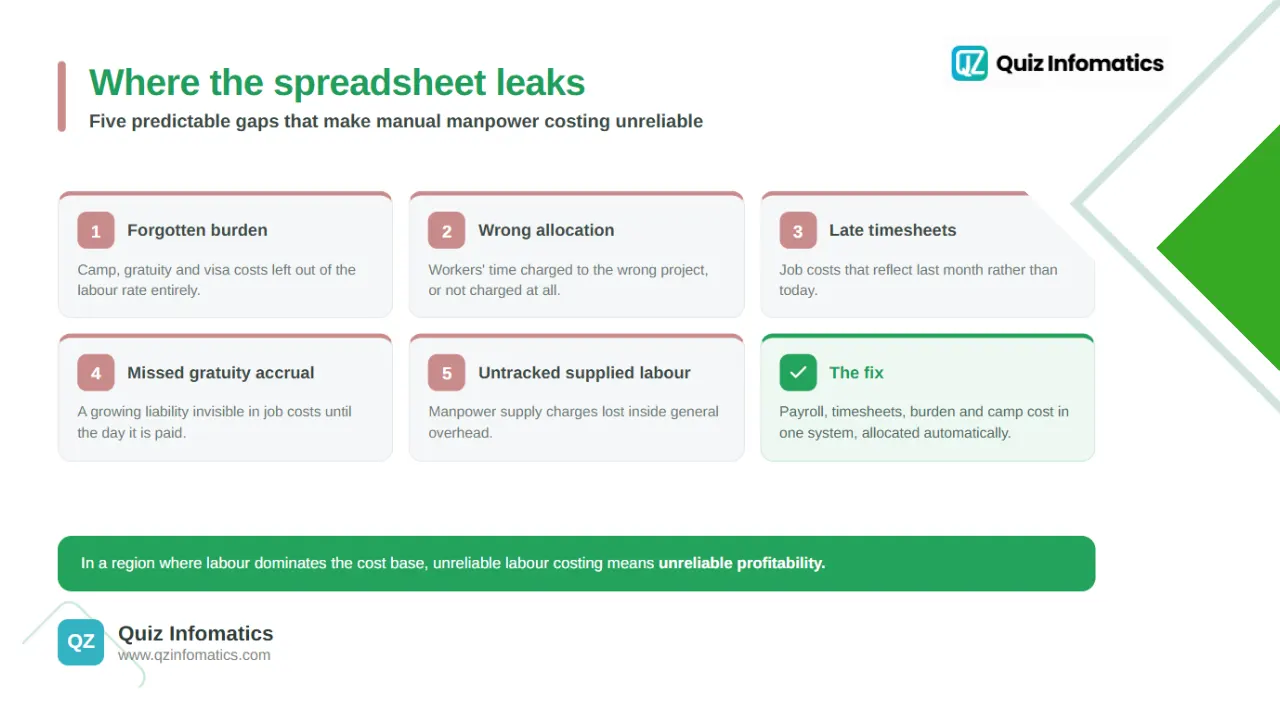
Common problems include:
Forgotten burden. Camp, gratuity, and visa costs left out of the labour rate.
Wrong allocation. Workers' time charged to the wrong project, or not at all.
Late timesheets. Job costs that reflect last month, not today.
Missed gratuity accrual. A growing liability that never appears in job costs until payout.
Untracked supplied labour. Manpower supply costs lost in general overhead.
Each of these makes job costs unreliable. In a region where labour is such a dominant cost, unreliable labour costing means unreliable profitability, which is a serious risk to the business.
How construction ERP handles manpower and labour burden
A construction ERP handles manpower cost by processing WPS payroll, capturing timesheets, applying fully-burdened rates, and allocating labour, including camp and gratuity, automatically to the right jobs. It removes the manual gaps that undermine spreadsheet costing.
In a well-configured system, wages flow through WPS-compliant payroll, timesheets capture project hours, burden components are built into each worker's rate, gratuity accrues automatically, and camp costs are allocated by headcount. The result is job costs that carry the true, fully-loaded cost of labour without manual calculation.
This is central to modern contractor accounting software. Platforms such as Odoo, configured for GCC construction and payroll, can bring WPS, HR, timesheets, and job costing together, and a well-run ERP implementation is what makes that allocation accurate and compliant.
Manpower cost management across the GCC
Across the GCC, the principles of labour burden and manpower allocation are the same, though the specific systems and rules vary by country. Contractors operating regionally need to handle each market's requirements.
The UAE has WPS and its Labour Law gratuity rules; Saudi Arabia operates wage protection alongside platforms such as Mudad and its own end-of-service framework; Qatar and Oman have their own wage-protection and labour systems. Labour accommodation standards, medical requirements, and visa processes also differ across the region.
For contractors working in more than one GCC market, a system that can handle these variations while allocating fully-burdened labour to jobs consistently is a genuine advantage. If you want the wider context on the systems behind this, our plain-English guide to what an ERP system is sets the foundation.
How QZ Infomatics helps contractors
Controlling manpower cost in the GCC comes down to capturing time accurately and charging it at a truly burdened rate, connected to your job costing. That connection is what turns the region's largest cost into a managed, visible one.
A practical step is to bring WPS payroll, timesheets, labour burden, camp cost allocation, and gratuity accrual into one system that feeds job costing automatically, so every project carries its real labour cost and profitability is honest. This turns manpower from a costing blind spot into a controlled part of the business.
If you would like help with that, our construction ERP software for UAE contractors brings manpower costing, BOQ, cost control, budgeting, subcontractor management, and billing into one platform, built for how GCC contracting businesses actually work.
Labour camp and manpower cost allocation, in a nutshell
To recap the essentials:
Labour burden is the full cost of employing a worker beyond their base wage, and in the GCC it is dominated by camp, transport, food, visa, medical, and gratuity costs.
GCC burden is unique: Western items like FICA and workers' comp do not apply, but a distinct and often larger set of costs does.
WPS is the mandatory wage-protection system that records the base wage and must be complied with across the region.
End-of-service gratuity accrues continuously and must be allocated to jobs, not left as a surprise at payout.
Fully-burdened labour, allocated to jobs via timesheets, is what gives accurate job costs and honest profitability, and a construction ERP is the reliable way to manage it.
In the GCC, labour is the biggest cost on almost every project, and its true cost is hidden inside camps, visas, and gratuity that spreadsheets rarely capture. Allocating it fully and accurately, in one connected system, is one of the most valuable things a regional contractor can do.
Frequently asked questions
What is labour burden in construction? Labour burden is the total cost of employing a worker beyond their base wage. It includes all the indirect costs of employment, and charging only the base wage to a project understates its true labour cost by around 30 percent.
What makes up labour burden in the GCC? In the GCC, labour burden includes labour camp accommodation, transport, food, visa and permit costs, medical insurance, end-of-service gratuity, air tickets, overtime, and camp overheads, on top of the base wage.
What is the WPS in the UAE? The Wage Protection System (WPS) is a mandatory electronic salary-transfer system that requires employers to pay wages through approved banks and agents, monitored by the Ministry of Human Resources and Emiratisation, to ensure workers are paid in full and on time.
How is end-of-service gratuity calculated in the UAE? Under the UAE Labour Law, a worker with at least a year of service is generally entitled to 21 days' basic wage for each of the first five years, and 30 days' basic wage for each subsequent year, based on basic salary. It should be accrued as it builds up.
How is a fully-burdened labour rate calculated? Add the worker's annual base wage and all burden components, camp, transport, food, visa, medical, gratuity, and more, then divide the total by the worker's productive hours in the year to get the burdened hourly rate.
How is labour camp cost allocated to projects? Calculate the total cost of running the camp, divide it by the number of workers to get a cost per worker, then charge that to projects based on how many of their workers the camp houses.
Why is labour costing different in the GCC? Because the cost components differ. Western burden items like income tax and workers' compensation largely do not apply, while GCC-specific costs like accommodation, transport, visas, and gratuity dominate, so generic labour-costing advice does not fit.
Can a construction ERP handle WPS and labour burden? Yes. A construction ERP can process WPS-compliant payroll, capture timesheets, apply fully-burdened rates, accrue gratuity, and allocate camp and manpower costs automatically to the right jobs.
About the author
QZ Infomatics Construction Technology Team - QZ Infomatics is a Dubai-based ERP and IT consultancy (Business Bay) that implements construction and contracting software across the UAE and GCC. The team helps contractors manage WPS payroll, labour burden, camp cost allocation, gratuity accrual, and job costing in one connected system, drawing on hands-on experience with construction ERP for GCC projects and their unique workforce costs. This guide reflects that practical, region-specific experience helping contracting businesses understand what their labour truly costs.
Not sure what your workforce really costs per project? See our construction ERP for UAE contractors.