Digital Transformation
What Is a Bill of Quantities (BOQ)?
Last updated: July 2026 · By the QZ Infomatics Construction Technology Team
Every construction project runs on one core question: what needs to be built, in what quantity, and at what cost? The document that answers it is the bill of quantities. Get it right and a project is priced fairly and controlled tightly. Get it wrong and costs spiral. This guide explains what a BOQ is in plain English, what goes into it, who prepares it, and why it sits at the heart of every well-run construction project, especially here in the UAE.
What is a BOQ?
A BOQ, or bill of quantities, is a detailed document that lists all the materials, labour, and work items required for a construction project, along with their measured quantities, so contractors can price the job accurately. It turns a set of drawings into an itemised, priceable list.
Think of it as the shopping list and pricing sheet for an entire build, broken down line by line. Instead of a single lump-sum guess, every element of the project is measured, described, and given a rate.
That structure is what makes a BOQ so powerful. It lets everyone price the same scope on the same basis, which keeps tendering fair and budgets honest.
What does BOQ mean in construction?
The BOQ meaning in construction is simple: it is the measured, itemised schedule of works that forms the basis for pricing, tendering, and cost control on a project. It is prepared from the project drawings and specifications.
Without a bill of quantities, contractors would each guess at quantities differently, making their bids impossible to compare. With one, every contractor prices the exact same measured items, so the client can compare tenders like for like.
Beyond tendering, the BOQ becomes a living cost-control tool used throughout the build, from interim payments to valuing changes. It is one of the most important documents in the entire construction process.
What is included in a bill of quantities?
A bill of quantities is organised into sections and line items, where each item carries a description, a unit of measurement, a quantity, a rate, and a total amount. The document is grouped logically so it is easy to price and check.
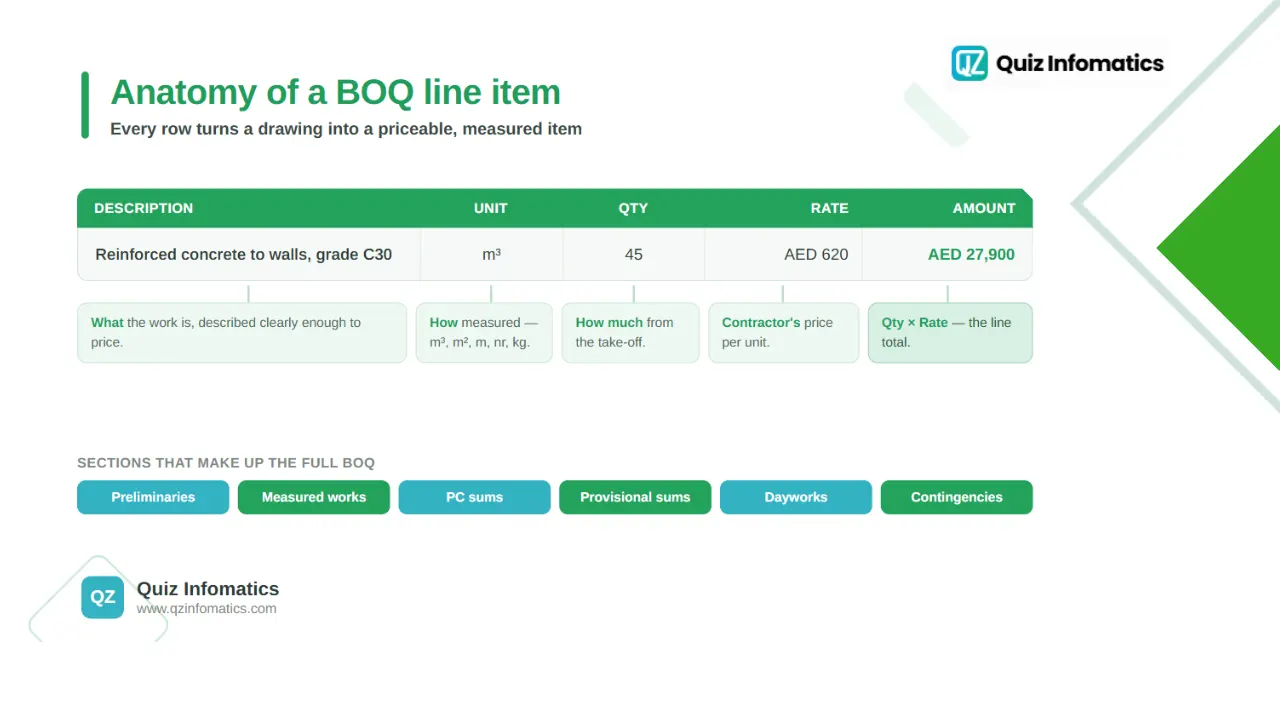
The main components you will find in a BOQ include:
Preliminaries. General project costs not tied to a specific trade, such as site setup, management, scaffolding, insurance, and temporary works.
Measured works. The core of the BOQ, listing actual construction items by trade (concrete, blockwork, finishes, and so on), each with a measured quantity.
Prime cost (PC) sums. Allowances for materials or work supplied by a nominated supplier or subcontractor, where the exact cost is not yet fixed.
Provisional sums. Allowances for work that cannot be fully measured yet because the design is incomplete.
Dayworks. Rates for work carried out on a time-and-materials basis, used for unforeseen tasks.
Contingencies. A sum set aside for unexpected costs.
Each measured line item typically shows a description of the work, a unit (such as square metres, cubic metres, linear metres, number, or kilograms), the quantity, the contractor's rate, and the resulting amount. Add up all the amounts, and you have the priced total for the project.
Why is a bill of quantities important?
A bill of quantities matters because it makes construction pricing fair, comparable, and controllable, from the first tender to the final account. Its value runs across the whole project lifecycle.
Here is why it is so important:
Fair, comparable tendering. Because every contractor prices the same measured quantities, the client can compare bids on a true like-for-like basis, rather than comparing guesses.
Accurate budgeting. A detailed BOQ produces a realistic project cost built from measured reality, not a rough lump sum.
Cost control during the build. Interim payments are calculated against BOQ items as work is completed, keeping cash flow tied to actual progress.
Valuing variations. When the client changes the design, the agreed BOQ rates provide a fair basis for pricing that change instead of arguing over cost.
Financial clarity. The BOQ underpins the final account, so everyone knows exactly what was built and what it cost.
This matters more than it might sound. Across the industry, roughly 9 in 10 large construction projects run over budget, with an average overrun of about 28 percent, and studies attribute close to a third of overruns to estimating errors. A well-prepared BOQ is one of the strongest defences against exactly that kind of estimating failure.
Who prepares a bill of quantities? The quantity surveyor
A bill of quantities is prepared by a quantity surveyor (QS), the construction professional responsible for measuring, costing, and managing the financial side of a project. The BOQ is one of their central deliverables.
A quantity surveyor takes the architect's and engineer's drawings and specifications and converts them into measured quantities through a process called "taking off." They apply a recognised standard method of measurement so that items are described and quantified consistently.
The QS role goes far beyond producing the BOQ. Quantity surveyors handle cost planning, tender evaluation, interim valuations, variation pricing, and the final account. In effect, they are the financial guardians of a construction project, and the BOQ is their primary tool.
What does a quantity surveyor do day to day?
Day to day, a quantity surveyor measures work, prices it, and controls project costs from start to finish. Their work keeps a project financially healthy.
Typical responsibilities include preparing and pricing the BOQ, advising on procurement and contracts, valuing completed work for payment, assessing the cost of design changes, managing subcontractor accounts, and settling the final account. On large UAE projects, a QS often works within FIDIC-based contracts, which rely heavily on accurate measurement and valuation.
How is a bill of quantities prepared?
A BOQ is prepared by measuring quantities from the project drawings and specifications, then describing and organising them under a standard method of measurement. The process demands precision, because every error flows straight into the pricing.
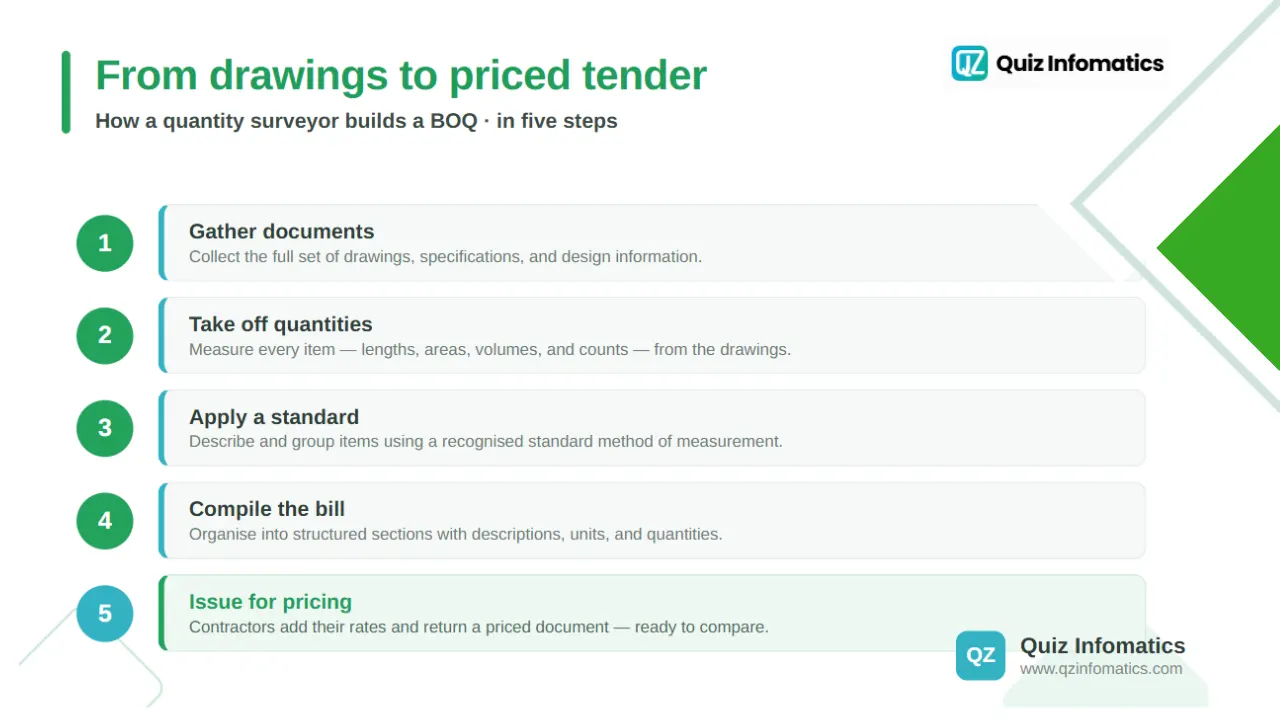
The preparation process generally follows these steps:
Gather documents. Collect the complete set of drawings, specifications, and design information.
Take off quantities. Measure every item of work from the drawings, calculating lengths, areas, volumes, and counts.
Apply a standard. Describe and group items using a recognised standard method of measurement so the BOQ is consistent and unambiguous.
Compile the bill. Organise everything into structured sections with descriptions, units, and quantities, ready for contractors to insert rates.
Issue for pricing. Send the unpriced BOQ to tendering contractors, who add their rates and return a priced document.
Accuracy at the take-off stage is everything. A missed quantity or a wrong unit can distort the entire project cost, which is why measurement is done so carefully and, increasingly, with digital tools.
What are the different types of BOQ?
There are several types of bill of quantities, and the right one depends on how complete the design is when pricing begins. Knowing the difference helps set the right expectations.
Firm BOQ. Prepared from complete, detailed drawings, giving accurate quantities. Used when the design is fully developed.
Approximate (or provisional) BOQ. Prepared from incomplete design information to give an early cost estimate, later refined as the design matures.
Elemental BOQ. Organised by building element (foundations, frame, roof, and so on) rather than trade, useful for cost planning.
Operational BOQ. Structured around the sequence of construction operations rather than measured items.
Most traditional tenders use a firm BOQ, because it gives contractors the certainty they need to price competitively and clients the accuracy they need to budget.
How is a BOQ used in tendering?
In tendering, the client issues an unpriced BOQ, each contractor inserts their rates, and the client compares the priced returns to select the best bid. The BOQ is the common yardstick that makes this possible.
Because every contractor prices identical quantities, the client is comparing genuine differences in rates and efficiency, not differences in interpretation. This transparency protects both sides: the client gets a fair price, and the contractor prices a clearly defined scope.
Once awarded, the priced BOQ usually becomes a contract document. From that point on, it governs payments, variations, and the final account, which is why getting it right at the tender stage is so valuable.
A simple BOQ example
To make it concrete, imagine a small section of a BOQ for a concrete wall. It might list an item such as "Reinforced concrete to walls, grade C30," with a unit of cubic metres, a quantity of 45, a contractor's rate, and a resulting amount.
Below it, another line might read "Formwork to walls," measured in square metres, with its own quantity, rate, and amount. Each trade continues this way, item by item, until the whole project is captured.
Add every amount together, include the preliminaries and any sums, and the total becomes the tender price. Multiply that structure across an entire building, and you can see both the power and the complexity of a full BOQ.
Common BOQ challenges
The main challenges with a bill of quantities are measurement errors, version control, and keeping the BOQ connected to the live project budget. These are exactly the gaps that cause cost overruns.
The most frequent problems include:
Take-off errors. A single mismeasurement can distort the whole project cost, and manual measurement is error-prone.
Version confusion. Designs change constantly, and an out-of-date BOQ priced against old drawings creates disputes.
Disconnected budgets. When the BOQ lives in a spreadsheet separate from procurement, subcontractor packages, and progress billing, cost control breaks down.
Slow variation pricing. Manually re-measuring and re-pricing every change is slow and inconsistent.
These issues are why so many contractors are moving from spreadsheets to dedicated software, connecting measurement, budgeting, and billing in one place.
Let’s talk about your business
Start with a free 30-minute call. We’ll ask the right questions, listen carefully, and give you an honest view of what’s possible.
BOQ software and construction ERP
The most reliable way to manage a BOQ today is with dedicated BOQ software or a construction ERP that links measurement to budgets, procurement, subcontractors, and billing. Digital tools remove much of the manual risk that leads to overruns.
Modern BOQ and construction ERP software connects the BOQ to the whole project financial workflow. Quantities feed directly into budgets, procurement, and subcontractor packages, and interim valuations are generated against BOQ items as work progresses, rather than being rebuilt by hand each month.
The benefit is tighter control. When the BOQ, the budget, and actual costs sit in one system, cost overruns become visible early instead of surfacing at the final account. Given that estimating errors drive a large share of construction overruns, this connection between accurate measurement and live cost tracking is where the real savings appear. For contractors, this is the difference between reacting to cost problems and preventing them.
BOQ and subcontractor and budget control
A BOQ is only as valuable as your ability to track it against subcontractors and the live budget throughout the build. This is where construction-specific software earns its place.
On a real project, the priced BOQ needs to be split into subcontractor packages, matched against purchase orders and site progress, and reconciled continuously so the project stays on budget. Doing this in disconnected spreadsheets is slow and risky. Doing it in an integrated system for subcontractor management and construction budget control keeps every dirham accounted for.
This is also where the BOQ connects to wider project controls. Programme tools such as Gantt charts in construction manage the schedule, while the BOQ and ERP manage the money, and the two together give a contractor full command of time and cost.
BOQ in the UAE construction sector
In the UAE, the bill of quantities is central to how construction is procured, priced, and controlled, given the scale and value of projects across the region. Accurate measurement and cost control are not optional here.
The UAE's construction market involves large, complex projects, FIDIC-based contracts, and demanding timelines, all of which rely on a solid BOQ to keep tendering fair and budgets under control. Add VAT and the growing move toward digital finance systems, and structured, software-managed BOQs are becoming the norm rather than the exception.
For UAE contractors, the combination of a well-prepared BOQ and a construction ERP is a genuine competitive advantage. If you want a broader primer on the systems behind this, our plain-English guide to what an ERP system is sets the foundation.
How QZ Infomatics helps contractors
Getting the most from a BOQ comes down to accurate measurement backed by software that connects it to your budget, procurement, and billing. That combination is what keeps projects profitable.
A practical approach is to move your BOQ, cost control, and subcontractor management off spreadsheets and into a construction-specific system, so measurement, budgets, and actual costs stay connected in real time. This turns the BOQ from a static tender document into a live cost-control tool.
If you would like help with that, our construction ERP software for UAE contractors brings BOQ, budgeting, subcontractor management, and progress billing into one platform, built for how contracting businesses actually work.
Bill of quantities, in a nutshell
To recap the essentials:
A BOQ (bill of quantities) is a detailed, measured document listing all materials, labour, and work items for a project, with quantities and rates.
It includes preliminaries, measured works, PC and provisional sums, dayworks, and contingencies, each priced line by line.
A quantity surveyor prepares the BOQ by measuring quantities from drawings and applying a standard method of measurement.
It matters because it makes tendering fair, budgeting accurate, and cost control possible from start to final account.
Software and construction ERP connect the BOQ to budgets, subcontractors, and billing, cutting the estimating errors that drive overruns.
A bill of quantities is far more than paperwork. It is the financial backbone of a construction project, and managing it well is one of the surest ways to protect your margins.
Frequently asked questions
What is a BOQ in construction? A BOQ, or bill of quantities, is a detailed document that lists all the materials, labour, and work items for a construction project with their measured quantities, so contractors can price the work on a fair, comparable basis.
What does BOQ stand for? BOQ stands for bill of quantities. It is the measured, itemised schedule of works used for pricing, tendering, and cost control on a construction project.
What is included in a bill of quantities? A BOQ includes preliminaries, measured works by trade, prime cost sums, provisional sums, dayworks, and contingencies. Each item has a description, unit, quantity, rate, and amount.
Who prepares a BOQ? A quantity surveyor prepares the BOQ by measuring quantities from the project drawings and specifications and applying a standard method of measurement.
What is a quantity surveyor? A quantity surveyor is the construction professional responsible for measuring, costing, and managing the financial side of a project, including preparing the BOQ, valuing work, and controlling costs.
What is the difference between a BOQ and an estimate? An estimate is a broad prediction of project cost, while a BOQ is a detailed, measured, itemised document that forms the basis for pricing and often becomes a contract document.
Can BOQ be managed with software? Yes. BOQ software and construction ERP systems automate measurement, link the BOQ to budgets, procurement, and billing, and reduce the manual errors that cause cost overruns.
Why is a BOQ important for cost control? A BOQ ties every payment, variation, and final account back to measured, agreed items, so costs stay visible and controllable throughout the build rather than surfacing as surprises at the end.
About the author
QZ Infomatics Construction Technology Team - QZ Infomatics is a Dubai-based ERP and IT consultancy (Business Bay) that implements construction and contracting software across the UAE and GCC. The team helps contractors manage BOQ, cost control, procurement, subcontractor accounts, and progress billing in one connected system, drawing on hands-on experience with construction ERP for UAE projects. This guide reflects that practical experience helping contracting businesses price and control their work.
Managing BOQ and budgets on spreadsheets? See our construction ERP for UAE contractors.