Digital Transformation
Plant and Equipment Cost Allocation Across Construction Projects
Last updated: July 2026 · By the QZ Infomatics Construction Technology Team
Excavators, cranes, generators, and trucks are among the most expensive assets a contractor owns, and they rarely stay on one job. They move between projects, sit idle for days, burn fuel, and need maintenance, and all of that cost has to land on the right project or your job costs are wrong. This buyer's guide explains how plant and equipment cost allocation works, what to look for in construction equipment management software, and how it connects to job costing inside a construction ERP.
Why is plant and equipment cost allocation so hard?
Plant and equipment cost allocation is hard because a single machine serves many projects, and its true cost, ownership, running, and operator costs, has to be split across all of them accurately. Getting this wrong quietly distorts the profitability of every job.
An owned excavator does not send you an invoice. Yet it costs money every day through depreciation, insurance, financing, maintenance, fuel, and its operator. If those costs are not charged to the projects the machine actually worked on, some jobs look more profitable than they are, and others look worse.
This is the core challenge. Materials and subcontractors come with invoices that are easy to allocate, but owned plant is a large, ongoing cost that has to be actively assigned to jobs, which is exactly what the right software makes possible.
What is construction equipment management software?
Construction equipment management software is a tool that tracks a contractor's plant and equipment, its location, usage, maintenance, and cost, and allocates that cost to the right projects. It turns a fleet of expensive, hard-to-track assets into managed, costed resources.
For a buyer, the point of this software is control and accuracy. Instead of guessing where machines are and roughly assigning their cost, you get a live picture of every asset, how much it is used, what it costs, and which jobs to charge.
Good equipment management software sits at the intersection of operations and finance. It helps the yard manager deploy assets efficiently and helps the accountant charge their cost to the correct projects, which is why it matters to the whole business.
What is construction fleet management software?
Construction fleet management software focuses on tracking and managing vehicles and mobile equipment, typically using GPS and telematics to monitor location, usage, and fuel. It overlaps heavily with equipment management, and many platforms do both.
Where "equipment management" often emphasises costing, maintenance, and allocation, "fleet management" emphasises real-time tracking, routing, and telematics data from the machines themselves. For a contractor, the ideal is a system that combines both: knowing where every asset is and what it is doing, and turning that into accurate cost allocation.
This is increasingly powered by connected devices on the equipment, feeding live data back to the software, which is where the Internet of Things enters the picture.
What is construction job costing, and where does plant fit?
Construction job costing is the practice of assigning all of a project's costs, labour, materials, subcontractors, and plant, to that specific job, so you know its true profitability. Plant and equipment is one of the biggest and most commonly mishandled components.
Every accurate job cost needs the machine time that project consumed charged to it, at a rate that reflects the equipment's real cost. Without that, the job cost is incomplete, and the profitability figure it produces is misleading.
This connects equipment management directly to the wider financial picture, including the bill of quantities and cost control. Plant is not a side issue in job costing; it is often the difference between a job that looks profitable and one that actually is.
Why plant cost allocation matters: the cost of idle equipment
Plant cost allocation matters because construction equipment is chronically underused, and idle machines bleed money whether or not their cost is tracked. The numbers are eye-opening.
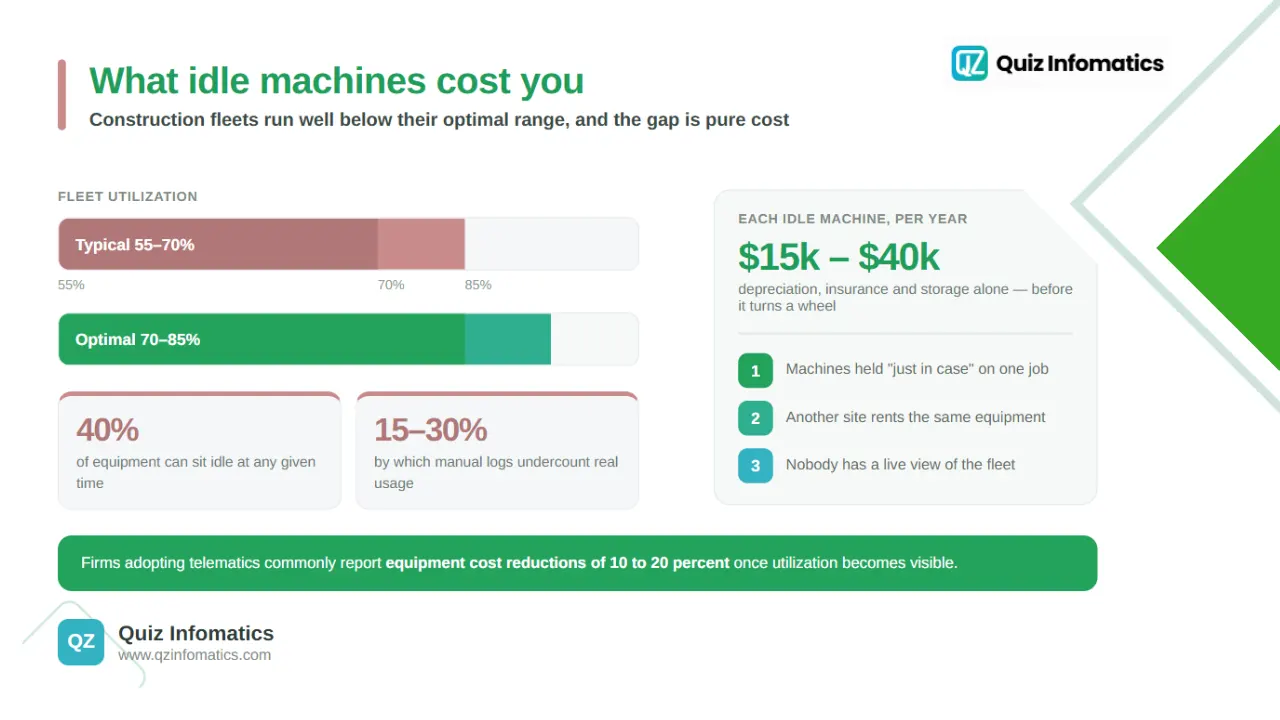
Industry data shows that construction fleets average only 55 to 70 percent utilization against an optimal range of 70 to 85 percent, meaning up to 40 percent of equipment can sit idle at any given time, with each idle machine costing an estimated 15,000 to 40,000 US dollars a year in depreciation, insurance, and storage alone. On a fleet of any size, that is a fortune in assets producing no revenue.
The reason is usually poor visibility. Machines get held on one project "just in case" while another job rents the same equipment, because nobody has a clear, live view of the fleet. Tracking utilization and cost properly is what surfaces this waste, and firms adopting telematics commonly report equipment cost reductions in the region of 10 to 20 percent.
How does plant cost allocation work?
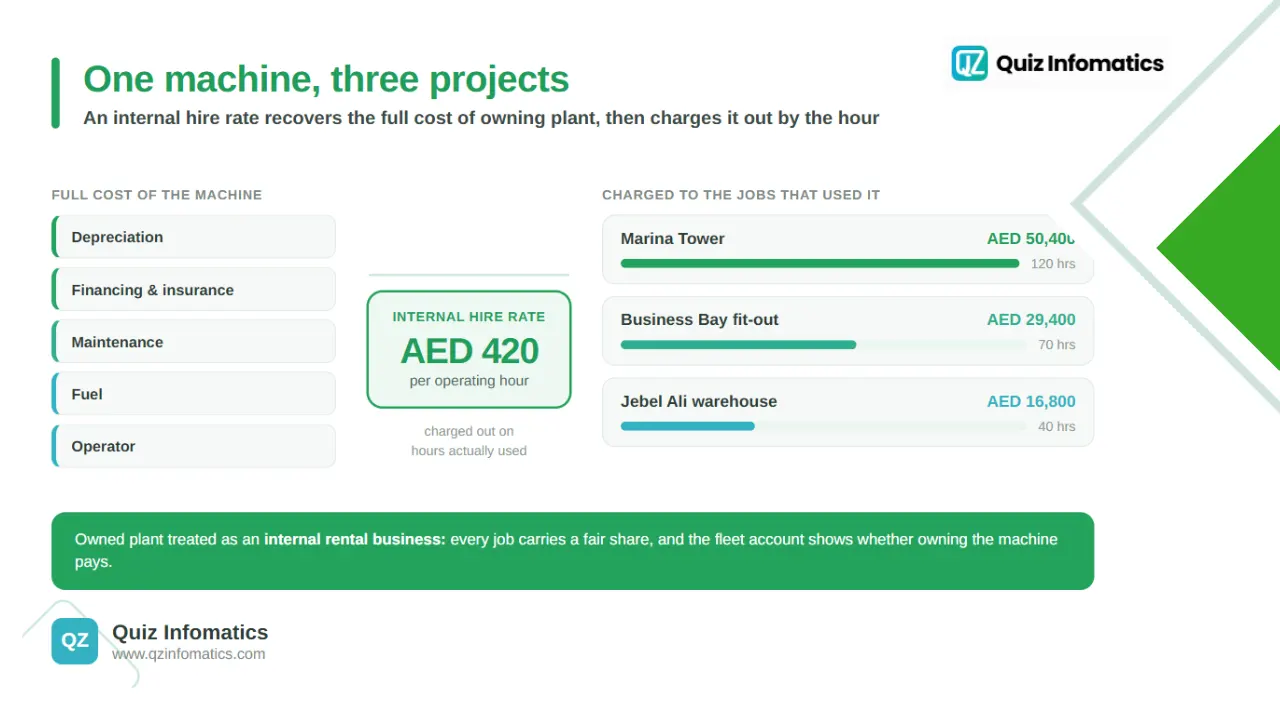
Plant cost allocation works by setting an internal hire rate for each machine that recovers its full cost, then charging that rate to projects based on the hours or days each project uses it. It treats owned plant like an internal rental business.
The internal hire rate, sometimes called a charge-out or plant rate, is calculated to recover the machine's ownership costs (depreciation, financing, insurance) and running costs (fuel, maintenance, operator) across its expected working hours. Each project is then charged for the machine time it consumes at that rate.
Done well, this achieves two things at once. Projects carry a fair share of equipment cost, giving accurate job costs, and the equipment "account" recovers the true cost of owning the fleet, revealing whether owning each machine is actually paying off.
Should you own or rent equipment?
The own-versus-rent decision should be driven by utilization data, because owning only makes sense when a machine is used enough to justify its cost. Good equipment management software is what makes that decision evidence-based.
A high-value machine used at 80 percent utilization pays back far faster than the same machine at 55 percent. When utilization data shows an owned asset is chronically underused, renting on demand may be cheaper; when a rented item is used constantly, buying may make sense.
Without utilization tracking, this decision is guesswork. With it, a contractor can right-size the fleet, sell or redeploy underused assets, and stop renting equipment they already own but cannot locate.
What features should you look for in equipment management software?
The key features to look for are asset tracking, utilization monitoring, cost allocation, maintenance management, and integration with your job costing. As a buyer, this is your evaluation checklist.
Prioritise these capabilities:
Asset register. A complete, live inventory of every machine, with its details and status.
Utilization tracking. Actual usage against available hours, ideally from telematics rather than manual logs.
Internal hire rates and cost allocation. The ability to charge machine time to projects at a proper rate.
Preventive maintenance. Scheduling and alerts based on hours or usage to avoid breakdowns.
Telematics and GPS integration. Real-time location, engine hours, and fuel data from the equipment.
Fuel tracking. Monitoring consumption and idling to control a major running cost.
Depreciation. Tracking asset value over time for finance and own-versus-rent decisions.
Job costing and ERP integration. Feeding equipment costs straight into project accounts.
Reporting and analytics. Clear dashboards on utilization, cost, and maintenance.
The single most important criterion is integration. A tool that tracks equipment beautifully but cannot push its costs into your job costing leaves the hardest problem, accurate project profitability, only half solved.
Telematics and IoT: real-time equipment data
Telematics and the Internet of Things (IoT) transform equipment management by streaming live data from machines, engine hours, location, fuel, and fault codes, directly into the software. This replaces guesswork and manual logging with hard data.
The difference is significant. Manual utilization logs typically undercount real usage by 15 to 30 percent compared with automated telematics, and they cannot provide the real-time location and fault alerts that prevent downtime and theft. Telematics turns every machine into a live data source.
Connecting that equipment data with the rest of your operations is exactly what platforms like CitrIoT are built for, and our IoT services help contractors turn telematics into real operational and cost insight. This is where equipment management stops being a spreadsheet exercise and becomes real-time control.
Equipment costs, job costing, and profitability
Equipment costs only deliver value when they flow into job costing and reveal true project profitability. This is the payoff of the whole exercise.
When allocated plant costs feed into a project's accounts, they become part of the WIP report and percentage-of-completion revenue recognition, giving an accurate picture of each job's real margin. A project that ignores its equipment cost will overstate its profit until the truth catches up.
This is why leading contractors treat equipment cost allocation as part of their core financial control, not a separate operational task. Accurate plant costing is what makes job costing, and therefore profitability, trustworthy.
Standalone tool or construction ERP?
The big buying decision is whether to choose a standalone equipment tool or manage plant inside a construction ERP, and for most contractors, integration wins. A connected system avoids the data silos that undermine accurate costing.
A standalone equipment app can track and locate machines well, but if it does not connect to your job costing, budgets, and billing, someone still has to move the numbers across by hand. A construction ERP handles equipment cost allocation as part of one connected system, so plant costs flow automatically into job costs, budgets, and profitability.
This is central to modern contractor accounting software. Platforms such as Odoo, configured for construction, can bring equipment, job costing, and cost control together, and a well-run ERP implementation is what makes that integration reliable.
How to choose the right software
Choose equipment management software by matching its features to your fleet size, your costing needs, and how well it integrates with the rest of your business. A structured evaluation avoids an expensive mismatch.
Practical steps include: assess your fleet and how equipment cost currently reaches your job costs; decide whether you need heavy telematics or mainly cost allocation; confirm the tool integrates with your accounting or ERP; check it handles internal hire rates and maintenance; and test it against a real project before committing. The right choice depends on whether you want a point solution or connected control across your whole business.
Let’s talk about your business
Start with a free 30-minute call. We’ll ask the right questions, listen carefully, and give you an honest view of what’s possible.
Plant and equipment management in the UAE
In the UAE, plant and equipment management is especially important given the scale of local fleets, harsh operating conditions, and intense cost pressure. Contractors here run large, valuable fleets across multiple sites.
The region's climate accelerates wear and makes preventive maintenance critical, while the scale of projects means significant capital tied up in plant. Accurate utilization tracking and cost allocation help UAE contractors control that investment, reduce idle waste, and cost their jobs correctly.
For UAE contractors, connecting equipment management to job costing and the wider business is a genuine advantage. If you want the wider context on the systems behind this, our plain-English guide to what an ERP system is sets the foundation.
How QZ Infomatics helps contractors
Controlling equipment cost comes down to tracking utilization and allocating that cost accurately to every job, in one connected system. That connection is what turns expensive assets into managed, costed resources.
A practical step is to bring equipment tracking, internal hire rates, maintenance, and telematics together with your job costing and budgets, so plant cost lands on the right projects automatically and idle waste becomes visible. This turns fleet management from a blind spot into a source of real savings.
If you would like help with that, our construction ERP software for UAE contractors brings equipment cost allocation, BOQ, cost control, budgeting, subcontractor management, and billing into one platform, built for how contracting businesses actually work.
Plant and equipment cost allocation, in a nutshell
To recap the essentials:
Plant and equipment cost allocation charges the true cost of owned machines, ownership, running, and operator costs, to the projects that use them.
Construction equipment management software tracks assets, utilization, maintenance, and cost, and allocates that cost to jobs.
Fleet management and telematics add real-time location and usage data, replacing manual logs that undercount usage.
It matters because up to 40 percent of construction equipment can sit idle, each idle machine costing tens of thousands a year.
Integration wins: managing plant inside a construction ERP flows equipment cost straight into job costing and true profitability.
Plant and equipment is too expensive to manage by guesswork. Tracking utilization, allocating cost accurately, and connecting it to job costing, ideally in one system, is one of the clearest ways for a contractor to protect margins and stop assets sitting idle.
Frequently asked questions
What is construction equipment management software? It is software that tracks a contractor's plant and equipment, including location, usage, maintenance, and cost, and allocates that cost to the right projects, giving control over expensive assets and accurate job costs.
What is the difference between equipment and fleet management software? Equipment management often emphasises costing, maintenance, and allocation, while fleet management emphasises real-time GPS and telematics tracking of vehicles and mobile plant. Many modern platforms combine both.
What is construction job costing? Construction job costing assigns all of a project's costs, labour, materials, subcontractors, and plant, to that specific job so you know its true profitability. Plant cost is a major and often mishandled part of it.
How is plant cost allocated to projects? By setting an internal hire rate for each machine that recovers its full ownership and running costs, then charging projects for the machine hours or days they use at that rate.
How much does idle equipment cost? Construction fleets average only 55 to 70 percent utilization, and each idle machine can cost an estimated 15,000 to 40,000 US dollars a year in depreciation, insurance, and storage, even when it is not running.
Do I need telematics? Telematics greatly improves accuracy, streaming real usage, location, and fuel data directly from machines. Manual logs typically undercount usage by 15 to 30 percent, so telematics is strongly recommended for larger fleets.
Should I own or rent equipment? It depends on utilization. A machine used enough justifies ownership, while a chronically underused one may be cheaper to rent. Utilization data from equipment software makes this an evidence-based decision.
Should equipment management be part of a construction ERP? For most contractors, yes. Managing plant inside a construction ERP flows equipment costs automatically into job costing, budgets, and profitability, avoiding the data silos of standalone tools.
What is an internal hire rate? An internal hire rate, also called a charge-out or plant rate, is the rate a contractor charges its own projects for using an owned machine. It is set to recover the machine's full ownership and running costs across its working hours.
About the author
QZ Infomatics Construction Technology Team - QZ Infomatics is a Dubai-based ERP and IT consultancy (Business Bay) that implements construction and contracting software across the UAE and GCC. The team helps contractors track equipment utilization, allocate plant cost to jobs, and connect telematics to job costing in one connected system, drawing on hands-on experience with construction ERP and IoT for UAE projects. This guide reflects that practical experience helping contracting businesses control their fleets and their margins.
Not sure which projects your plant costs really belong to? See our construction ERP for UAE contractors.