
Digital Transformation
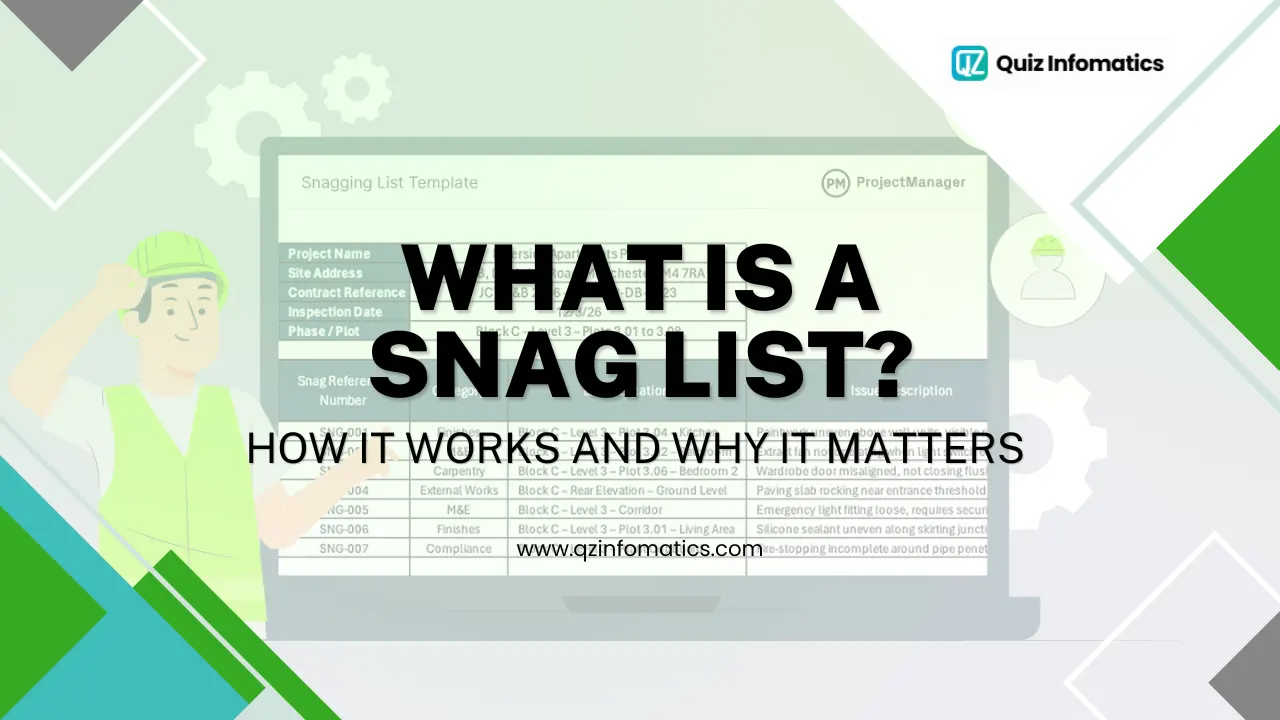
What Is a Snag List?
Last updated: July 2026 · By the QZ Infomatics Construction Technology Team
A building can look finished and still be full of small problems: a door that sticks, a chipped tile, a socket that does not work, a paint run on a wall. Finding and fixing all of those before handover is the job of the snag list. It is one of the last, and most important, quality steps on any construction project. This guide explains what a snag list is, how snagging works, what belongs on the list, and how it differs from a variation order, with a clear focus on construction in the UAE.
What is a snag list?
A snag list is a document that records all the defects, unfinished items, and work that does not meet the required standard on a construction project, so they can be fixed before the project is handed over. It is the punch list of things still to put right.
The word "snag" simply means a small defect or problem. A snag list, sometimes called a punch list, defects list, or deficiency list, gathers all of these into one place near the end of a project.
Its purpose is quality control at handover. Before a client accepts a building and makes final payment, the snag list ensures every outstanding issue has been identified, assigned, fixed, and signed off.
What is snagging?
Snagging is the process of inspecting a completed or near-complete building to identify defects and unfinished work, which are then recorded on the snag list. If the snag list is the document, snagging is the activity that produces it.
Snagging usually involves walking through the property room by room, systematically checking finishes, fittings, and functions against the specification and drawings. Every issue found is logged, often with a photo and a precise location.
In the UAE, snagging is a well-established part of both large construction projects and residential property handovers. Off-plan buyers frequently commission professional snagging inspections before they accept an apartment or villa, which is why "snagging" is such a widely searched term locally.
What goes on a snag list?
A snag list records each defect with enough detail for someone to find it and fix it, typically including the location, a description, a photo, the responsible party, and a status. Clarity is what makes it useful.
A well-structured snag list item usually includes:
Location. The exact room, area, or grid reference where the defect is.
Description. A clear explanation of what is wrong, such as "chipped tile" or "door does not close."
Photo. A picture that removes any ambiguity about the issue.
Category. Whether it is cosmetic, functional, or safety-related.
Responsible party. The subcontractor or trade accountable for fixing it.
Status. Open, in progress, fixed, or closed, with dates.
The more specific each item is, the faster it gets resolved. Vague entries like "bathroom needs work" waste time and cause disputes, while precise, photographed items get fixed cleanly.
What are the types of snags?
Snags generally fall into three categories: cosmetic, functional, and safety-related, and a good snagging inspection covers all three. Each affects the handover differently.
Cosmetic snags. Visual defects such as paint runs, scratches, chips, uneven finishes, or poor sealant work. They do not stop the building working but affect quality and client satisfaction.
Functional snags. Things that do not work as they should, such as a leaking tap, a faulty socket, a door that will not close, or air conditioning that underperforms.
Safety-related snags. Defects that pose a hazard, such as a loose balustrade, exposed wiring, a trip hazard, or a missing smoke detector.
Safety-related snags matter most, because they connect quality directly to construction safety. A building should never be handed over with hazards outstanding, which is why safety defects are prioritised and often tie back to the project's wider safe-working documentation, including its method statements.
A snag list example
To make it concrete, imagine a few rows from the snag list for a newly built apartment. It shows how specific a good entry should be.
One row might read: location "Master bedroom, north wall"; description "paint run below window, approximately 30cm"; category "cosmetic"; responsible "painting subcontractor"; status "open"; with a photo attached. Another might read: location "Kitchen, under sink"; description "waste pipe connection leaking"; category "functional"; responsible "plumbing subcontractor"; status "open".
A safety row would stand out: location "Balcony"; description "balustrade loose at fixing point"; category "safety"; responsible "steelwork subcontractor"; status "open, priority". Each row tells whoever picks it up exactly what to fix, where, and who owns it. Multiply that across a whole building, and you have a complete, actionable snag list.
How does the snagging process work?
The snagging process runs from inspection to sign-off in a clear sequence: inspect, record, assign, rectify, re-inspect, and close. Following it properly is what turns a list of problems into a clean handover.
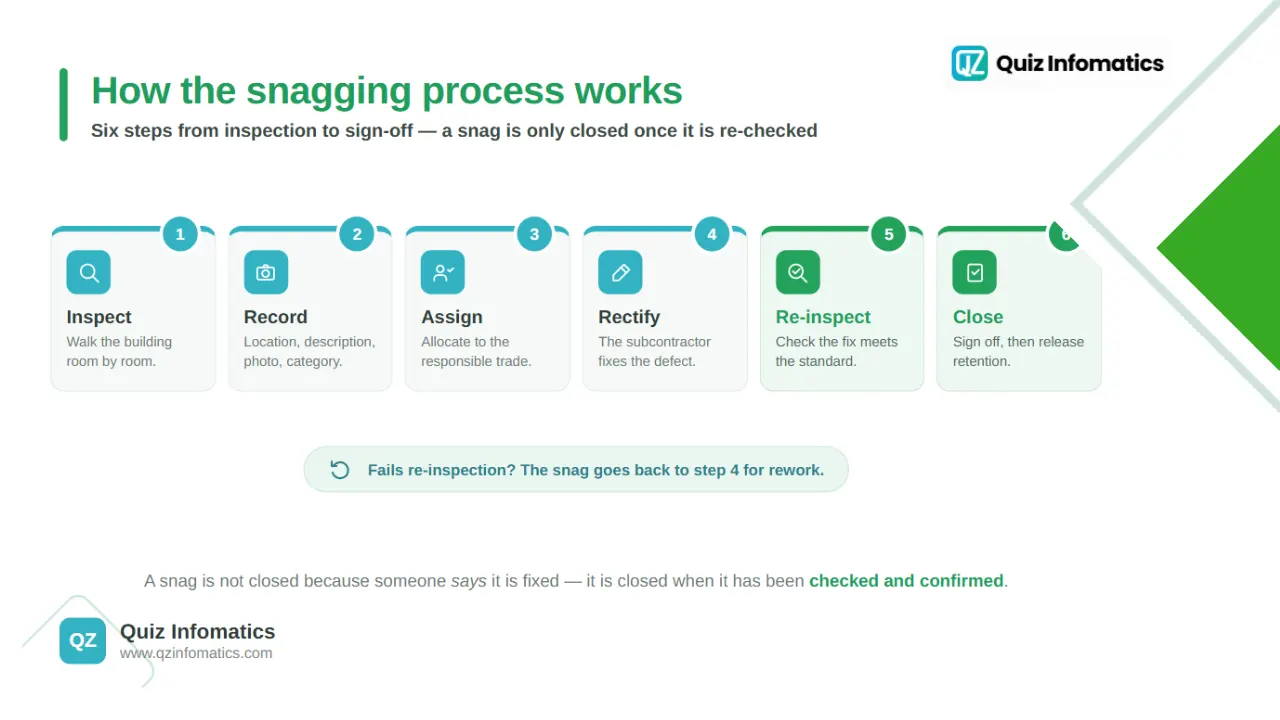
The typical steps are:
Inspect. Walk the building systematically and identify every defect and unfinished item.
Record. Log each snag with location, description, photo, and category on the snag list.
Assign. Allocate each item to the responsible subcontractor or trade.
Rectify. The responsible party fixes the defect.
Re-inspect. Check that each fix is completed to the required standard.
Close. Sign off resolved items, and track anything still outstanding.
The re-inspection step is where many projects slip. A snag is not closed just because someone says it is fixed; it is closed when it has been checked and confirmed. This is why tracking status carefully matters so much.
Who prepares a snag list?
A snag list is usually prepared by the client's side, whether the consultant, project manager, architect, or a professional snagging inspector, and the contractor is responsible for fixing the items. It is a check on the contractor's work.
On large projects, the consultant or project manager conducts the snagging inspection at practical completion and issues the list to the main contractor. The main contractor then coordinates the relevant subcontractors to rectify each item.
In the UAE residential market, independent snagging companies are commonly hired by property buyers to inspect a unit before handover. Either way, the principle is the same: an independent eye identifies the defects, and the party responsible for the work puts them right.
When does snagging happen?
Snagging happens near the end of a project, mainly at practical completion before handover, and again during the defects liability period that follows. There are usually two key moments.
The first is at practical completion, when the building is essentially finished. The pre-handover snag list must be cleared, or substantially cleared, before the client accepts the building and it is put into use.
The second is during the defects liability period (DLP), a set time after handover, often 12 months, during which the contractor remains responsible for fixing defects that appear. Snags raised during the DLP are logged and rectified in the same way, protecting the client after they have moved in.
Snag list vs variation order: what's the difference?
The difference is fundamental: a snag is defective or incomplete work the contractor must fix at their own cost, while a variation order is a client-requested change to the scope that the contractor is paid to carry out. Confusing the two causes real disputes.
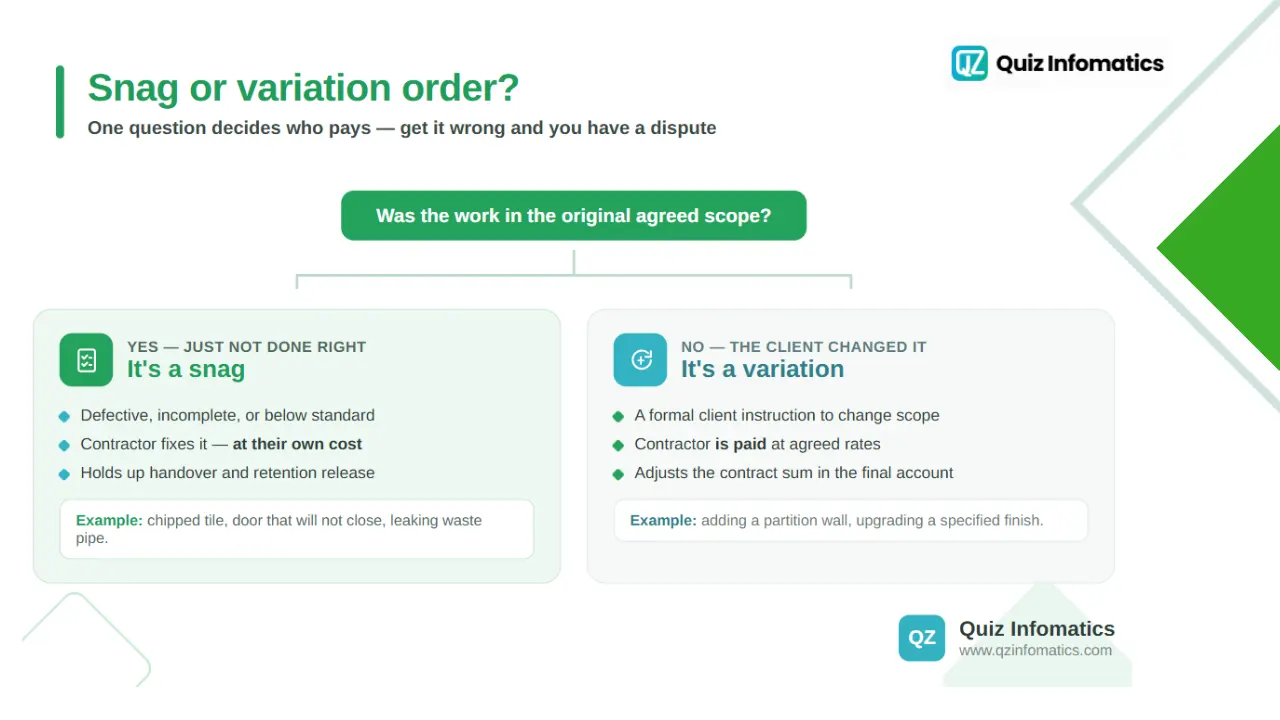
A snag is the contractor's responsibility because the work was not done correctly or completely in the first place. Fixing a chipped tile or a door that will not close is not extra work; it is finishing the job to the agreed standard, at no additional charge.
A variation order (also called a change order) is different. It is a formal instruction from the client to change the scope, such as adding a partition wall or upgrading a finish. Because it changes what was agreed, the contractor is entitled to be paid for it, usually priced against agreed rates.
The distinction matters commercially. Recategorising a defect as a variation, or vice versa, directly affects who pays. This is exactly the kind of judgement the quantity surveyor manages, keeping snags and variations properly separated in the final account.
Snag lists, retention, and payment
Snag lists are closely tied to money, because retention and final payment usually depend on defects being cleared. This is what gives the snag list its commercial weight.
On most construction contracts, the client holds back a percentage of the contract value as retention, released only once the work is complete and defects are rectified. An outstanding snag list can therefore delay the release of significant sums to the contractor.
Clearing snags promptly is not just about quality; it directly affects cash flow. A contractor who de-snags efficiently gets paid faster, while one who lets snags drag on ties up their own money and strains the client relationship.
Why do snag lists matter?
Snag lists matter because unresolved defects cost money, delay handover, and damage reputations, and rework is a large hidden cost in construction. The financial stakes are higher than they first appear.
Industry research shows that rework typically accounts for somewhere between about 4 and 10 percent of total project cost, with poor communication and quality issues among the leading causes. Every snag left to the last minute, or missed entirely, feeds into that figure.
Beyond the direct cost, unresolved snags carry other consequences: delayed handover and retention, disputes between client and contractor, safety risks if hazards are missed, and reputational damage that affects future work. A rigorous snagging process is a cheap insurance policy against all of these.
Done well, snagging protects everyone. The client gets a building that meets the standard they paid for, and the contractor gets a clean handover, faster payment, and a satisfied client who may return.
Common snagging mistakes to avoid
The most common snagging mistakes are vague entries, poor tracking, and leaving snagging too late. Each undermines an otherwise good process.
Watch out for these pitfalls:
Vague descriptions. "Fix the kitchen" is not actionable; "replace chipped worktop near the sink" is.
No photos. A picture prevents arguments about what the defect actually was.
Poor tracking. Losing sight of which snags are open, assigned, or closed leads to items slipping through.
Leaving it too late. Snagging only at the very end concentrates a huge volume of fixes into a rushed period.
No re-inspection. Marking items closed without checking them means defects reappear at handover.
Avoiding these comes down to being specific, keeping clear records, and treating snagging as an ongoing discipline rather than a last-minute scramble.
Managing snag lists digitally
The most efficient way to manage snagging today is with digital tools that capture defects with photos, assign them to subcontractors, and track them to closure. Paper lists and spreadsheets simply cannot keep up on a busy project.
Modern snagging is typically done on a tablet or phone, capturing the defect, its location, and a photo on the spot, then assigning it instantly to the responsible trade. Everyone sees live status, so nothing gets lost between inspection and rectification.
This connects directly to how a contractor manages subcontractors and payments. When snags are tracked in the same system as subcontractor management, the main contractor can hold each trade accountable for their defects and tie rectification to their payments and retention.
Let’s talk about your business
Start with a free 30-minute call. We’ll ask the right questions, listen carefully, and give you an honest view of what’s possible.
Snag lists in the UAE
In the UAE, snagging is a standard and expected part of both commercial construction and residential handover, reflecting the market's focus on quality. It is deeply embedded in how projects close out here.
On large UAE projects, consultants and project managers run formal snagging at practical completion, and retention and defects liability periods are written into contracts. In the residential market, professional snagging inspections before off-plan handover have become common practice for buyers protecting a major purchase.
For UAE contractors, managing snagging efficiently across multiple subcontractors is essential to closing projects cleanly and getting paid. If you want the wider context on the systems behind this, our plain-English guide to what an ERP system is sets the foundation.
How QZ Infomatics helps contractors
Clearing snags cleanly is part of a bigger goal: running a construction project where quality, subcontractors, and payments are all under control. That control is what protects both the handover and the margin.
A practical step is to manage snagging, subcontractor rectification, and retention in the same system as your BOQ, budget, and progress billing, so quality and commercial control live together rather than in separate silos. This turns de-snagging from a chaotic scramble into a tracked, accountable process tied directly to payment.
If you would like help with that, our construction ERP software for UAE contractors brings subcontractor management, BOQ, cost control, budgeting, and progress billing into one platform, built for how contracting businesses actually work.
Snag lists, in a nutshell
To recap the essentials:
A snag list records the defects and unfinished items on a project that must be fixed before handover, also known as a punch list.
Snagging is the inspection process that identifies these defects, done at practical completion and during the defects liability period.
Snags fall into cosmetic, functional, and safety-related categories, with safety defects taking priority.
A snag differs from a variation order: a snag is defective work the contractor fixes at their own cost, while a variation is paid, client-instructed change.
Snagging is tied to money, because retention and final payment usually depend on defects being cleared.
A snag list is not just a punch list of minor complaints. It is the final quality gate that protects the client, the contractor, and the reputation of the whole project, which is exactly why doing it well matters so much.
Frequently asked questions
What is a snag list in construction? A snag list is a document that records all the defects, unfinished items, and substandard work on a construction project, so they can be fixed before the project is handed over to the client.
What is snagging? Snagging is the process of inspecting a completed or near-complete building to identify defects and unfinished work, which are then recorded on the snag list for rectification.
What is the difference between a snag list and a punch list? They are the same thing. "Snag list" is common in the UK, UAE, and many other markets, while "punch list" is the American term for the same document.
What is the difference between a snag and a variation order? A snag is defective or incomplete work the contractor must fix at their own cost. A variation order is a client-requested change to the scope that the contractor is paid to carry out.
Who prepares a snag list? Usually the client's side, such as the consultant, project manager, architect, or a professional snagging inspector, prepares the list, and the contractor is responsible for fixing the items.
When does snagging take place? Snagging happens near the end of a project, mainly at practical completion before handover, and again during the defects liability period that follows handover.
Does a snag list affect payment? Yes. Retention and final payment usually depend on defects being cleared, so an outstanding snag list can delay the release of money to the contractor.
Can snagging be managed with software? Yes. Digital snagging tools capture defects with photos, assign them to subcontractors, and track them to closure, which is far more reliable than paper lists or spreadsheets on a busy project.
About the author
QZ Infomatics Construction Technology Team - QZ Infomatics is a Dubai-based ERP and IT consultancy (Business Bay) that implements construction and contracting software across the UAE and GCC. The team helps contractors manage snagging, subcontractor accounts, BOQ, cost control, and progress billing in one connected system, drawing on hands-on experience with construction ERP for UAE projects. This guide reflects that practical experience helping contracting businesses deliver quality and control their work.
Struggling to track snags and subcontractor rectification across projects? See our construction ERP for UAE contractors.