
Digital Transformation
The Role of a Quantity Surveyor
Last updated: July 2026 · By the QZ Infomatics Construction Technology Team
Behind every construction project that finishes on budget is someone who measured, priced, and controlled the money at every stage. That person is the quantity surveyor. Often working quietly away from the site itself, the quantity surveyor is the financial backbone of a build. This guide explains what a quantity surveyor does, the responsibilities that define the role, and why cost control is at the centre of everything they do, especially in the UAE's demanding construction market.
What is a quantity surveyor?
A quantity surveyor (QS) is a construction professional responsible for managing all the costs and financial aspects of a building project, from the first estimate to the final account. In simple terms, they make sure a project is priced accurately and stays financially under control.
If an architect designs the building and an engineer makes it stand up, the quantity surveyor makes sure it can be built for the right price and does not run away with the budget. They are the money experts of the construction team.
The role blends measurement, cost planning, contracts, and commercial management. A good quantity surveyor protects both the client's budget and the contractor's margin, which is why the role is so valued.
What does a quantity surveyor do?
A quantity surveyor measures construction work, prices it, and controls the project's costs throughout its lifecycle. Their job spans the entire project, not just one phase.
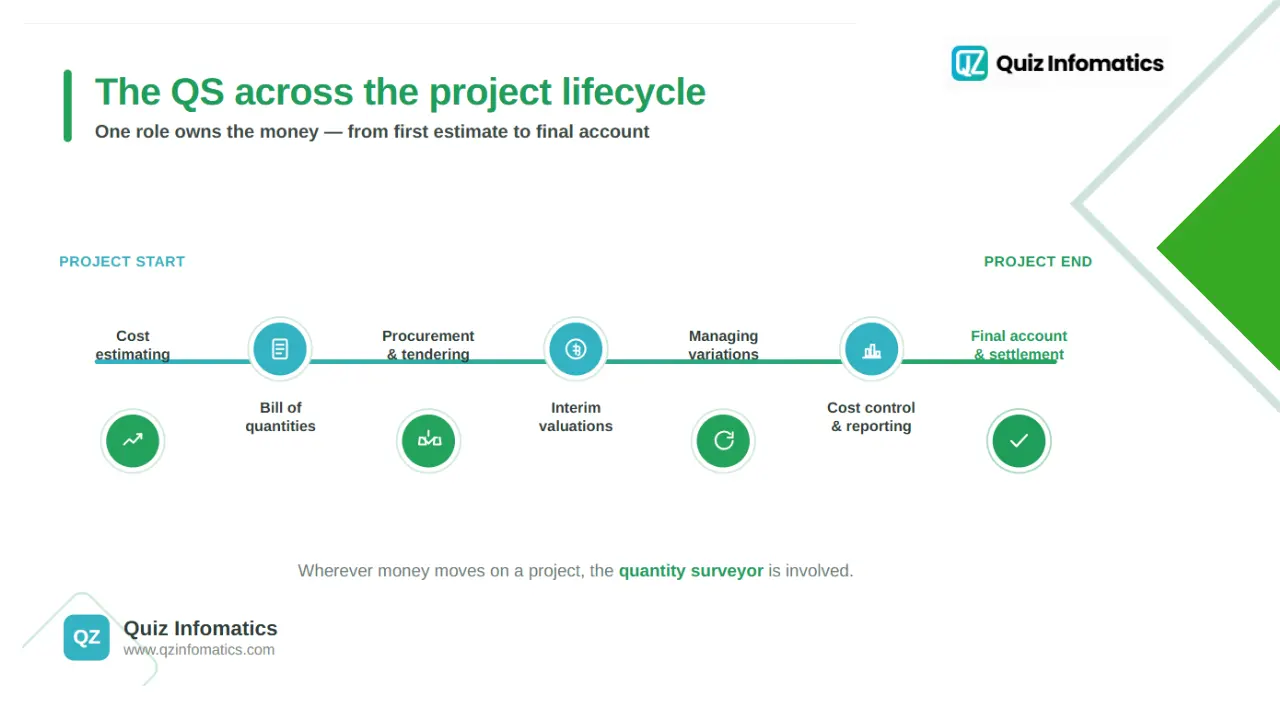
At the start, they estimate costs and help set the budget. During tendering, they prepare and evaluate pricing documents. Through construction, they value completed work, price changes, and track spending against the budget. At the end, they settle the final account.
In short, wherever money moves on a project, the quantity surveyor is involved. This continuous financial oversight is what keeps a build commercially healthy from beginning to end.
The key responsibilities of a quantity surveyor
The core responsibilities of a quantity surveyor cover cost estimating, measurement, procurement, valuation, and cost control across the whole project. Each one plays a part in keeping the project on budget.
Here are the main duties that define the role.
Cost estimating and planning
Early in a project, the quantity surveyor prepares cost estimates and budgets before detailed design is complete. These early numbers guide critical decisions about scope, materials, and feasibility.
Accurate early estimating sets the financial tone for the whole project. Get it wrong here, and every later stage inherits the error.
Preparing the bill of quantities
The quantity surveyor measures the work from drawings and specifications to produce the bill of quantities, the itemised document contractors use to price the job. This "taking off" of quantities is one of their most technical tasks.
The bill of quantities is central to fair tendering, because it lets every contractor price identical quantities on the same basis. It also becomes the reference point for payments and variations later on.
Procurement and tendering
Quantity surveyors advise on how to procure the work and manage the tender process. They help select the right contract, issue pricing documents, and evaluate the bids that come back.
Their analysis ensures the client compares tenders fairly and chooses value, not just the lowest headline number. This protects the project from underpriced bids that lead to problems later.
Valuations and interim payments
As construction progresses, the quantity surveyor values the work completed each month so contractors are paid fairly and on time. These interim valuations tie payment directly to actual progress on site.
Getting valuations right keeps cash flowing to contractors while protecting the client from overpaying. It is one of the most regular and important tasks in the role.
Managing variations
When the design changes, as it almost always does, the quantity surveyor prices the variation using agreed rates. This keeps changes fair and transparent rather than a source of dispute.
Well-managed variations prevent the slow, uncontrolled cost creep that quietly wrecks project budgets.
Cost control and reporting
Throughout the build, the quantity surveyor tracks actual spending against the budget and reports on the project's financial health. This ongoing cost control is arguably the heart of the role.
By spotting overspends early, the QS gives the project team time to act before small problems become expensive ones. Regular cost reporting keeps everyone, from site managers to the board, informed.
Final account and settlement
At the end of a project, the quantity surveyor agrees the final account, reconciling everything that was built against everything that was paid. This closes the project financially and settles any outstanding amounts.
A clean, well-managed final account reflects a project that was controlled properly from the start.
Why cost control is at the heart of the role
Cost control is the single most important thing a quantity surveyor does, because construction is notorious for going over budget. The numbers make the case starkly.
Across the industry, research by Bent Flyvbjerg found that around 90 percent of large construction projects go over budget, with an average overrun of about 28 percent, while McKinsey has estimated that global construction inefficiencies cost roughly 1.6 trillion US dollars a year. These are not rare disasters; they are the norm the quantity surveyor exists to prevent.
Effective cost control means tracking committed and actual costs against the budget continuously, forecasting the final cost, and flagging risks early enough to act. The quantity surveyor does this by connecting measurement, valuations, and reporting into a single, honest picture of where the money is going.
The best cost control is proactive, not reactive. Rather than explaining an overspend after it happens, a strong QS sees it coming and helps the team steer around it. This is where modern tools have transformed the role, replacing month-old spreadsheets with live data.
Key cost-control techniques a quantity surveyor uses
A quantity surveyor controls project costs using a set of proven techniques that turn budgets into live, managed numbers rather than static targets. These are the practical methods behind good cost control.
The main techniques include:
Cost planning. Setting and refining a budget early, broken down by element, so there is a clear benchmark to measure against.
Committed cost tracking. Recording costs the moment they are committed through orders and subcontracts, not just when invoices arrive, so nothing is a surprise.
Cost value reconciliation (CVR). Regularly comparing the value of work done against its actual cost to reveal the true profit or loss on a project.
Cost forecasting. Projecting the final cost from current data, so the team can act on where the project is heading, not just where it has been.
Change and risk management. Pricing variations promptly and keeping a contingency for identified risks.
The common thread is timeliness. Cost control only works when the data is current, which is exactly why quantity surveyors increasingly rely on integrated software rather than spreadsheets updated once a month.
Types of quantity surveyor
There are two main types of quantity surveyor, defined by which side of the project they work on: the client's side and the contractor's side. Both do similar technical work but with different goals.
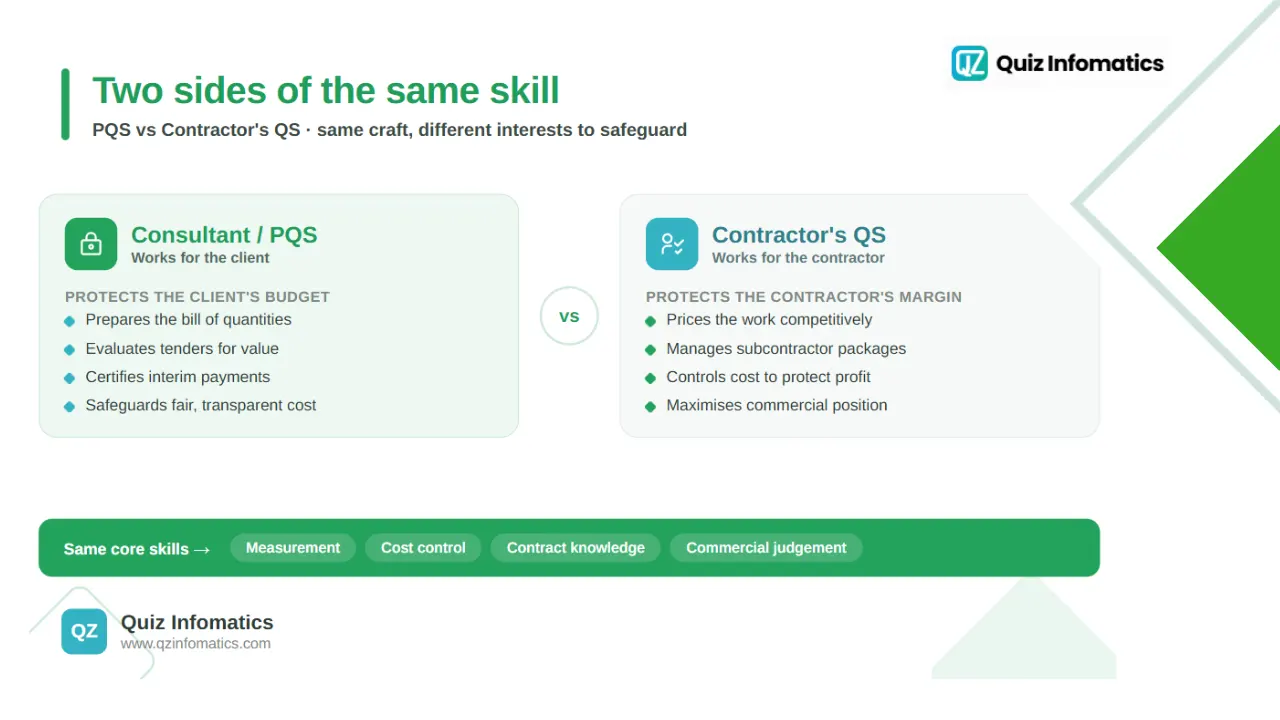
Consultant or PQS (Professional Quantity Surveyor). Works for the client, focusing on protecting the client's budget, preparing the bill of quantities, evaluating tenders, and certifying payments.
Contractor's QS or commercial manager. Works for the contractor, focusing on maximising the contractor's commercial position, pricing work, managing subcontractors, and controlling costs to protect margin.
Both roles rely on the same core skills of measurement, cost control, and contract knowledge. The difference is whose interests they are safeguarding. On large projects, QSs from both sides negotiate valuations and final accounts together.
The quantity surveyor and subcontractor management
A major part of a contractor's quantity surveyor role is managing subcontractor costs, which often make up the bulk of project spend. Keeping these under control is essential to profitability.
This involves splitting the work into subcontractor packages, agreeing rates, valuing subcontractor work, and reconciling it against the main contract. When subcontractor accounts drift out of control, project margins disappear quickly.
Doing this across disconnected spreadsheets is slow and error-prone. Integrated construction cost control and subcontractor management software lets a QS track every package against the budget in real time, which is increasingly how modern contracting businesses operate.
Skills and qualifications of a quantity surveyor
A quantity surveyor needs strong numeracy, measurement skills, contract knowledge, and commercial awareness, usually backed by a relevant degree and professional accreditation. The role blends technical precision with commercial judgement.
Key skills include:
Measurement and numeracy. Accurate take-off and cost calculation are fundamental.
Contract knowledge. Understanding construction contracts, including FIDIC forms common in the UAE, is essential.
Commercial awareness. Knowing how to protect a budget or a margin under real-world pressure.
Attention to detail. Small errors in measurement or valuation can have large financial consequences.
Communication. Negotiating valuations and explaining costs clearly to non-financial stakeholders.
Many quantity surveyors hold a degree in quantity surveying or construction and work toward professional accreditation, such as membership of the Royal Institution of Chartered Surveyors (RICS). In the UAE, RICS-accredited QSs are in strong demand.
Quantity surveyor vs estimator vs project manager
A quantity surveyor is sometimes confused with an estimator or a project manager, but the roles are distinct. Understanding the difference clarifies what a QS actually does.
An estimator focuses mainly on pricing work at the tender stage. A quantity surveyor does that too, but continues through the whole project, managing valuations, variations, and the final account. A project manager, by contrast, focuses on delivering the project on time and to scope, coordinating people and programme rather than owning the numbers.
Put simply, the project manager runs the build, the estimator prices it at the start, and the quantity surveyor owns the money from beginning to end. On many projects the QS and PM work side by side, with the QS handling cost and the PM handling delivery.
Let’s talk about your business
Start with a free 30-minute call. We’ll ask the right questions, listen carefully, and give you an honest view of what’s possible.
How the quantity surveyor role is changing
The quantity surveyor role is shifting from manual measurement and spreadsheets toward digital tools, live data, and construction software. Technology is changing how the job is done, not what it is for.
Traditionally, a QS spent hours on manual take-off and updated cost reports that were out of date the moment they were finished. Today, digital measurement, BIM, and construction ERP systems automate much of the routine work and give the QS real-time cost visibility instead of monthly snapshots.
This lets quantity surveyors spend less time compiling numbers and more time on analysis, forecasting, and advice. Tools that turn project data into clear insight, such as those explored in our piece on turning business data into smarter decisions, are becoming central to the modern QS toolkit. The role is becoming more strategic, not less important.
Programme and cost are also increasingly managed together. While tools like Gantt charts in construction handle the schedule, integrated cost systems handle the money, giving the QS and the wider team a unified view of time and cost.
The quantity surveyor in the UAE
In the UAE, quantity surveyors are in high demand, driven by the scale and value of construction across the region. The role is well established and highly regarded here.
The UAE's construction market is defined by large, complex projects, FIDIC-based contracts, and tight commercial pressure, all of which depend on skilled quantity surveyors to keep costs under control. Add VAT, corporate tax, and the sector's rapid move toward digital finance systems, and the QS role has become both more technical and more strategic.
For UAE contractors, pairing strong quantity surveying with the right software is a genuine competitive advantage. If you would like the wider context on the systems behind this, our plain-English guide to what an ERP system is sets the foundation.
How QZ Infomatics supports quantity surveyors and contractors
The most effective quantity surveying today combines professional expertise with software that connects measurement, budgets, subcontractors, and reporting. That combination is what keeps projects profitable.
A practical step is to move cost control, valuations, and subcontractor management off spreadsheets and into a construction-specific system, so the QS works from live data rather than month-old figures. This turns cost control from a backward-looking report into a real-time steering tool.
If you would like help with that, our construction ERP software for UAE contractors brings BOQ, cost control, budgeting, subcontractor management, and progress billing into one platform, built for how contracting businesses actually work.
The quantity surveyor, in a nutshell
To recap the essentials:
A quantity surveyor manages all the costs and financial aspects of a construction project, from first estimate to final account.
Their responsibilities include cost estimating, preparing the bill of quantities, procurement, valuations, variations, and cost control.
Cost control is at the heart of the role, because most large construction projects run over budget without it.
There are two main types, working on the client's side (PQS) or the contractor's side, with subcontractor management a major focus for the latter.
The role is evolving toward digital tools and live data, making software and construction ERP central to the modern QS.
A quantity surveyor is far more than a measurer of quantities. They are the financial guardian of a construction project, and their work is one of the surest ways to protect its budget and its profit.
Frequently asked questions
What is a quantity surveyor? A quantity surveyor is a construction professional who manages the costs and financial aspects of a building project, from initial estimates through to the final account, with cost control at the centre of the role.
What does a quantity surveyor do? A quantity surveyor estimates costs, prepares the bill of quantities, manages tendering, values completed work for payment, prices variations, and controls costs throughout a construction project.
What is the difference between a quantity surveyor and an estimator? An estimator mainly prices work at the tender stage, while a quantity surveyor covers the entire project lifecycle, including valuations, variations, cost control, and the final account.
What qualifications does a quantity surveyor need? Most quantity surveyors hold a degree in quantity surveying or construction and often work toward professional accreditation such as RICS membership, alongside strong numeracy, measurement, and contract skills.
How does a quantity surveyor control costs? A quantity surveyor controls costs by tracking actual and committed spending against the budget, forecasting the final cost, valuing work accurately, and flagging risks early, increasingly using construction software for real-time visibility.
What is the difference between a quantity surveyor and a project manager? A project manager focuses on delivering the project on time and to scope, while a quantity surveyor owns the financial side, managing measurement, costs, and the budget throughout.
Are quantity surveyors in demand in the UAE? Yes. The scale and value of construction in the UAE creates strong demand for skilled quantity surveyors, particularly those with RICS accreditation and experience of FIDIC contracts.
Can quantity surveying be done with software? Yes. Modern construction ERP and cost-control software automate measurement and valuations, connect the budget to actual costs, and give quantity surveyors real-time visibility instead of month-old reports.
About the author
QZ Infomatics Construction Technology Team - QZ Infomatics is a Dubai-based ERP and IT consultancy (Business Bay) that implements construction and contracting software across the UAE and GCC. The team helps contractors and quantity surveyors manage BOQ, cost control, procurement, subcontractor accounts, and progress billing in one connected system, drawing on hands-on experience with construction ERP for UAE projects. This guide reflects that practical experience helping contracting businesses price and control their work.
Want to give your quantity surveyors real-time cost control? See our construction ERP for UAE contractors.