
Digital Transformation
Value Engineering in Construction
Last updated: July 2026 · By the QZ Infomatics Construction Technology Team
When a construction budget comes back higher than expected, the instinct is often to start cutting: cheaper materials, thinner specifications, corners quietly shaved. That approach usually backfires. Value engineering offers a smarter alternative, a structured way to reduce cost without reducing what the building actually needs to do. This guide explains what value engineering is, how the process works, when to use it, and how it fits into cost control and construction contracts, with a clear focus on the UAE.
What is value engineering?
Value engineering (VE) is a systematic method for improving the value of a project by analysing its functions and finding ways to deliver those functions at a lower cost, without sacrificing quality, performance, or safety. It is about achieving the same result for less, or a better result for the same money.
The emphasis on function is what sets value engineering apart. Rather than simply asking "how do we spend less?", it asks "what does this element actually need to do, and what is the most cost-effective way to achieve that?"
This is a crucial distinction. Value engineering is not about making a building cheaper and worse. It is about eliminating unnecessary cost while protecting everything that matters to the project's purpose.
The value equation
Value engineering is built on a simple idea: value equals function divided by cost. Improving value means increasing function, reducing cost, or both, while keeping the required performance intact.
In practice, this means you can raise value in a few ways. You can deliver the same function for a lower cost, achieve better function for the same cost, or occasionally accept a small, acceptable reduction in a non-essential function for a large saving. What you never do is compromise essential function, safety, or code compliance.
That formula keeps the focus where it belongs. Every proposed change is judged not just on how much it saves, but on whether it still delivers what the project genuinely requires.
Value engineering vs cost cutting
The single most important thing to understand is that value engineering is not cost cutting. Cost cutting removes value; value engineering preserves it while removing waste.
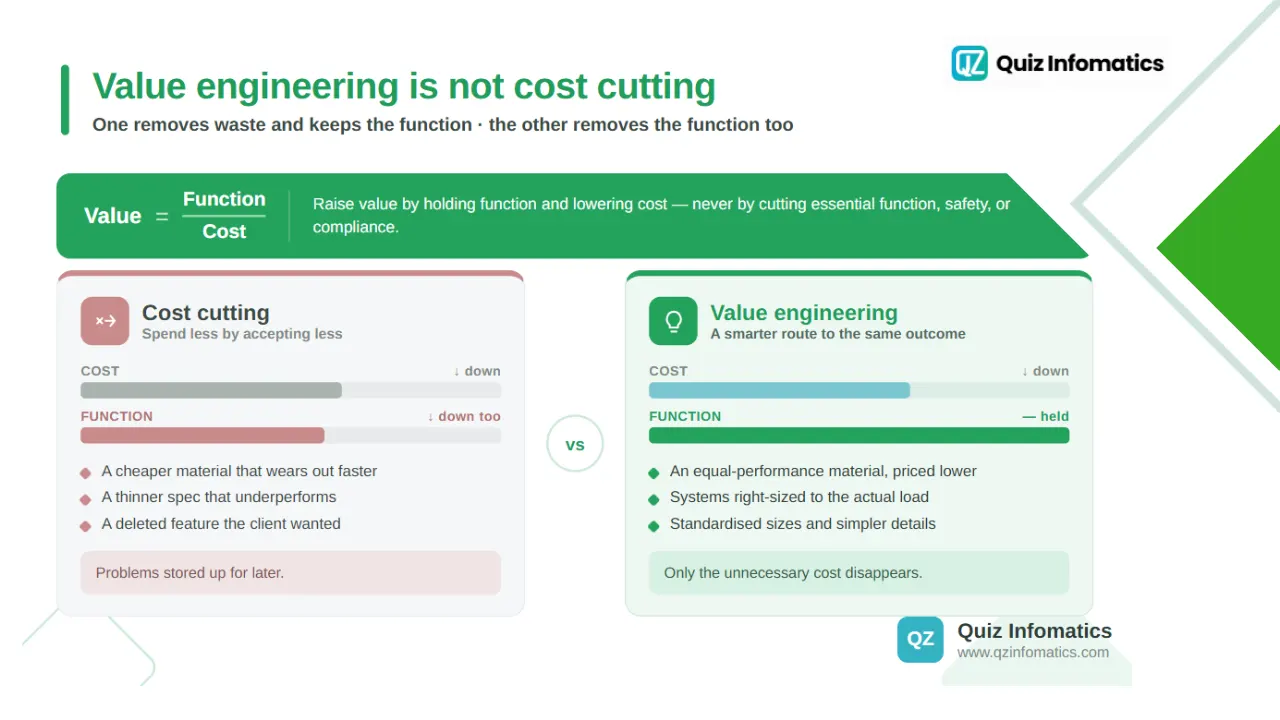
Cost cutting means spending less by accepting less: a cheaper material that wears out faster, a thinner specification that underperforms, a deleted feature the client actually wanted. It reduces cost and function together, often storing up problems for later.
Value engineering is disciplined and function-led. It finds a different way to deliver the same required outcome for less, such as an alternative material with equal performance at a lower price. Done properly, the building performs exactly as intended, and only the unnecessary cost disappears.
Confusing the two is where value engineering gets a bad name. When people say a project was "value engineered" and mean it was cheapened, what actually happened was cost cutting dressed up in the wrong label.
Where did value engineering come from?
Value engineering originated at General Electric during the Second World War, when material shortages forced engineers to find substitutes for scarce components. An engineer named Lawrence Miles noticed something surprising: many of the substitutes performed as well or better, at lower cost.
That insight, that focusing on function rather than the specific material often reveals cheaper and equally effective solutions, became the foundation of value engineering. It has since been formalised and spread across manufacturing, engineering, and construction worldwide.
Today it is a recognised discipline with its own methodology and professional bodies, widely used on major construction projects to control cost while protecting quality.
The value engineering process
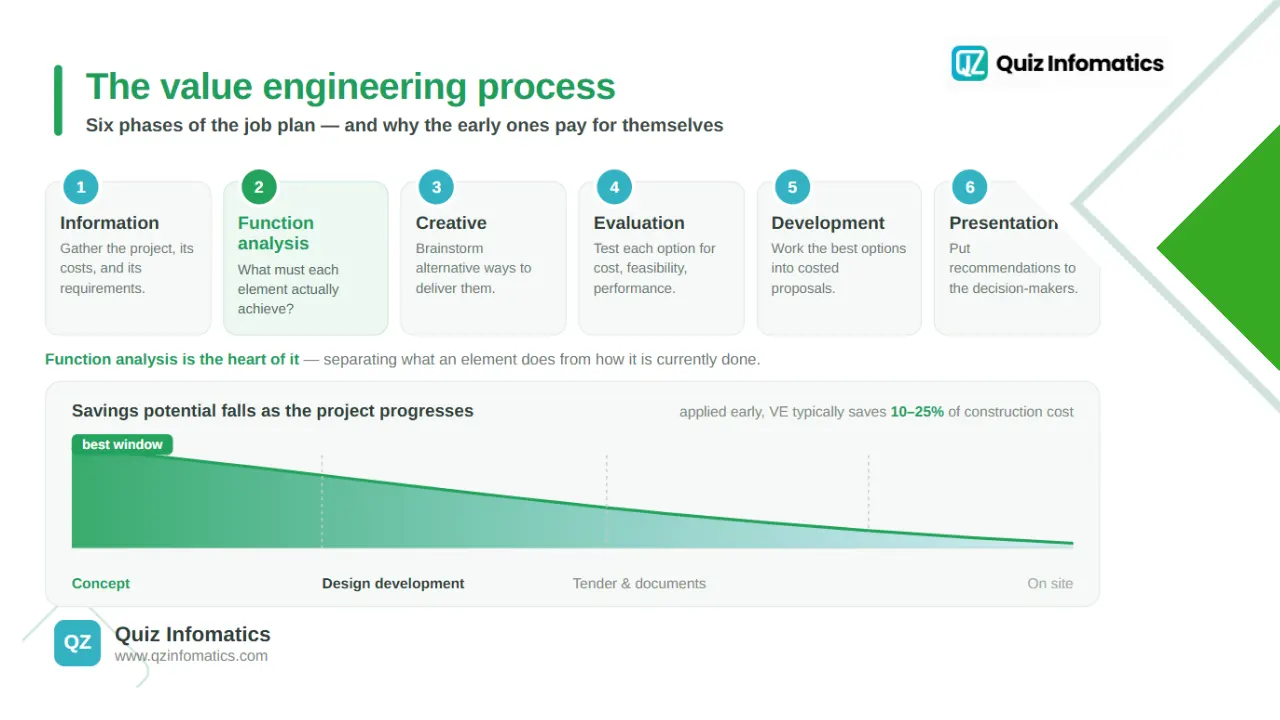
Value engineering follows a structured job plan, typically running through six phases from gathering information to presenting recommendations. The structure is what makes it rigorous rather than a random hunt for savings.
The standard phases are:
Information. Gather full details of the project, its costs, and its requirements.
Function analysis. Break the project into its functions and ask what each element must actually achieve.
Creative (speculation). Brainstorm alternative ways to deliver those functions.
Evaluation. Assess the alternatives for cost, feasibility, and performance.
Development. Work up the best options into detailed proposals with costs and benefits.
Presentation. Present recommendations to decision-makers for approval.
Function analysis is the heart of the process. By separating what an element does from how it is currently done, the team opens up alternatives that would never surface from simply staring at the drawings.
When should value engineering be done?
Value engineering delivers the most value when applied early, during the design development stage, because changes are far cheaper and easier before construction begins. Timing is everything.
Early in design, alternatives can be explored freely and incorporated at little cost. Once detailed construction documents are finalised, permits are issued, and work starts on site, changing course becomes progressively more expensive and disruptive. The window for painless improvement narrows quickly.
The savings potential is significant when the timing is right. Research indicates that effective value engineering typically saves around 10 to 25 percent of total construction cost, depending on the project type and how early it is applied. Applied late, the same exercise yields far less, which is why experienced teams build value engineering into the design phase rather than treating it as a last-minute rescue.
Value engineering examples in construction
Value engineering in construction usually shows up as smarter choices about materials, systems, and methods that cut cost while holding performance. Real examples make the concept concrete.
Common examples include:
Material substitution. Replacing a specified material with an alternative that meets the same performance and appearance at a lower price.
Foundation optimisation. Switching from a deep to a shallow foundation where the ground conditions allow, which can cut foundation cost substantially.
Right-sizing systems. Correctly sizing mechanical, electrical, and plumbing systems rather than overdesigning them.
Standardisation. Using standard component sizes and repeated details to reduce waste and simplify procurement.
Simplifying geometry. Rationalising complex shapes that add cost without adding function.
Prefabrication. Moving work off-site to reduce labour, waste, and programme.
In each case, the required function is preserved. A properly designed shallow foundation performs just as reliably as a deep one where the geotechnical data supports it; the saving comes from removing unnecessary cost, not necessary performance.
A value engineering example in practice
To make it concrete, imagine a mid-rise office project where the specified external cladding is coming in over budget. A cost-cutting response would be to switch to a visibly cheaper, lower-grade panel and accept a worse facade.
A value engineering response is different. The team analyses the function the cladding must perform: weather protection, thermal performance, fire rating, and a certain appearance. They then source an alternative panel that meets every one of those requirements, from a different supplier, at a lower price per square metre. The facade looks and performs as intended, but the cost drops.
The same thinking is applied across the project: right-sizing the air conditioning to the actual load, standardising door and window sizes, and simplifying a complex roof detail. Individually modest, together these preserve the building's function and appearance while removing a meaningful slice of cost. That is value engineering, as opposed to simply buying cheaper.
Value engineering and cost control
Value engineering is a proactive form of cost control, applied at the design stage to shape costs before they are locked in. It complements the ongoing cost control that continues throughout construction.
Where day-to-day cost control tracks and manages spending as work proceeds, value engineering intervenes earlier, changing the design and specification so the costs being tracked are lower in the first place. The two work together across the project lifecycle.
This is squarely the territory of the quantity surveyor, who quantifies the cost of each value engineering option and confirms that proposed savings are real. Without that rigorous costing, value engineering proposals are just opinions; with it, they become defensible decisions.
Value engineering and construction contracts
Value engineering interacts closely with construction contracts, which often include specific provisions for proposing and sharing the benefit of cost-saving changes. Understanding this contractual dimension is essential.
Many contracts include value engineering clauses that allow the contractor to submit a value engineering change proposal (VECP), suggesting an alternative that reduces cost. Because the contractor is bringing the idea forward, contracts frequently share the resulting savings between the client and the contractor as an incentive. In some public-sector frameworks, the sharing split is formally defined.
There are important contractual mechanics to get right. A value engineering change is a change to the agreed scope, so it must be properly instructed and documented, much like any variation, to avoid disputes over cost, responsibility, and design liability. Handled well, VE clauses align everyone's interests around finding genuine value.
What are the benefits of value engineering?
The core benefit of value engineering is lower cost with protected function, but the advantages extend well beyond the price tag. Done properly, it improves the whole project.
Key benefits include:
Reduced cost. The most visible benefit, achieved without cutting essential quality.
Preserved function and quality. Performance, safety, and compliance stay intact.
Better decisions. Function analysis forces clearer thinking about what the project really needs.
Improved efficiency. Simpler, standardised solutions often build faster and with less waste.
Lifecycle value. Good VE considers running and maintenance costs, not just capital cost.
Innovation. The creative phase surfaces solutions that would not otherwise be considered.
Together these make value engineering a tool for improving a project, not just shrinking its budget. That is the difference between value engineering and simply spending less.
The risks: when value engineering goes wrong
Value engineering can backfire when it slides into cost cutting or ignores long-term consequences. Being aware of the risks is how you avoid them.
Common pitfalls include:
False economy. A cheaper option that costs more over the building's life through higher maintenance or energy use.
Cutting essential function. Removing something that was actually needed, damaging performance or client satisfaction.
Applying it too late. Rushed, late-stage VE under budget pressure often becomes crude cost cutting.
Ignoring lifecycle cost. Focusing only on capital cost while overlooking operating cost.
The safeguard against all of these is discipline: keep the focus on function, consider whole-life cost, and involve experienced professionals who can tell genuine value from a false saving.
Let’s talk about your business
Start with a free 30-minute call. We’ll ask the right questions, listen carefully, and give you an honest view of what’s possible.
Value engineering, the BOQ, and the budget
Value engineering directly affects the bill of quantities and the project budget, because every accepted change alters quantities, rates, or both. Keeping those changes properly reflected is essential.
When a value engineering proposal is accepted, the bill of quantities and cost plan must be updated so the budget reflects the new reality. Tracking these changes carefully is what turns a promising idea into a confirmed saving on the books.
This is where connected software helps. Managing value engineering decisions against a live construction budget in a single system means savings are captured and tracked rather than lost in version-controlled spreadsheets, and the impact on the overall project is always visible.
Value engineering in the UAE
In the UAE, value engineering is widely used on major projects, driven by large budgets, ambitious designs, and pressure on material costs. It is a standard part of how significant developments are delivered.
The UAE's pipeline of complex, high-value projects creates strong incentives to optimise cost without compromising the quality these developments demand. With construction material costs having risen sharply in recent years, the ability to preserve function while controlling cost has become more valuable than ever.
For UAE contractors and developers, value engineering, applied early and costed rigorously, is a genuine competitive advantage. If you want the wider context on the systems behind this, our plain-English guide to what an ERP system is sets the foundation.
How QZ Infomatics helps contractors
Capturing the value from value engineering depends on connecting design decisions to real cost and budget control. Ideas only become savings when they are tracked properly.
A practical step is to manage value engineering options, their cost impacts, and the resulting budget changes in the same system as your BOQ, procurement, and subcontractor accounts, so savings are confirmed and controlled rather than assumed. This keeps the whole project's cost picture accurate as decisions are made.
If you would like help with that, our construction ERP software for UAE contractors brings BOQ, cost control, budgeting, subcontractor management, and progress billing into one platform, built for how contracting businesses actually work.
Value engineering, in a nutshell
To recap the essentials:
Value engineering is a systematic method for improving project value by delivering required functions at lower cost, without sacrificing quality, performance, or safety.
It is not cost cutting: value engineering removes waste while protecting function, whereas cost cutting removes function too.
It follows a structured process, from information and function analysis through creativity, evaluation, and development to presentation.
It works best early, during design development, when changes are cheapest and savings are largest.
It connects to cost control, construction contracts, the BOQ, and the budget, and needs rigorous costing to turn ideas into real savings.
Value engineering is not about building cheaply. It is about building smartly, getting exactly what the project needs for the lowest sensible cost, which is one of the most valuable disciplines in construction.
Frequently asked questions
What is value engineering in construction? Value engineering is a systematic method for improving a project's value by analysing its functions and finding ways to deliver them at lower cost, without reducing quality, performance, or safety.
Is value engineering the same as cost cutting? No. Cost cutting reduces cost by accepting reduced function or quality. Value engineering reduces cost while preserving the required function, by finding smarter, more efficient ways to achieve the same outcome.
When should value engineering be done? Value engineering is most effective early, during the design development stage, because changes are far cheaper and easier before construction documents are finalised and work begins on site.
What is the value engineering process? It typically follows six phases: information gathering, function analysis, creative brainstorming, evaluation, development of the best options, and presentation of recommendations for approval.
How much can value engineering save? Effective value engineering commonly saves around 10 to 25 percent of construction cost, depending on the project type and how early it is applied. Savings are much smaller when it is applied late.
What is a value engineering change proposal? A value engineering change proposal (VECP) is a contractor's formal suggestion of an alternative that reduces cost. Many contracts allow VECPs and share the resulting savings between client and contractor.
What is the value equation in value engineering? Value equals function divided by cost. Value engineering improves this ratio by delivering the same function for less cost, or better function for the same cost, without compromising essential requirements.
Does value engineering reduce quality? Done correctly, no. Genuine value engineering protects quality, safety, and performance, removing only unnecessary cost. Reductions in quality are cost cutting, not value engineering.
About the author
QZ Infomatics Construction Technology Team - QZ Infomatics is a Dubai-based ERP and IT consultancy (Business Bay) that implements construction and contracting software across the UAE and GCC. The team helps contractors connect cost decisions to real budget control by bringing BOQ, budgets, subcontractor accounts, and progress billing into one connected system, drawing on hands-on experience with construction ERP for UAE projects. This guide reflects that practical experience helping contracting businesses control cost and protect value.
Want to track value engineering savings against a live budget? Subcontractor management software.