Digital Transformation
What Is a Method Statement?
Last updated: July 2026 · By the QZ Infomatics Construction Technology Team
Construction is one of the most dangerous industries in the world, and most serious incidents are preventable with proper planning. The document that captures that planning, task by task, is the method statement. It is how a contractor proves a job can be done safely before anyone picks up a tool. This guide explains what a method statement is, what it contains, when it is required, and how it fits into construction safety and contracts, with a clear eye on how it works in the UAE.
What is a method statement?
A method statement is a document that describes, step by step, how a specific construction task will be carried out safely. It sets out the sequence of work, the hazards involved, and the control measures that keep workers safe.
In plain terms, it is a safe plan of action for a particular job. Before high-risk work begins, the method statement explains exactly how it will be done, by whom, with what equipment, and with what precautions.
Method statements are often paired with a risk assessment, and together the two are known as RAMS (Risk Assessment and Method Statement). The risk assessment identifies the dangers; the method statement explains how to work safely around them.
What does a method statement include?
A method statement includes the task details, the step-by-step sequence of work, the hazards and their control measures, and the resources needed to do the job safely. It leaves nothing about the safe method to guesswork.
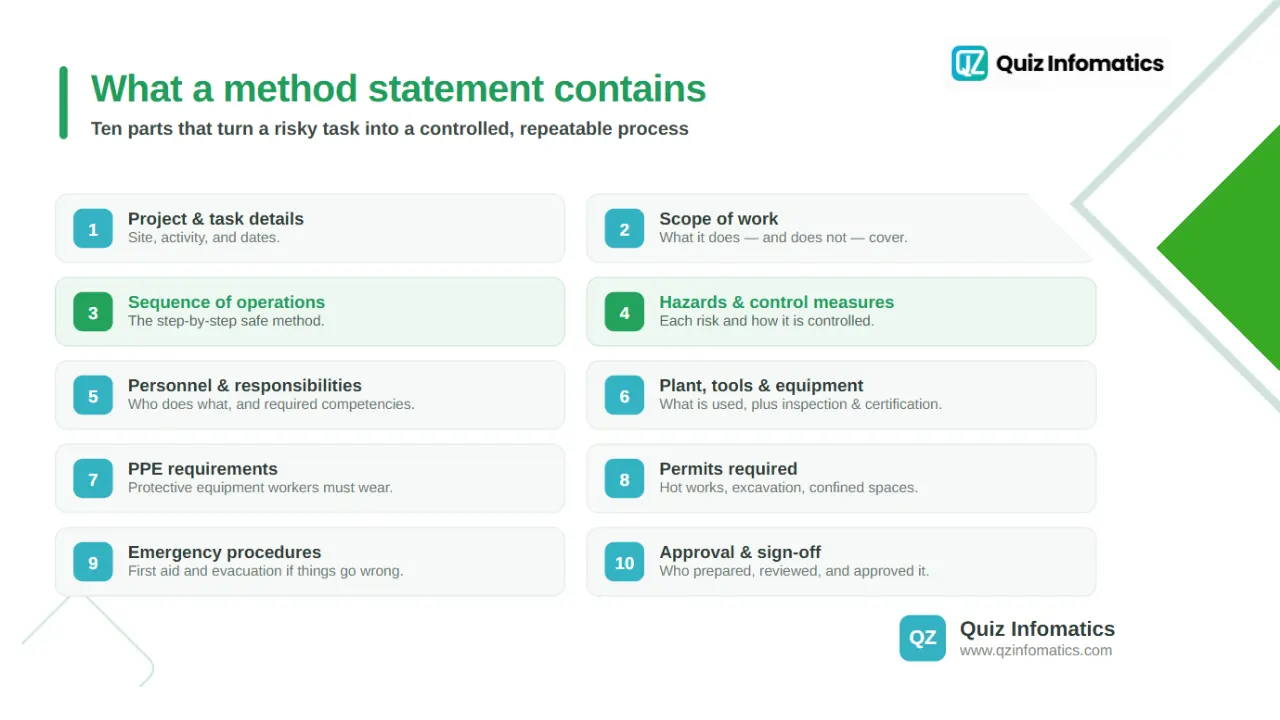
A well-written method statement typically covers:
Project and task details. The site, the specific activity, and the dates.
Scope of work. Exactly what the task involves, and what it does not.
Sequence of operations. A clear, step-by-step description of how the work will be carried out.
Hazards and control measures. The risks involved and how each one will be controlled.
Personnel and responsibilities. Who does what, and the competencies or training required.
Plant, tools, and equipment. What will be used, and any inspection or certification needed.
PPE requirements. The personal protective equipment workers must wear.
Permits required. Any permits to work, such as for hot works, excavation, or confined spaces.
Emergency procedures. What to do if something goes wrong, including first aid and evacuation.
Approval and sign-off. Who prepared, reviewed, and approved the document.
The heart of it is the sequence of operations combined with the control measures. Together they turn a risky task into a controlled, repeatable, safe process everyone can follow.
Method statement vs risk assessment: what's the difference?
The difference is simple: a risk assessment identifies the hazards and rates the risks, while a method statement describes the safe way to carry out the work. They are two halves of the same safety picture.
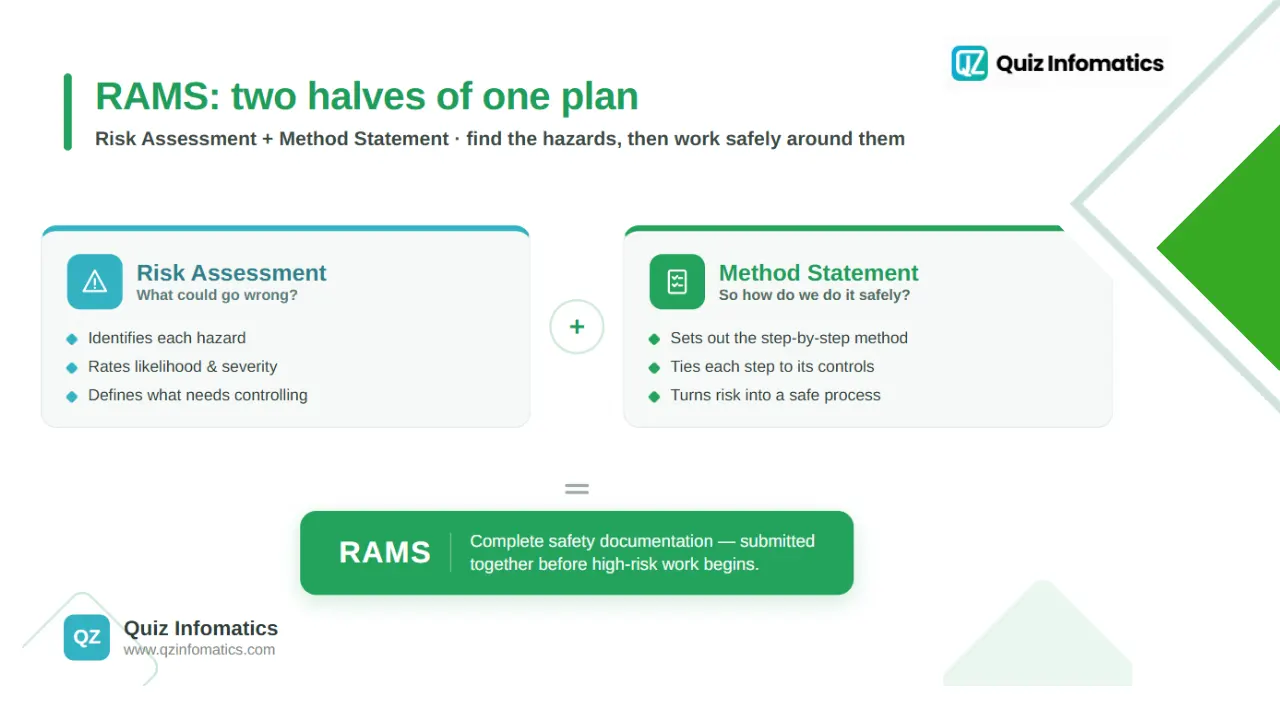
A risk assessment answers "what could go wrong, how likely is it, and how serious?" It scores each hazard and defines what needs controlling. The method statement then answers "so how exactly do we do this job safely?" by laying out the method and the controls in sequence.
This is why the two are usually produced and submitted together as RAMS. One without the other is incomplete: a risk assessment with no method leaves workers unsure how to proceed, and a method statement with no risk assessment has no basis for its controls.
Why are method statements important for construction safety?
Method statements are important because they turn safety from an afterthought into a planned, communicated system of work, which is exactly what construction safety demands. The industry's risk profile makes this essential.
The numbers are sobering. In the United States, construction accounts for roughly 1 in 5 workplace fatalities despite making up only about 6 percent of the workforce, yet companies with strong safety programmes report up to 70 percent fewer accidents. Falls remain the single biggest killer on site. Method statements exist precisely to prevent these outcomes.
Their value comes down to four things:
Safety. They ensure high-risk work is planned and controlled before it starts, not improvised on site.
Legal compliance. They help contractors meet health and safety obligations and demonstrate due diligence.
Consistency. They give every worker the same safe method to follow, reducing the variation that causes accidents.
Communication. A method statement is only useful if it is shared, so briefing it to the team spreads the safe method to everyone doing the work.
When is a method statement required?
A method statement is required for high-risk construction activities and whenever a client or main contractor demands one, which on most sites means before any significant work begins. The higher the risk, the more essential it is.
Activities that almost always need a method statement include:
Work at height, such as roofing, scaffolding, and elevated platforms
Excavation and groundworks
Lifting operations and crane work
Confined space entry
Demolition
Hot works, such as welding and cutting
Electrical work and work near live services
Beyond the activity itself, method statements are frequently a contractual requirement. Main contractors typically require every subcontractor to submit and get approval for their method statements before mobilising to site.
Who prepares and approves a method statement?
A method statement is prepared by the contractor or subcontractor carrying out the work, then reviewed and approved by the main contractor, consultant, or client before work starts. Competence is key at every stage.
The person writing it should understand both the task and its hazards, which usually means an experienced supervisor, engineer, or health and safety professional. It is then reviewed by the site or safety manager, and formally approved through the project's document-control process.
This approval workflow matters. On a busy project, dozens of method statements from different subcontractors need to be submitted, reviewed, approved, and tracked, and losing control of that process is a real risk to both safety and the programme.
How do you write a good method statement?
A good method statement is specific to the actual task and site, written in clear steps, and communicated to everyone who will do the work. Generic, copy-pasted documents are the most common failing.
The practical approach is to describe the real sequence of operations for this particular job, tie each step to its hazards and controls, specify the exact equipment, PPE, and permits, and assign clear responsibilities. It should then be briefed to the team, often through a toolbox talk, so the safe method is understood rather than just filed.
Crucially, a method statement is a living document. If the work, the site conditions, or the team changes, it should be reviewed and updated rather than left to drift out of date.
A method statement example in practice
To make it concrete, imagine a simple method statement for installing cladding at height on a UAE building. It shows how the pieces fit together in a real task.
The scope would be defined as fixing external cladding panels to the third-floor facade using a mobile elevating work platform. The sequence would then run step by step: inspect and set up the platform on stable ground, cordon off the area below, raise operatives with harnesses clipped to anchor points, lift panels using approved rigging, fix them per the drawings, and lower and secure the platform at the end of the shift.
Against those steps sit the controls: trained and certified platform operators, fall-arrest harnesses, exclusion zones below, daily equipment inspections, and a stop-work trigger for high winds, which matter in the UAE climate. Permits, PPE, and emergency procedures are listed alongside. The result is a document a supervisor can brief in a toolbox talk and a worker can actually follow, which is exactly the point.
Let’s talk about your business
Start with a free 30-minute call. We’ll ask the right questions, listen carefully, and give you an honest view of what’s possible.
Method statements and construction contracts
Method statements are frequently a formal requirement of construction contracts, making them a contractual obligation as well as a safety tool. Ignoring them can breach the contract, not just good practice.
In many construction contracts, including the FIDIC-based forms common in the UAE, the contractor is required to submit method statements for approval before carrying out specified works. Payment, access, and permission to proceed can all depend on having approved documentation in place.
This links method statements directly to project delivery. A subcontractor without approved method statements may be unable to start work, causing delays that ripple through the programme. Managing this documentation efficiently is therefore both a safety and a commercial issue, closely tied to how well a project handles its bill of quantities, subcontractor packages, and wider contract administration.
Method statements and subcontractor management
On most projects, method statements are managed at the subcontractor level, with each subcontractor responsible for the safe method of their own packages. Keeping track of them all is a significant coordination task.
A main contractor may be managing method statements, permits, insurances, and competency records for dozens of subcontractors at once. When this lives in email chains and spreadsheets, approvals get lost, out-of-date documents slip through, and compliance becomes hard to prove.
This is where integrated subcontractor management software makes a real difference, giving the main contractor one place to submit, review, approve, and track method statements and related documents against each subcontractor and work package.
Common method statement mistakes to avoid
The most common method statement mistakes are being too generic, too vague, or never actually communicated to the workforce. Each one undermines the whole purpose of the document.
Watch out for these pitfalls:
Generic templates. A method statement copied from another job and not tailored to the actual site and task is close to useless.
Vague controls. Saying "work safely" is not a control measure; specific, actionable steps are.
No communication. A document filed but never briefed to the team does not protect anyone.
Out-of-date versions. Conditions change, and an unrevised method statement can become dangerous.
Poor version control. Workers following an old version while a newer one sits unapproved is a serious risk.
Avoiding these comes down to being specific, keeping documents current, and making sure the safe method actually reaches the people doing the work.
Managing method statements digitally
The most efficient way to manage method statements today is through construction software that handles document control, approvals, and version tracking in one place. Digital management removes much of the risk that comes with paper and spreadsheets.
A good system stores every method statement against its project and subcontractor, tracks approval status, keeps a clear version history, and links documentation to the work packages it relates to. Instead of chasing emails, a project team sees at a glance what is approved, what is pending, and what is missing.
This is part of a wider shift toward digital construction management. Our construction management software for UAE contractors brings document control, subcontractor management, cost control, and progress tracking into one platform, so safety documentation and commercial control live together rather than in separate silos. Alongside tools like Gantt charts in construction for scheduling, this gives contractors a genuinely connected view of a project.
Method statements in the UAE
In the UAE, method statements are a standard and often mandatory part of construction, driven by strict health and safety regulations and demanding client requirements. Safety documentation is taken seriously across the region.
Regulatory frameworks such as Dubai Municipality's construction safety requirements and Abu Dhabi's occupational safety and health system set clear expectations for safe systems of work. On large UAE projects, clients and main contractors routinely require approved method statements and permits before high-risk activities can proceed.
For UAE contractors, managing this volume of safety documentation efficiently is essential to keeping projects both safe and on schedule. If you want the wider context on the systems behind this, our plain-English guide to what an ERP system is sets the foundation.
How QZ Infomatics helps contractors
Managing method statements well is part of a bigger picture: running a construction project where safety, documents, and commercial control are all connected. That integration is what keeps projects safe and profitable.
A practical step is to move document control, subcontractor management, and cost control off scattered spreadsheets and email into a construction-specific system, so approvals, versions, and compliance are always visible and up to date. This turns safety documentation from an administrative burden into a controlled, auditable process.
If you would like help with that, our construction ERP software for UAE contractors brings document management, subcontractor management, BOQ, cost control, and progress billing into one platform, built for how contracting businesses actually work.
Method statements, in a nutshell
To recap the essentials:
A method statement describes, step by step, how a specific construction task will be carried out safely.
It includes the work sequence, hazards and controls, resources, PPE, permits, and emergency procedures.
With a risk assessment, it forms RAMS: the risk assessment finds the hazards, the method statement sets out the safe method.
It is required for high-risk activities and is often a contractual obligation before work can start.
Digital management through construction software keeps method statements, approvals, and subcontractor compliance under control.
A method statement is not just paperwork to satisfy a client. It is a practical tool that keeps workers safe, keeps a project compliant, and keeps work moving, which is exactly why getting it right matters so much.
Frequently asked questions
What is a method statement in construction? A method statement is a document that describes step by step how a specific construction task will be carried out safely, including the work sequence, hazards, control measures, and resources needed.
What is the difference between a method statement and a risk assessment? A risk assessment identifies hazards and rates the risks, while a method statement sets out the safe method for doing the work. Together they are known as RAMS.
What does RAMS stand for? RAMS stands for Risk Assessment and Method Statement. It is the combined safety documentation that identifies hazards and describes how to carry out the work safely.
When is a method statement required? A method statement is required for high-risk activities such as work at height, excavation, lifting, confined spaces, demolition, and hot works, and whenever a client or main contractor requires one before work begins.
Who prepares a method statement? The contractor or subcontractor carrying out the work prepares the method statement, usually through an experienced supervisor or safety professional. It is then reviewed and approved by the main contractor, consultant, or client.
What should a method statement include? It should include project and task details, the step-by-step sequence of work, hazards and control measures, responsibilities, plant and equipment, PPE, permits, and emergency procedures.
Are method statements a legal requirement? Method statements are a key part of demonstrating health and safety compliance and are frequently required by both regulations and construction contracts, particularly for high-risk work.
Can method statements be managed with software? Yes. Construction management and ERP software store method statements, track approvals and versions, and link them to subcontractors and work packages, making compliance far easier to manage and prove.
About the author
QZ Infomatics Construction Technology Team - QZ Infomatics is a Dubai-based ERP and IT consultancy (Business Bay) that implements construction and contracting software across the UAE and GCC. The team helps contractors manage document control, subcontractor compliance, BOQ, cost control, and progress billing in one connected system, drawing on hands-on experience with construction ERP for UAE projects. This guide reflects that practical experience helping contracting businesses run safer, better-controlled projects.
Struggling to manage safety documents and subcontractors across projects? See our construction ERP for UAE contractors.