
Digital Transformation
Work Breakdown Structure (WBS) Explained
Last updated: July 2026 · By the QZ Infomatics Construction Technology Team
A large construction project can feel impossible to grasp all at once: thousands of tasks, dozens of trades, months of work, and a budget running into the millions. The way professionals tame that complexity is deceptively simple. They break the whole thing down into manageable pieces using a work breakdown structure. This guide explains what a WBS is, how it works, how to build one, and why it sits at the foundation of construction project management, scheduling, and cost control, with a clear focus on the UAE.
What is a work breakdown structure?
A work breakdown structure (WBS) is a hierarchical breakdown of the total scope of a project into smaller, manageable components, arranged from the overall project at the top down to individual work packages at the bottom. It turns one enormous job into an organised set of smaller ones.
The core idea is decomposition: taking something too big to control and dividing it into pieces small enough to plan, estimate, schedule, and assign. Each level of the WBS adds more detail than the one above it.
A WBS is not a to-do list or a schedule. It defines what will be delivered, not when or in what order. That distinction is important, because the WBS becomes the foundation that scheduling, budgeting, and resourcing are all built on.
What does WBS stand for?
WBS stands for work breakdown structure. The name captures exactly what it does: it breaks the work of a project down into a structured hierarchy.
The word "work" here refers to work products or deliverables, the tangible outcomes of the project, rather than the activities needed to produce them. A good WBS is built around deliverables, such as "foundations" or "electrical installation," not around actions like "digging" or "wiring."
This deliverable focus is what keeps a WBS clear and complete. It describes the whole of what the project will produce, which everyone can then plan around.
Why is a work breakdown structure important?
A WBS is important because breaking a large project into smaller components dramatically improves the chances of controlling and completing it successfully. The evidence for this is striking.
Research into project outcomes shows that small projects succeed roughly 90 percent of the time, while very large projects can succeed less than 10 percent of the time, and breaking significant initiatives into smaller, trackable components is one of the clearest ways to reduce that risk. A WBS is precisely that mechanism: it converts an unmanageable whole into a set of manageable parts.
There is a second, related benefit. Scope creep, where work quietly expands beyond what was agreed, affects a majority of projects and drives significant budget overruns. A well-built WBS that captures 100 percent of the scope makes it far harder for work to be forgotten or to sneak in uncontrolled.
In short, the WBS is where control begins. Without it, scheduling and budgeting are built on sand.
What does a work breakdown structure look like?
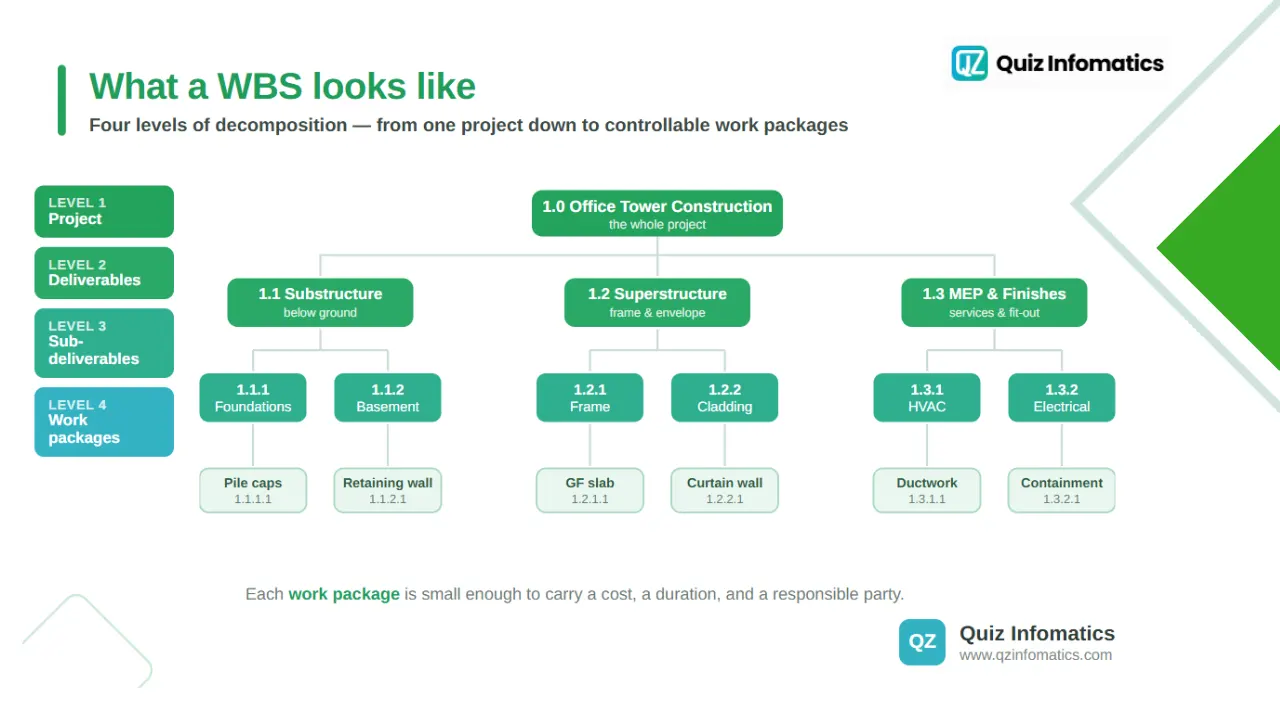
A WBS looks like a hierarchy or tree, with the whole project at the top and progressively smaller components branching out below it. Each level breaks the level above into more detail.
A typical structure has these levels:
Level 1: The project. The entire project as a single item, such as "Office Tower Construction."
Level 2: Major deliverables or phases. Big chunks such as "Substructure," "Superstructure," "MEP," and "Finishes."
Level 3: Sub-deliverables. Each major chunk broken down further, such as "Foundations" and "Basement" under Substructure.
Level 4: Work packages. The lowest level, small enough to estimate, schedule, assign, and control, such as "Pile caps" or "Ground floor slab."
The work package at the bottom is the key unit. It is small enough that you can put a cost, a duration, and a responsible party against it, which is exactly what makes the whole project controllable.
The 100% rule and the WBS dictionary
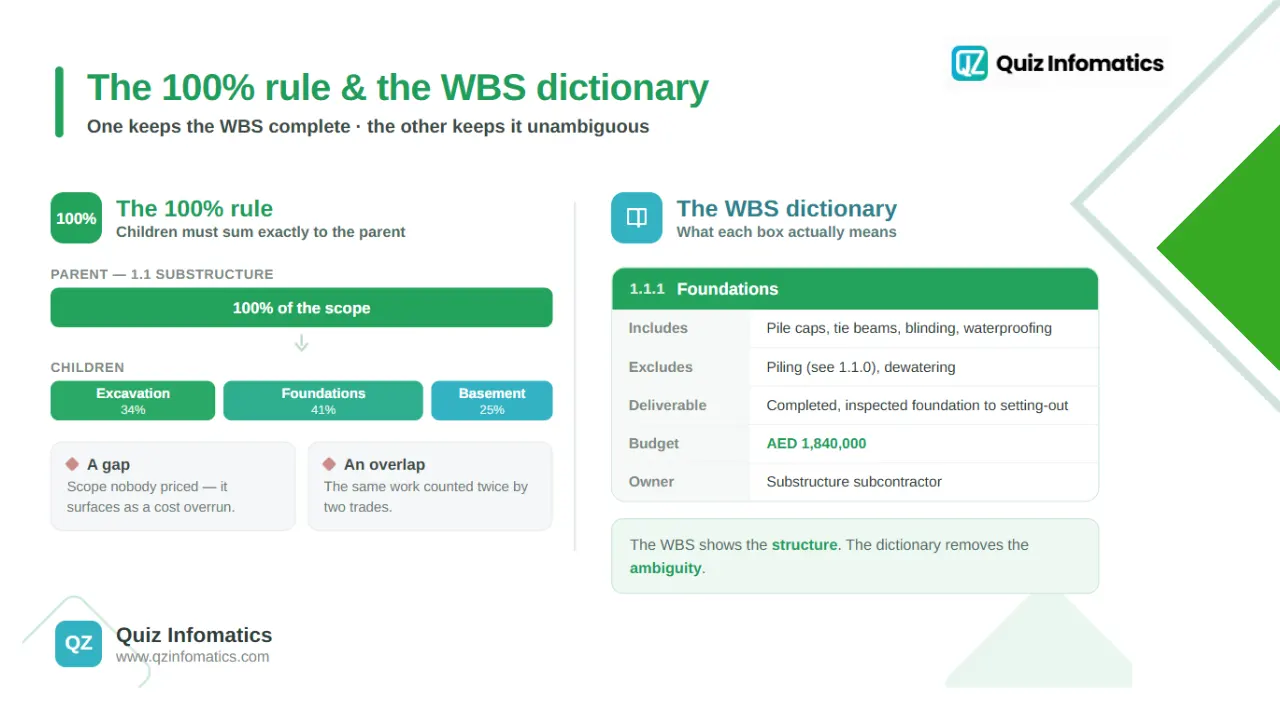
Two concepts make a WBS reliable: the 100% rule and the WBS dictionary. Both keep it complete and unambiguous.
The 100% rule states that a WBS must capture 100 percent of the project scope, no more and no less. Every child element must add up to its parent, so nothing is missed and nothing is duplicated. If it is not in the WBS, it is not in the project.
The WBS dictionary is a companion document that describes each element in detail: what it includes, its deliverables, and often its budget and responsible party. Where the WBS shows the structure, the dictionary explains what each box actually means, removing ambiguity.
Together they ensure the WBS is both complete and clearly understood by everyone on the project.
What are the types of WBS?
There are two main ways to organise a WBS: by deliverable or by phase, and construction projects often combine them with area or zone breakdowns. The right choice depends on how the project is best controlled.
Deliverable-based WBS. Organised around the physical outputs, such as building elements or systems. This is the most common and recommended approach.
Phase-based WBS. Organised around project stages, such as design, procurement, and construction.
Zone or area-based breakdown. Common in construction, dividing the project by building, floor, or zone, which suits how work is actually sequenced on site.
In practice, a large UAE construction project might combine these, breaking the work down by zone, then by system or trade within each zone. The goal is always the same: components small enough to plan and control.
How do you create a work breakdown structure?
You create a WBS by starting with the whole project and progressively decomposing it into smaller components until you reach work packages you can manage. It is a top-down process.
The typical steps are:
Define the project scope. Be clear on the total deliverable, drawing on the contract and drawings.
Identify major deliverables. Break the project into its big components or phases.
Decompose each one. Break each major component into sub-deliverables.
Continue to work-package level. Keep breaking down until each package is small enough to estimate, schedule, and assign.
Apply a coding system. Give each element a unique number, so it can be referenced across the schedule and budget.
Create the WBS dictionary. Describe each element clearly.
Validate against the 100% rule. Confirm the whole scope is captured, with no gaps or overlaps.
The skill lies in decomposing to the right level: detailed enough to control, but not so detailed that the WBS becomes unmanageable. Work packages are usually sized so they can be realistically estimated and tracked.
The WBS and the critical path method
The WBS defines the work, and scheduling tools then sequence it, which is where the critical path method comes in. The two work hand in hand.
A WBS on its own does not show timing or order; it shows scope. To build a schedule, planners take the work packages from the WBS and break them into the activities needed to deliver each one, then link those activities with logic. The critical path method, explained in our Primavera P6 guide, then calculates the sequence of activities that determines the project's finish date.
This is why a clean WBS is so valuable: it gives the schedule a solid structure to build on. Those activities are usually visualised as Gantt charts in construction, turning the WBS-derived schedule into the familiar bar chart everyone recognises.
The WBS and cost control
The WBS is also the backbone of project cost control, because costs are estimated and tracked against its components. It connects scope directly to money.
When each work package carries a cost, the WBS becomes a cost breakdown structure, letting you budget bottom-up and track actual spending against each element. This aligns naturally with the bill of quantities, where measured quantities and rates give each package its value.
Managing that budget against actual committed and spent costs is where a construction ERP earns its place. Bringing the WBS, the budget, and actual costs together in a single system for construction budget control is what turns a static plan into live cost control, so overruns are visible early rather than at the final account.
The WBS and construction project management
In construction project management, the WBS is the foundation everything else is built on: the schedule, the budget, resourcing, and accountability all flow from it. Get the WBS right, and the rest becomes far more manageable.
Beyond scope and cost, the WBS supports responsibility assignment. By mapping work packages to the teams or subcontractors responsible for them, often through an organisational breakdown structure, every part of the project has a clear owner. It also underpins progress measurement, because completed work packages give an objective read on how far along the project really is.
This makes the WBS more than a planning artefact. It is a control tool used throughout the project, keeping scope, cost, schedule, and responsibility aligned from start to finish.
The WBS and subcontractor packages
In construction, WBS work packages frequently map directly onto subcontractor packages, making the WBS the basis for procuring and managing subcontractors. This is a practical, everyday use of the structure.
A main contractor typically breaks the project into packages, then awards each to a subcontractor. Those packages are essentially WBS elements, each with its own scope, budget, and programme. Managing them well, tracking each subcontractor's scope, cost, and progress, is central to delivering the project profitably.
Doing this across scattered spreadsheets is slow and risky. Handling it in dedicated subcontractor management software lets a contractor tie each package back to the WBS, the budget, and actual costs, keeping the whole project under control.
Let’s talk about your business
Start with a free 30-minute call. We’ll ask the right questions, listen carefully, and give you an honest view of what’s possible.
What are the benefits of a WBS?
The benefits of a WBS come from the clarity and control that decomposition provides across the entire project. They touch every part of delivery.
Key benefits include:
Complete scope. The 100% rule ensures nothing is forgotten or duplicated.
Better estimating. Costing small work packages is far more accurate than guessing at the whole.
Stronger scheduling. The schedule is built on a clear, structured foundation.
Clear accountability. Every package has an owner.
Objective progress tracking. Completed packages give a real measure of progress.
Reduced risk. Breaking a large project down makes it far more controllable.
Together these explain why the WBS is considered one of the most fundamental tools in project management. It is where good planning starts.
Common WBS mistakes to avoid
The most common WBS mistakes are organising it around activities instead of deliverables, and breaking it down to the wrong level of detail. Both undermine its usefulness.
Watch out for these pitfalls:
Listing activities, not deliverables. A WBS should describe outputs, not the actions to produce them; that is the schedule's job.
Too much or too little detail. Over-decomposing creates an unmanageable structure, while too little leaves packages too big to control.
Breaking the 100% rule. Gaps mean forgotten scope; overlaps mean double-counting.
Ignoring the dictionary. Without clear definitions, elements get interpreted differently by different people.
Avoiding these comes down to focusing on deliverables, decomposing to a sensible level, and defining each element clearly.
The WBS in the UAE construction sector
In the UAE, a well-structured WBS is essential on the large, complex projects that define the market. It underpins how these projects are planned, priced, and controlled.
UAE construction is characterised by major developments, FIDIC-based contracts, and demanding programmes, all of which rely on a clear breakdown of scope to manage. The WBS ties directly to the programme in tools like Primavera P6, to the budget and BOQ, and to the subcontractor packages that deliver the work.
For UAE contractors, a disciplined WBS connected to real cost and schedule control is a genuine advantage. If you want the wider context on the systems behind this, our plain-English guide to what an ERP system is sets the foundation.
How QZ Infomatics helps contractors
A WBS is only as valuable as your ability to connect it to real cost, schedule, and subcontractor control. That connection is what turns a plan into delivery.
A practical step is to link your WBS work packages to your budget, procurement, and subcontractor accounts in one system, so scope, cost, and progress stay aligned rather than drifting apart in separate spreadsheets. This turns the WBS from a planning diagram into a live control framework.
If you would like help with that, our construction ERP software for UAE contractors brings BOQ, cost control, budgeting, subcontractor management, and progress billing into one platform, built for how contracting businesses actually work.
Work breakdown structure, in a nutshell
To recap the essentials:
A work breakdown structure (WBS) is a hierarchical breakdown of a project's total scope into manageable components, from the project down to work packages.
It follows the 100% rule, capturing all the scope with no gaps or overlaps, and is explained by a WBS dictionary.
It is the foundation for scheduling, cost control, resourcing, and accountability.
It connects to the critical path method for scheduling, the BOQ for cost, and subcontractor packages for delivery.
In construction, it is essential for controlling the large, complex projects typical of the UAE market.
A WBS is not bureaucracy for its own sake. It is the structure that makes a huge, complex project controllable, which is exactly why professional project management begins with it.
Frequently asked questions
What is a work breakdown structure? A work breakdown structure is a hierarchical breakdown of a project's total scope into smaller, manageable components, from the overall project at the top down to individual work packages at the bottom.
What does WBS stand for? WBS stands for work breakdown structure. It breaks the work of a project into a structured hierarchy of deliverables and work packages.
What is the 100% rule in a WBS? The 100% rule states that a WBS must capture 100 percent of the project scope, with every element adding up to its parent, so nothing is missed and nothing is duplicated.
What is the difference between a WBS and a schedule? A WBS defines the scope, what will be delivered, while a schedule defines the timing and sequence. The schedule is built by breaking WBS work packages into activities and linking them.
What is a work package? A work package is the lowest level of a WBS, small enough to estimate, schedule, assign, and control. In construction, work packages often map directly to subcontractor packages.
How detailed should a WBS be? Detailed enough that each work package can be realistically estimated, scheduled, and tracked, but not so detailed that the structure becomes unmanageable. The right level balances control with practicality.
How does a WBS relate to cost control? When each work package carries a cost, the WBS becomes a cost breakdown structure, allowing bottom-up budgeting and tracking of actual spending against each element, which underpins project cost control.
Is a WBS used in construction? Yes. A WBS is fundamental in construction, structuring scope by element, system, or zone, and connecting directly to the schedule, the BOQ, the budget, and subcontractor packages.
About the author
QZ Infomatics Construction Technology Team - QZ Infomatics is a Dubai-based ERP and IT consultancy (Business Bay) that implements construction and contracting software across the UAE and GCC. The team helps contractors connect scope, cost, and subcontractor control by bringing BOQ, budgets, subcontractor accounts, and progress billing into one connected system, drawing on hands-on experience with construction ERP for UAE projects. This guide reflects that practical experience helping contracting businesses plan and control their work.
Want your WBS connected to real cost and subcontractor control? See our construction ERP for UAE contractors.