

Digital Transformation
Variation Orders and Change Orders: Raising, Approving and Costing in ERP
Last updated: July 2026 · By the QZ Infomatics Construction Technology Team
Every construction project changes as it goes, and every change has to be captured, approved, and paid for properly. Handle that well and changes are a normal part of business; handle it badly and a small, undocumented change can grow into a six-figure dispute. The document at the centre of it all is the change order, or variation order, and managing it is far easier inside proper construction ERP software than on paper. This guide explains how to raise, approve, and cost change orders, and how software keeps the whole process under control.
What is a change order in construction?
A change order is a formal, agreed amendment to a construction contract that modifies the scope, cost, or schedule of the work. It documents exactly what is changing, why, and what it means for the price and the programme.
Changes are almost guaranteed on any project, whether from an owner's new request, a design development, or an unforeseen site condition. The change order turns that change from an informal conversation into a documented, priced, and approved instruction that both parties agree to.
Getting this right is one of the most important disciplines in construction. A signed change order protects the contractor's right to be paid and the client's clarity on what they are buying.
Variation order vs change order: are they the same?
Yes, a variation order and a change order are the same thing: a formal contractual change to the works. The only difference is terminology, and which term is used depends on where you are.
"Change order" is the standard term in the United States, while "variation order," or simply "variation," is used under the FIDIC contracts common in the UK, the GCC, and the UAE. Both describe an instructed change to scope, cost, or time.
So a contractor in Dubai raising a "variation" and one in Chicago raising a "change order" are doing exactly the same thing. This guide uses the terms interchangeably, and our companion piece on variation orders and construction contracts covers the FIDIC contractual detail in depth.
Why do change orders happen, and what types are there?
Change orders happen whenever the agreed scope needs to change, and they come in several standard types. Understanding the types helps teams handle each correctly.
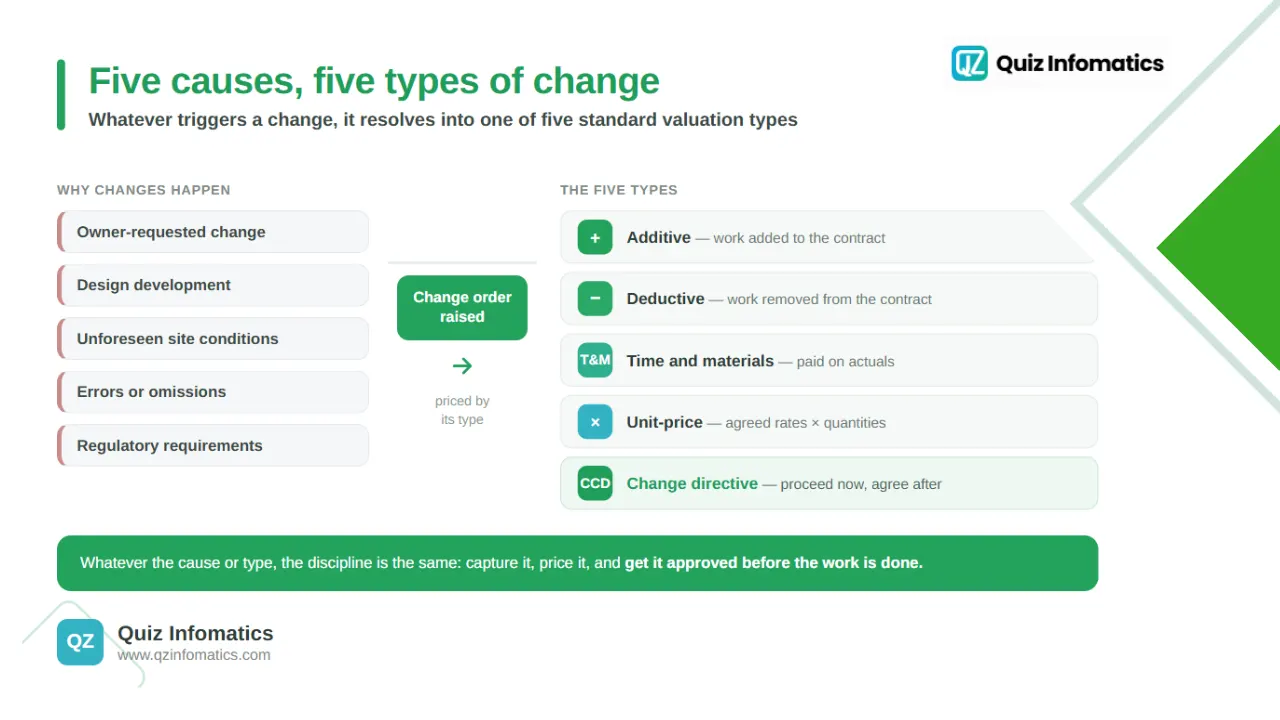
Common causes include owner-requested changes, design development, unforeseen site conditions, errors or omissions in the documents, and regulatory requirements. The main types of change order are:
Additive. Adding work to the contract.
Deductive. Removing work from the contract.
Time and materials. Paid on actual labour and materials where the scope cannot be fixed in advance.
Unit-price. Valued using agreed rates for measured quantities.
Construction change directive (CCD). A directive to proceed immediately, with cost and time agreed afterward, to keep work moving.
Whatever the cause or type, the same discipline applies: capture it, price it, and get it approved before the work is done. The alternative, doing changed work on a handshake, is where disputes begin.
The change order process: raising, approving, and costing
The change order process runs from raising the change, through approving it, to costing and instructing it, and every step needs to be documented. Skipping or rushing any stage creates risk.
Here is how the process works in practice.
Raising a change order
A change order starts with a change request, sometimes called a change order request (COR), which identifies the change and the reason for it. Whoever spots the need, the contractor, the client, or the consultant, raises it formally rather than acting informally.
Raising it promptly and clearly matters. A change captured early, with a clear description and supporting information, is far easier to price and approve than one reconstructed weeks later from memory.
Approving a change order
The change request then goes through an approval workflow, where the relevant parties review it and the client signs off before work proceeds. Approval authority often depends on the value of the change, with larger changes needing higher sign-off.
The most important rule in the whole process is simple: never perform changed work without a signed change order. Doing so is the single most common cause of payment denial and disputes, because the contractor has no documented agreement to rely on.
Costing a change order
Costing values the change fairly, usually using the contract's valuation rules, then adds the agreed markup for overhead and profit. This is where accuracy protects the margin.
Where the changed work matches existing items, the rates in the bill of quantities apply; where it does not, pro-rata or fair rates are agreed. A markup, commonly around 10 to 15 percent for overhead and profit, is typically added. This valuation is core to the quantity surveyor's role, and costing must capture not just direct costs but indirect and consequential ones, such as delay and disruption, which are where disputes most often arise.
A change order example
To make it concrete, imagine a client asks to add a glass partition to an office fit-out midway through the job. The contractor raises a change order request describing the added work and its reason.
The change is reviewed and the client signs off. The quantity surveyor then costs it: the added glazing and framing are priced from comparable rates, a markup of around 12 percent is applied for overhead and profit, and a short extension of time is agreed because the glass has a two-week lead time. Once signed, the change order lifts the contract sum, updates the budget, and flows into the next progress bill. Handled this way, it is routine. Done on a verbal nod, the same partition can become a payment dispute months later.
The cost of getting change orders wrong
Getting change orders wrong is expensive, because poorly managed changes are the leading cause of construction disputes. The stakes are high and rising.
Industry analysis is blunt on this: change in scope is identified as the single biggest cause of construction claims and disputes globally, affecting close to 39 percent of projects, and a mismanaged dispute frequently begins as one small, undocumented change order. On major projects, change order costs commonly represent 10 to 15 percent of the contract value, and roughly a third of projects experience at least one major change.
The lesson is clear. A change order handled properly, raised, approved, costed, and documented, is routine business. The same change handled loosely can escalate into a claim that costs a fortune and sours the client relationship. Discipline is cheap insurance.
Change orders, the contract sum, and the budget
Every approved change order adjusts the contract sum and must flow through to the project budget, or cost control quickly falls apart. Keeping the numbers aligned is essential.
When a change order is approved, the contract value goes up or down, and the budget, forecast, and cash-flow projections all need to reflect it. If changes pile up without the budget being updated, the contractor loses sight of the true financial position of the project.
This is why connecting change orders to a live construction budget matters so much. A change that is approved but never reflected in the budget is a blind spot, and blind spots are where profit quietly disappears.
Change orders and the schedule
Change orders often affect the programme as well as the cost, so their schedule impact must be assessed and, where justified, an extension of time sought. Time and cost go hand in hand.
A change can push out the completion date, and the contractor may be entitled to an extension of time to avoid liability for delay damages. Any additional cost of that delay is usually pursued separately, and both depend on documenting the schedule impact clearly when the change is raised.
Ignoring the time dimension is a common mistake. A change order that captures the cost but not the programme impact leaves the contractor exposed to delay claims later.
Subcontractor change orders
Change orders flow down to subcontractors, so a main contractor must manage changes in two directions at once. This multiplies the administrative burden.
When the scope changes, the main contractor often needs to issue corresponding change orders to the affected subcontractors, price and approve them, and reconcile everything against the main contract change. Tracking this across many subcontractors and packages is a significant task.
Handling it in dedicated subcontractor management software lets a main contractor tie each subcontractor change order back to the main contract change, the budget, and billing, keeping the whole chain consistent.
Change orders, billing, and WIP
Approved change orders feed directly into billing and revenue recognition, so they must be captured accurately to keep the financial picture right. They are not just a scope matter; they are a money matter.
An approved change order increases the value the contractor can bill, so it flows into the next round of progress billing and interim payment certificates. It also changes the contract value used in the WIP report and percentage-of-completion revenue recognition, affecting how much revenue and profit are recognised.
This connection is exactly why change orders should not live in a standalone spreadsheet. When they are disconnected from billing and revenue, the project's reported financial position drifts away from reality.
What is change order management software?
Change order management software is a tool that digitises the whole change order process, from raising and approving to costing and tracking, in one place. It replaces paper forms and scattered spreadsheets.
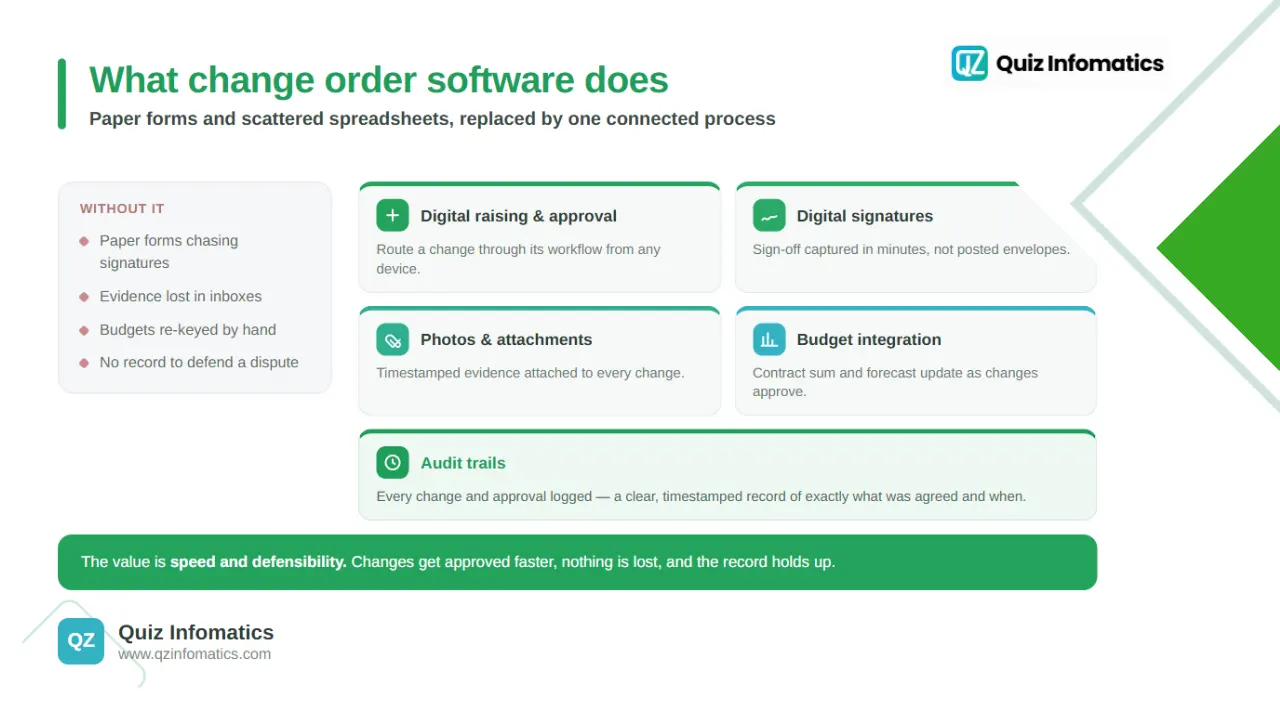
Good change order management software typically offers:
Digital raising and approval. Create and route change orders through an approval workflow from any device.
Digital signatures. Capture sign-off quickly, eliminating paper delays.
Photo and document attachments. Support each change with timestamped evidence.
Budget integration. Update project financials automatically as changes are approved.
Audit trails. Track every change and approval for compliance and dispute defence.
The value is speed and defensibility. Changes get approved faster, nothing is lost, and if a dispute ever arises, there is a clear, timestamped record of exactly what was agreed and when.
Managing change orders in a construction ERP
The most powerful approach is to manage change orders inside a construction ERP, where they connect to the budget, billing, subcontractors, and revenue automatically. This turns change management from an administrative chore into a source of financial control.
In a construction ERP, a change order raised and approved updates the contract sum, adjusts the budget, feeds the next billing cycle, and flows into the WIP and revenue figures, all without re-keying. The audit trail is built in, and the whole project's financial position stays accurate as changes happen.
This is central to modern contractor accounting software. Platforms such as Odoo, configured for construction, can bring change orders together with billing and cost control, and a well-run ERP implementation is what makes that integration reliable.
Variation orders in the UAE
In the UAE, changes are handled as variation orders under FIDIC-based contracts, following strict procedures for instruction, valuation, and notice. The discipline is the same as change order management elsewhere, under local terminology.
UAE contracts empower the engineer to instruct variations and set out how they are valued and paid, with strict notice requirements that can affect entitlement. On the large projects typical of the region, the volume and value of variations make disciplined, software-supported management essential.
For UAE contractors, connecting variation management to budgeting, billing, and revenue is a genuine advantage. If you want the wider context on the systems behind this, our plain-English guide to what an ERP system is sets the foundation.
Let’s talk about your business
Start with a free 30-minute call. We’ll ask the right questions, listen carefully, and give you an honest view of what’s possible.
How QZ Infomatics helps contractors
Controlling change orders comes down to a fast, documented process connected to your budget, billing, and subcontractor accounts. That connection is what protects both entitlement and margin.
A practical step is to raise, approve, and cost every change in one system, so the contract sum, budget, billing, and revenue all update automatically and nothing is lost. This turns change management into a controlled, auditable process rather than a source of disputes.
If you would like help with that, our construction ERP software for UAE contractors brings BOQ, cost control, budgeting, subcontractor management, billing, and change orders into one platform, built for how contracting businesses actually work.
Change orders and variation orders, in a nutshell
To recap the essentials:
A change order (or variation order) is a formal, agreed amendment to a construction contract that modifies scope, cost, or schedule.
The two terms are equivalent: "change order" is used in the US, "variation order" under FIDIC contracts in the UK, GCC, and UAE.
The process is to raise, approve, and cost each change, and never to do changed work without a signed order.
Change orders affect the contract sum, budget, schedule, billing, and revenue, so they must be captured accurately.
Change order management software and ERP digitise the whole process, speeding approvals and creating a defensible record.
Changes are inevitable on construction projects. Managing them with a disciplined process, in one connected system, is what separates the contractors who profit from change from those who end up fighting over it.
Frequently asked questions
What is a change order in construction? A change order is a formal, agreed amendment to a construction contract that modifies the scope, cost, or schedule of the work, documenting exactly what is changing and its impact on price and time.
What is the difference between a change order and a variation order? There is no real difference. They are the same thing under different names: "change order" is the US term, while "variation order" is used under FIDIC contracts in the UK, GCC, and UAE.
How do you raise a change order? A change order starts with a change request that identifies the change and the reason for it. It is then reviewed, approved through a sign-off workflow, and costed before the changed work proceeds.
How are change orders costed? Change orders are valued using the contract's rules, typically existing rates for matching work or fair rates otherwise, plus a markup of around 10 to 15 percent for overhead and profit, and should include indirect and consequential costs.
Why should you never do work without a signed change order? Because without a signed change order, the contractor has no documented agreement to be paid for the changed work. This is the leading cause of payment denial and disputes in construction.
What is change order management software? It is software that digitises the change order process, letting teams raise, approve, cost, and track changes in one place, with digital signatures, attachments, budget integration, and audit trails.
How much do change orders cost on a project? On major projects, change order costs commonly represent around 10 to 15 percent of the contract value, and a high frequency of changes can also reduce productivity significantly.
Can a construction ERP manage change orders? Yes. A construction ERP raises, approves, and costs change orders and connects them automatically to the contract sum, budget, billing, subcontractors, and revenue, keeping the project's financial position accurate.
About the author
QZ Infomatics Construction Technology Team - QZ Infomatics is a Dubai-based ERP and IT consultancy (Business Bay) that implements construction and contracting software across the UAE and GCC. The team helps contractors raise, approve, and cost change orders and variations, connected to billing, budgets, and subcontractor accounts, in one system, drawing on hands-on experience with construction ERP for UAE projects. This guide reflects that practical experience helping contracting businesses control change and protect their margins.
Managing change orders on paper and spreadsheets? See our construction ERP for UAE contractors.