
Digital Transformation
Variation Orders & Construction Contracts
Last updated: July 2026 · By the QZ Infomatics Construction Technology Team
Almost no construction project is built exactly as it was first drawn. Designs evolve, clients change their minds, and site conditions spring surprises. How those changes are instructed, priced, and paid for is governed by the construction contract, and getting it wrong is one of the most common ways contractors lose money. This guide explains variation orders, how they fit into construction contracts, and how retention money works, with a clear focus on the UAE and its FIDIC-based contracts.
What is a variation order?
A variation order is a formal instruction under a construction contract to change the agreed scope of work, whether by adding, omitting, or altering something. Because it changes what was agreed, the contractor is usually entitled to an adjustment to the price, the time, or both.
A variation order is also called a change order, and it is the proper, contractual way to handle any change to the works. It converts an informal "can you just change this?" into a documented instruction with defined cost and time consequences.
This matters because a variation is not free work and it is not the contractor's fault. It is a change the client has requested or that circumstances require, and the contract sets out how the contractor is compensated for it.
Why do variations happen?
Variations happen on almost every project because designs, requirements, and conditions rarely stay fixed from start to finish. Understanding the common triggers helps teams anticipate and manage them.
The usual causes include:
Client-requested changes. The client decides to add, upgrade, or alter something during the build.
Design development. Details are refined or corrected as the design matures.
Unforeseen site conditions. Ground conditions, existing services, or other surprises force a change.
Errors and omissions. Gaps or mistakes in the original design or documentation need resolving.
Regulatory or authority requirements. A change is required to meet a code or an authority's demand.
Because variations are inevitable, the goal is not to eliminate them but to manage them properly. A well-run variation process protects both the client and the contractor; a poorly run one breeds disputes.
Variation order vs variation claim: what's the difference?
The difference is important: a variation order is an instructed change with an agreed basis for payment, while a variation claim is a request for additional time or money that is not straightforwardly covered by an instruction. One is proactive, the other is contested territory.
A variation order follows the contract's change mechanism: the change is instructed, valued using agreed rules, and paid. A claim arises when the contractor believes they are entitled to more time or money, for example due to delay or disruption caused by the change, and must substantiate that entitlement.
The distinction has real consequences. Well-handled variations are priced and settled smoothly, while claims are where projects often end up in dispute. Keeping changes within the orderly variation process, with proper records, is one of the best ways to avoid costly claims later.
How are variations valued?
Variations are valued using a hierarchy of methods set out in the contract, usually starting with the rates in the bill of quantities and moving to fair rates or dayworks where those do not apply. Consistent valuation keeps changes fair.
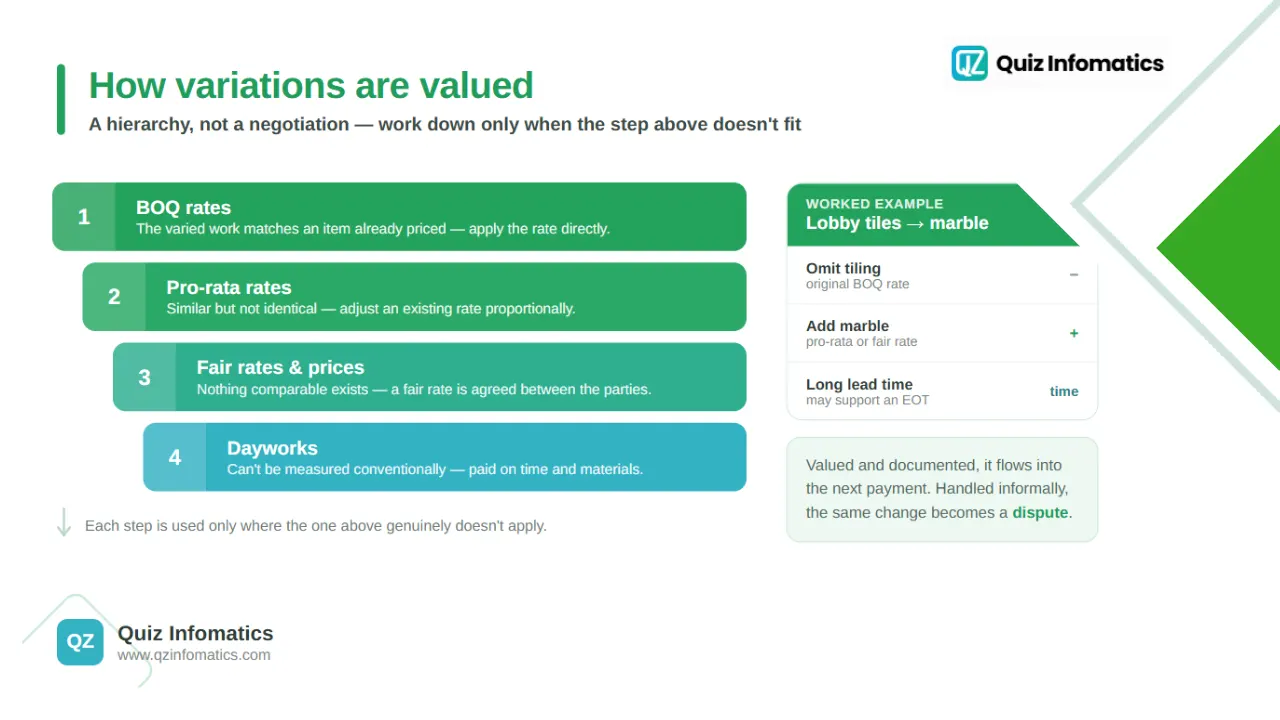
The typical order is:
BOQ rates. Where the varied work matches items already priced, the existing bill of quantities rates apply directly.
Pro-rata rates. Where the work is similar but not identical, existing rates are adjusted proportionally.
Fair rates and prices. Where nothing comparable exists, a fair rate is agreed.
Dayworks. Where work cannot be measured conventionally, it is paid on a time-and-materials basis.
This valuation is core to the quantity surveyor's role. Getting it right protects the contractor's margin and gives the client confidence that changes are priced fairly, rather than becoming a source of conflict.
A variation order example
To make it concrete, imagine a client decides mid-project to upgrade the lobby flooring from standard tiles to marble. The consultant issues a variation order instructing the change.
The quantity surveyor then values it: the omitted tiling is deducted using the original BOQ rate, and the added marble is priced, either from a comparable BOQ rate, a pro-rata adjustment, or a newly agreed fair rate if nothing similar exists. If the marble has a long lead time that pushes the programme, the contractor may also seek an extension of time. Properly instructed and documented, the change flows smoothly into the next valuation and payment. Done informally, the same change can become a dispute over what was agreed and what it was worth.
Variations and construction contracts: the FIDIC framework
In the UAE and across the GCC, most construction contracts are based on the FIDIC forms, which set out clear procedures for instructing and valuing variations. Understanding this framework is essential for anyone working on regional projects.
FIDIC (the International Federation of Consulting Engineers) publishes standard contract forms widely used in the region, including the Red Book for traditional build contracts, the Yellow Book for design and build, and the Silver Book for turnkey and EPC projects. These contracts contain a dedicated variations clause that empowers the engineer to instruct changes and sets out how they are valued and paid.
Two features matter especially. First, variations must generally be properly instructed, not assumed, so a contractor should be cautious about proceeding on a verbal or informal request. Second, notice requirements and timescales are strict, and failing to give the required notice can jeopardise a contractor's entitlement. Careful contract administration is not bureaucracy; it is how entitlement is protected.
Why documentation matters: the cost of getting it wrong
Documentation matters enormously, because poor contract administration is the single biggest cause of construction disputes, and disputes are expensive. The evidence is stark.
The Middle East has repeatedly ranked as one of the world's costliest regions for construction disputes, with Arcadis reporting regional average dispute values around 80 million US dollars and resolution times exceeding a year, and consistently identifying failure to properly administer the contract as the leading cause, followed by poorly substantiated claims. Variations and their records sit right at the centre of this.
The lesson is simple. Instruct variations properly, value them promptly, keep thorough records, and give the notices the contract requires. The contractor who documents diligently protects their entitlement; the one who relies on goodwill and memory often pays for it later.
What is retention money?
Retention money is a percentage of each payment that the client withholds from the contractor as security, released only once the work is complete and any defects have been rectified. It is a financial safeguard built into most construction contracts.
Retention is typically set at around 5 to 10 percent of the value of work done, deducted from each interim payment up to an agreed limit. The client holds this money as protection: if the contractor fails to complete the work or fix defects, the client has funds to cover the shortfall.
The purpose is to give the client leverage to ensure quality and completion. For the contractor, though, retention represents a significant sum of their own money held back, which is why understanding and managing it carefully is so important to cash flow.
How and when is retention money released?
Retention money is usually released in two halves: the first at practical completion, and the second after the defects liability period ends. This two-stage release ties the money directly to quality and completion.
The first half is typically released when the project reaches practical completion and is handed over. The second half is held through the defects liability period, often 12 months, and released once any defects identified during that time have been rectified.
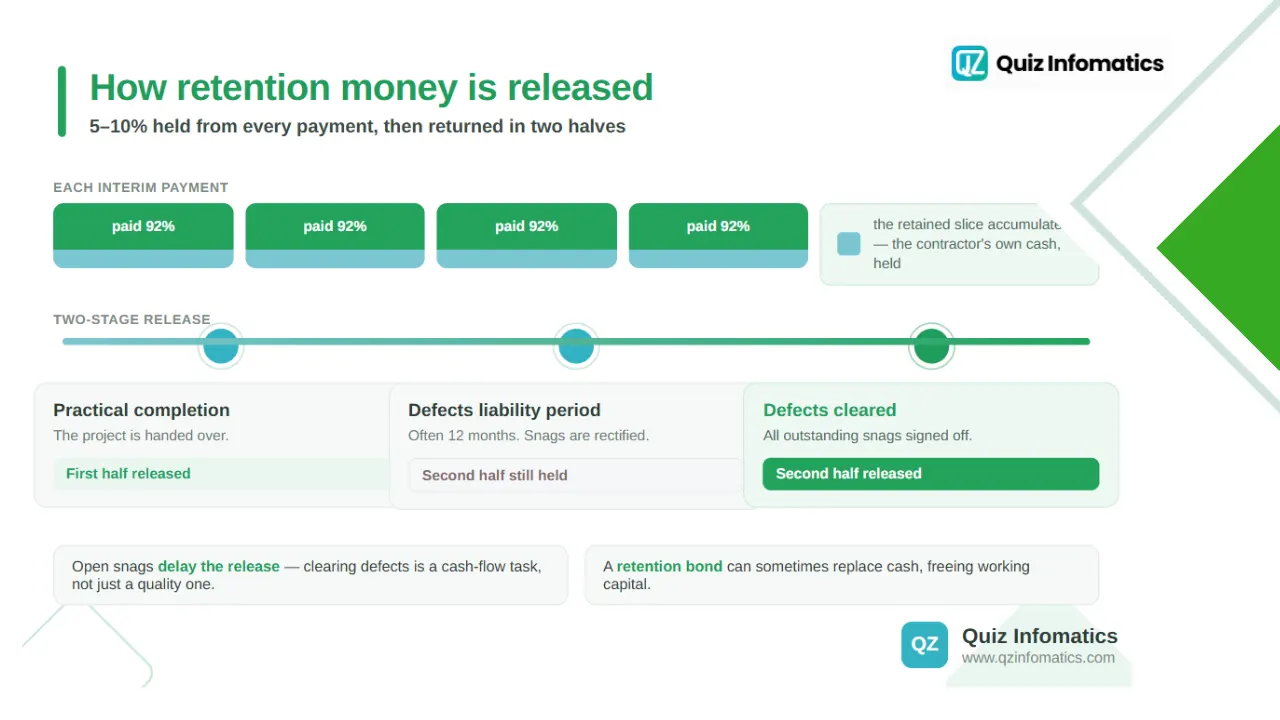
This is where retention connects directly to defects and the snag list. Outstanding snags can delay the release of retention, so clearing defects promptly is not just about quality; it directly affects when the contractor gets paid. Some contracts also allow a retention bond to be substituted for cash retention, freeing up the contractor's working capital.
Interim payments and the payment cycle
Construction contracts pay contractors through regular interim payments based on the value of work completed, rather than in a single lump sum at the end. This keeps cash flowing through a long project.
The cycle usually works like this: the contractor submits a payment application for the work done in the period, the engineer or quantity surveyor values it and issues a payment certificate, retention is deducted, and the client pays. Variations approved in the period are included in the valuation.
Getting this cycle right is central to a contractor's financial health. Accurate, timely valuations that properly capture variations and correctly apply retention are what keep cash flowing and disputes at bay.
Extensions of time and delay
When a variation or other event delays the project, the contractor may be entitled to an extension of time (EOT), adjusting the completion date. This protects the contractor from penalties for delays that were not their fault.
An EOT does not automatically bring extra money; it adjusts the programme so the contractor is not liable for delay damages for that period. Additional cost caused by the delay is usually pursued separately as a claim, which must be substantiated with records.
Like variations, EOT entitlement depends heavily on giving proper notice and keeping good records. A genuine delay poorly documented can become a lost entitlement, which is why disciplined contract administration matters so much.
How variations and retention affect cash flow
Variations and retention both have a direct, significant impact on a contractor's cash flow, which is often where projects succeed or fail commercially. Managing them tightly is essential.
Unvalued or slowly settled variations tie up money the contractor has already spent, while retention holds back a slice of every payment for months. Together they can leave a contractor carrying substantial sums, straining working capital even on a profitable project.
This is where connected software makes a real difference. Managing variations, valuations, retention, and payments in dedicated contractor accounting software gives a live view of what is owed, what is retained, and what is outstanding, so cash is controlled rather than lost track of across spreadsheets.
Common problems with variations and retention
The most common problems are unrecorded variations, slow valuation, and retention that is never properly chased. Each quietly erodes a contractor's margin.
Frequent issues include:
Proceeding without instruction. Doing varied work on a verbal request, then struggling to get paid.
Late or missing notices. Losing entitlement by failing to notify within the contract's timescales.
Slow valuation. Letting variations pile up unvalued, tying up cash.
Forgotten retention. Failing to track and claim retention when it falls due.
Poor records. Being unable to substantiate a variation or claim when challenged.
Avoiding these comes down to disciplined process and good records, ideally supported by a system that tracks every variation, valuation, and retention amount against each project and subcontractor.
Let’s talk about your business
Start with a free 30-minute call. We’ll ask the right questions, listen carefully, and give you an honest view of what’s possible.
Variations, retention, and contracts in the UAE
In the UAE, variations, retention, and claims are governed largely by FIDIC-based contracts and are central to how projects are managed commercially. The regional context makes getting them right especially important.
The scale and complexity of UAE projects, combined with the region's history of high-value disputes, means contract administration carries real weight here. Variations must be instructed and documented carefully, retention is standard and significant, and the same discipline extends to managing subcontractors, whose own variations and retention must be tracked in turn.
For UAE contractors, strong control of variations and retention, backed by the right software, is a genuine commercial advantage. If you want the wider context on the systems behind this, our plain-English guide to what an ERP system is sets the foundation.
How QZ Infomatics helps contractors
Controlling variations and retention comes down to accurate records connected to your budget, payments, and subcontractor accounts. That connection is what protects both entitlement and cash flow.
A practical step is to manage variations, valuations, retention, and interim payments in the same system as your BOQ, budget, and subcontractor accounts, so nothing is lost and cash is always visible. This turns contract administration from a paperwork risk into a controlled, auditable process, including for the subcontractor packages managed through subcontractor management software.
If you would like help with that, our construction ERP software for UAE contractors brings BOQ, cost control, budgeting, subcontractor management, variations, retention, and progress billing into one platform, built for how contracting businesses actually work.
Variation orders and construction contracts, in a nutshell
To recap the essentials:
A variation order is a formal contractual instruction to change the scope of work, usually entitling the contractor to an adjustment of price, time, or both.
Variations are valued using a hierarchy of methods, starting with BOQ rates and moving to fair rates or dayworks.
Construction contracts, mostly FIDIC-based in the UAE, set strict procedures and notice requirements for variations and claims.
Retention money is a percentage withheld as security, typically released in two halves at practical completion and after the defects liability period.
Documentation is everything, because poor contract administration is the leading cause of expensive construction disputes.
Variations and retention are where a construction project's commercial success is often decided. Managing them with discipline, and the right software, is one of the surest ways for a contractor to protect both entitlement and cash flow.
Frequently asked questions
What is a variation order in construction? A variation order is a formal instruction under a construction contract to change the agreed scope of work by adding, omitting, or altering something. The contractor is usually entitled to an adjustment to the price, the time, or both.
What is the difference between a variation and a claim? A variation is an instructed change valued under the contract's change mechanism. A claim is a request for additional time or money that must be substantiated, often arising from delay or disruption, and is more likely to be contested.
How are variations valued? Variations are valued using a hierarchy: existing BOQ rates where the work matches, pro-rata rates for similar work, fair rates where nothing comparable exists, and dayworks for work that cannot be measured conventionally.
What is retention money in construction? Retention money is a percentage of each payment, typically 5 to 10 percent, withheld by the client as security. It is released once the work is complete and any defects have been rectified.
When is retention money released? Retention is usually released in two halves: the first at practical completion, and the second after the defects liability period ends and any defects have been fixed.
What is FIDIC? FIDIC refers to the standard construction contract forms published by the International Federation of Consulting Engineers, widely used in the UAE and GCC. They set out procedures for variations, payments, retention, and claims.
What is an extension of time? An extension of time (EOT) adjusts the completion date when a variation or other qualifying event delays the project, protecting the contractor from delay damages for that period. Additional cost is usually claimed separately.
Why do variations cause disputes? Variations cause disputes when they are not properly instructed, valued, or documented. Missing notices, verbal instructions, and poor records make entitlement hard to prove, which is why disciplined contract administration is essential.
About the author
QZ Infomatics Construction Technology Team - QZ Infomatics is a Dubai-based ERP and IT consultancy (Business Bay) that implements construction and contracting software across the UAE and GCC. The team helps contractors control variations, valuations, retention, and payments by bringing BOQ, budgets, subcontractor accounts, and progress billing into one connected system, drawing on hands-on experience with construction ERP for UAE projects. This guide reflects that practical experience helping contracting businesses administer their contracts and protect their cash flow.
Losing track of variations and retention across projects? See our construction ERP for UAE contractors.